By Brennan, B.S. Engineering · Published · Updated · Data: Census Bureau 2024, BLS May 2025
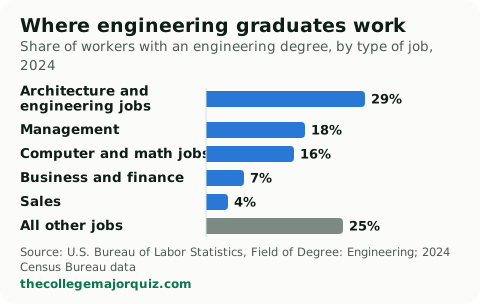
An engineering degree can take you well beyond engineering. You can work as an engineer in your field, but graduates also become software developers, project managers, consultants, sales engineers, plant managers and executives. Only 29% of workers with an engineering degree work in architecture and engineering jobs, according to Bureau of Labor Statistics (BLS) data. The rest are spread across management (18%), computer and math jobs (16%), business and finance (7%), sales (4%) and other fields.
My own degree took me into specialty chemicals, but that's just one path. The government data below shows where the degree leads for everyone else.
Where do engineering graduates work?
About 5.8 million employed U.S. workers have an engineering degree. Here's how they're spread across types of jobs:
The single most common job for engineering graduates isn't an engineering job at all. It's software developer, which employs 10% of them. Next come engineers in specialties BLS groups as "all other" (7%), civil engineers (6%), managers in many different fields (6%), mechanical engineers (4%) and electrical engineers (3%). Aerospace engineers, architectural and engineering managers, chief executives and industrial engineers each account for another 2%. For the engineering jobs projected to grow fastest, see the best degrees for the future.
When I compare the data, the degree pays off across those paths. Workers with an engineering degree earned a median of $105,000, compared with $73,000 for all fields, and 72% worked in jobs that typically require at least a bachelor's degree, compared with 61% of all graduates.
What jobs can you get with an engineering degree?
The most direct path is working as an engineer in the field you studied. Each engineering major leads to its own set of jobs:
- Mechanical engineering: design, manufacturing, reliability and maintenance, robotics, and aerospace and defense roles. See what a mechanical engineer does.
- Electrical engineering: power, electronics, controls and instrumentation, communications, and defense systems. See what an electrical engineer does.
- Chemical engineering: designing and running the processes that make products like gasoline, detergents, paper, electronics and food. See what a chemical engineer does.
- Aerospace engineering: aircraft, spacecraft, satellites and missiles. See what an aerospace engineer does.
- Civil engineering: planning, designing and supervising buildings and infrastructure projects. About half work at engineering firms, and many work for state or local government. More on that in the civil engineer guide.
- Computer engineering: designing and testing computers and related equipment, with semiconductor makers as the biggest employers. Computer engineering careers split between hardware and software.
- Industrial engineering: designing the systems that run production, in and outside factories. BLS projects 12% job growth for industrial engineers from 2025 to 2035 (more on industrial engineers).
- Biomedical engineering: medical devices, equipment and software, with jobs at research firms, device makers and in health care. See biomedical engineering jobs and pay.
- Environmental engineering: solving environmental problems, often for engineering firms, state agencies or consultants. Read about the environmental engineer's job.
Smaller fields, such as petroleum, nuclear and materials engineering, are in our guide to the types of engineering degrees.
Engineering jobs pay well across the board. To compare them, see the highest paying engineering jobs.
What other careers can you do with an engineering degree?
An engineering degree trains you to break down problems, work with numbers and manage technical projects, and employers outside engineering pay for that. These are some of the most common paths beyond traditional engineering jobs, with May 2025 pay and 2025 to 2035 job growth from the BLS:
| Career | Median pay | Job growth | Experience needed |
|---|---|---|---|
| Software developer | $135,980 | 10%* | None |
| Sales engineer | $124,900 | 3% | None |
| Project management specialist | $102,320 | 7% | None |
| Management analyst (consultant) | $101,860 | 10% | Less than 5 years |
| Industrial production manager | $126,060 | 3% | 5 years or more |
| Architectural and engineering manager | $171,270 | 6% | 5 years or more |
*Growth for software developers, quality assurance analysts and testers combined. All occupations average: 3%.
Software developer
Software developers design computer applications and programs. They typically need a bachelor's degree in computer and information technology or a related field, such as engineering or mathematics, and it's the most common job for engineering graduates.
Sales engineer
Sales engineers sell products and services that take technical expertise to explain, such as software or support. They typically need a bachelor's degree in engineering or a related field, which makes it a well-paid way to use an engineering degree while working with customers.
Project management specialist
Project management specialists coordinate the budget, schedule, staffing and other details of a project. Some employers prefer candidates with a degree in a technical field related to the industry, such as engineering, so engineers can move into it from technical roles.
Management analyst or consultant
Management analysts, often called management consultants, recommend ways to make organizations more efficient. Engineering is one of the common bachelor's degrees for the job, alongside business and social science.
Plant, operations and engineering management
Many engineers move into management after gaining experience. Industrial production managers oversee the operations of manufacturing plants, and business and engineering are common majors for the job. Architectural and engineering managers plan, direct and coordinate engineering work; they typically need an engineering or architecture degree and years of experience as an engineer. For how that path works in practice, see the management section of our engineering pay guide.
Patent agent or patent attorney
Engineering graduates can work in patent law without giving up the technical side. A bachelor's degree in nearly any engineering field, from aerospace to industrial, meets the scientific and technical requirement to sit for the U.S. Patent and Trademark Office's registration exam. Pass it and you're registered as a patent agent, who can help inventors apply for patents; if you're also a licensed attorney, you register as a patent attorney.
Most of the engineers I went to school with stayed in traditional engineering roles, unless they couldn't find an engineering job. A few civil and mechanical graduates I know went into hands-on construction work, which can be a path toward running projects as a general contractor.
Graduate school, an MBA or law school
Many engineering grads also go back to school: 41% of workers with an engineering degree hold an advanced degree, close to the 39% for all fields, according to BLS. The most common routes are:
- A master's in engineering to specialize, sometimes through a 5-year program that combines a bachelor's and master's degree.
- A master's in engineering management or an MBA for those headed into management. Engineers who want to stay on the technical management side often earn a master's in engineering management, while those interested in general management skills earn an MBA.
- Law school, which, combined with an engineering degree and the patent registration exam, leads to work as a patent attorney.
Is $70,000 a good starting salary for an engineer?
It's a solid salary, but below what most engineering graduates earn early on. Median early-career pay (ages 22 to 27) ranged from $75,000 for civil, general and miscellaneous engineering majors to $90,000 for computer engineering, not counting engineering technology, according to the New York Fed, compared with $58,000 for all majors. For a sense of real offers, in my experience most chemical engineers starting out now earn $85,000 to $95,000, and most mechanical engineers I know started at around $85,000 to $88,000. Location, industry and company all move the number.
Is engineering a useful degree?
Yes, and the data backs it up. Engineering graduates are more likely than graduates overall to work in jobs that need their degree, and recent engineering graduates were less likely to be underemployed: 14.7% to 31.7% across the engineering majors in the New York Fed's data (not counting engineering technology), compared with 39.4% for all majors. In my opinion, the bigger advantage is flexibility. With about 3 in 10 working in engineering and the rest in software, management, business and sales, the degree keeps doors open even if you decide engineering itself isn't your long-term career.
Still unsure about engineering? The free quiz can show how it stacks up against other fields for you.
Other questions about the degree
Can an engineer earn $200,000 a year?
Yes, but usually after moving into management. Architectural and engineering managers earned a median of $171,270 in May 2025, and the top 10% earned more than $262,760, according to the BLS. Most engineering specialties had median pay above $100,000.
Do most engineering graduates work as engineers?
No. Only 29% of workers with an engineering degree work in architecture and engineering jobs, according to BLS data for 2024. The rest work in management, computer and math jobs, business and finance, sales and other fields.
What can you do with an engineering technology degree?
BLS says mechanical engineering technology programs, for example, focus less on theory and more on the practical application of engineering principles, and mechanical engineering technologists help engineers design, develop, test and manufacture tools, engines, machines and other devices. Recent engineering technology graduates earned a median of $65,000 early in their careers, and 44.4% worked in jobs that don't need a degree, according to the New York Fed. A degree from an accredited engineering program is usually necessary to become a licensed Professional Engineer.
Other engineering guides
To pick a branch, start with types of engineering degrees. Pay by field is in the highest paying engineering jobs, and mechanical vs. electrical engineering compares two of them side by side.
Sources
Where grads work comes from the BLS's Field of Degree tables (2024 census data, updated Oct 29, 2026). That's federal data, not a survey of my own. The patent rules are from the USPTO itself.
- U.S. Bureau of Labor Statistics. Field of Degree: Engineering (2024 Census Bureau data; last modified October 29, 2026). bls.gov
- U.S. Bureau of Labor Statistics. Occupational Outlook Handbook (May 2025 pay, 2025-35 projections; last modified August 27, 2026): software developers, sales engineers, project management specialists, management analysts, industrial production managers, architectural and engineering managers.
- U.S. Bureau of Labor Statistics. Occupational Outlook Handbook: mechanical engineers and mechanical engineering technologists and technicians.
- U.S. Patent and Trademark Office. General Requirements Bulletin for Admission to the Examination for Registration to Practice in Patent Cases (August 2026), Category A. uspto.gov
- U.S. Patent and Trademark Office. Becoming a patent practitioner. uspto.gov
- Federal Reserve Bank of New York. The Labor Market for Recent College Graduates (outcomes by major, 2024 data). newyorkfed.org