By Brennan, B.S. Engineering · Published · Updated · Pay data: May 2025, released August 2026
A chemical engineer designs the equipment and processes that turn raw materials into products like gasoline, detergents, paper, electronics, food and clothing. They test and improve those processes, fix problems, keep them safe and within environmental rules, and estimate what production costs. Their median pay was $125,040 in May 2025 (Bureau of Labor Statistics, or BLS).
I'm in specialty chemicals myself. I've held three kinds of roles so far, production, project management and now process development, and each felt like a different job.
What is chemical engineering?
It's the branch of engineering that uses chemistry, physics and math to design the equipment and processes that make products at scale. BLS lists these core duties:
- Conduct research to develop new and improved manufacturing processes
- Design and plan the layout of equipment
- Establish safety procedures for working with dangerous chemicals
- Conduct tests and monitor production processes
- Troubleshoot problems in manufacturing processes
- Make sure equipment and processes comply with safety and environmental regulations
- Estimate production costs for management
Some specialize in one process, such as oxidation, or a field such as nanomaterials. Others do research in areas like biotechnology.
What does a chemical engineer do on a daily basis?
Your days look very different depending on the role. Production, process development and project work are separate jobs, even at the same company.
In production: keeping the process running
The day starts with yesterday. You review the previous day's process data and the quality (QA/QC) results to make sure the batches were good. If the process has intermediate steps or in-process testing, you check that data too. The goal is a process that stays in good shape and runs smoothly. Some days you also help train operators.
You work most with operators, maintenance and plant managers. That means daily production meetings, sit-downs to work through a process issue, and a three-month plan for the unit so everyone knows their part. With maintenance, you plan shutdowns: the timeline, and getting equipment ready to hand over so they can do their work.
When I was in production, my time was roughly 60% office and 40% plant. I was also on call 24 hours a day, 7 days a week. Any time there was an issue, they called me. That's a downside, but it's the nature of the job.
In process development: the lab and the pilot plant
This is my current role. I split my time between the lab and the pilot plant, running lab or pilot plant batches to validate a process and doing workups to prove it out.
Data runs through this job and production alike. We work with large data sets for feasibility studies and to manage chemical processes, so you need the analytic skills to see what's going on.
In project roles
Project engineer is one of the most common first titles for new grads, and I've worked in project management too. On the manufacturing sites I know, project engineers run capital (CapEx) and operating (OpEx) projects, from small to large.
A small one might be switching a process to a new type of pump. The project engineer gets design data from the site's mechanical or process engineers, sends the specs to vendors, gathers quotes, then builds the budget, plan and timeline to get the pump installed. A bigger one might be replacing a reactor: going back to the original vendor or fabricator for updated quotes, handing over the design specs and laying out how the job will get done. The largest are capacity upgrades, like scaling up a reactor or a whole unit for more throughput.
The tools that carry across
My most important tool is Excel. I haven't used process simulation software. Instead I've done a lot of data analysis, charting and graphing in Excel, plus P&ID (piping and instrumentation diagram) reviews and safety reviews. In my experience, data analysis is one of the most useful chemical engineering skills. BLS adds evaluating designs and processes to propose improvements, and using calculus and other advanced math.
Across the field, BLS says chemical engineers mostly work in offices or labs. Some spend time in industrial settings to oversee production, or visit plants and refineries to monitor operations.
Where do chemical engineers work?
Chemical engineers held about 21,900 jobs in 2025. Their largest employers were chemical manufacturing (28%), engineering firms (11%), research and development firms (9%), machinery makers (6%) and corporate offices (6%), according to the BLS.
The industry you pick shapes both the work and the pay. That's true whether you go into oil and gas, specialty chemicals (where I work), consulting or contracting.
Process engineer and production engineer are the entry-level chemical engineering jobs I see most. Among new grads I know, it's roughly a 50-50 split between the two. With experience, people move into roles like plant manager or asset manager, and some move to the business side.
How much do chemical engineers make?
The median chemical engineer salary was $125,040 in May 2025. Pay ran from under $79,420 for the lowest 10% to over $182,880 for the top 10%. Industry matters: the median was $147,960 at machinery makers, $135,720 at corporate offices, $127,090 at engineering firms, $124,540 in research and development and $112,300 in chemical manufacturing.
By major, chemical engineering graduates earned a median of $85,000 early in their careers (ages 22 to 27) and $135,000 at mid-career (35 to 45). That mid-career figure is the highest of any engineering major in New York Fed data.
New chemical engineers I know usually start at $85,000 to $95,000, depending on the area and the company. Oil and gas tends to pay the most, with specialty chemicals next, and roles in the Southeast usually pay well. To see where chemical engineering lands against other branches, check our ranking of engineering jobs by pay.
Chemical engineer vs. chemist: what's the difference?
Chemists and materials scientists research and analyze the chemical properties of substances to develop new materials, products and knowledge. Chemical engineers use that chemistry, along with physics and engineering, to design the equipment and processes that make products at scale. In short, chemists develop the chemistry, and chemical engineers turn it into production.
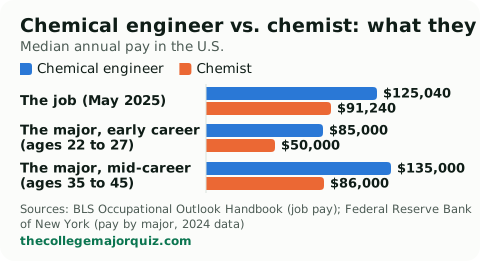
| Chemical engineer | Chemist | |
|---|---|---|
| Median pay of the job (May 2025) | $125,040 | $91,240 |
| Major's pay, early career | $85,000 | $50,000 |
| Major's pay, mid-career | $135,000 | $86,000 |
| Recent grads in jobs that don't need a degree | 17.9% | 42.8% |
| Grads with a graduate degree | 48.1% | 67.5% |
Sources: BLS Occupational Outlook Handbook (job pay); Federal Reserve Bank of New York (pay and outcomes by major, 2024 data).
I weighed this choice myself. I liked chemistry and thought about a chemistry degree, but people I talked to who worked in chemical plants told me engineering paid better. The numbers above back them up. If you're torn between the two majors, see chemistry vs. chemical engineering.
Is chemical engineering hard?
Yes, for most students. My former classmates saw it as the hardest engineering major, ahead of electrical, mechanical and civil. Accredited programs add chemistry and physics courses on top of engineering, and BLS notes that chemical engineers use calculus and other advanced math to analyze, design and troubleshoot.
My hardest classes were the transport series: heat transfer, fluid dynamics and mass transfer. What got me through was more time with the textbook, working through how it set up and solved each problem. That helped me picture the concepts and keep up.
Is chemical engineering a good career?
I think so. Just 17.9% of recent chemical engineering grads work in jobs that don't need a degree. For graduates of all majors combined, it's 39.4%. BLS also projects 5% job growth from 2025 to 2035, faster than the 3% average.
The best part, for me, is how much you learn. You work with a diverse group of people and help on a lot of different things, so you see how everyone in the plant does their job. The hardest part was the on-call hours in production. Starting out is tough too. There's so much to learn that it can feel overwhelming, so take it one piece at a time.
How to become a chemical engineer
- Earn a bachelor's degree in chemical engineering or a related field. Employers often prefer accredited programs, and a Professional Engineer (PE) license later on generally takes an EAC/ABET-accredited degree.
- Take an internship or co-op if your school offers one. Some colleges run cooperative education (co-op) programs alongside classes.
- Land your first role. You don't need a license at entry level. Experienced engineers may go on to earn a PE license.
- Move between roles. Switching between production, project management and process development has built my skills and opened doors. Many chemical engineers who want to go into management later earn an MBA or a niche master's degree or certificate.
I loved this major, but it isn't for everyone. The free quiz can help you see whether it fits you.
Chemical engineering questions
Do chemical engineers work in labs?
Some do. BLS says chemical engineers generally work in offices or laboratories, and they sometimes work in industrial plants to oversee production. In process development, part of my own week is in the lab.
What is the starting salary for a chemical engineer?
Chemical engineering graduates ages 22 to 27 earned a median of $85,000 in New York Fed data. Most new chemical engineers I know start between $85,000 and $95,000, depending on the area and the company.
Do chemical engineers work long hours?
Sometimes. Most chemical engineers work full time, but BLS says some go past 40 hours a week to hit production targets or fix problems. In production, I was on call around the clock, and some nights the calls came every other hour.
Engineers you'll meet on the job
At a plant, you may work with electrical, environmental and industrial engineers, so those are good reads next. For the bigger picture, see types of engineering degrees and which engineering jobs pay the most.
Sources
The day-to-day parts are from my own work. Pay and job numbers are from the BLS and the New York Fed, checked against each original source.
- U.S. Bureau of Labor Statistics. Occupational Outlook Handbook: Chemical Engineers (May 2025 pay, 2025-35 projections; last modified October 29, 2026). bls.gov
- U.S. Bureau of Labor Statistics. Occupational Outlook Handbook: Chemists and Materials Scientists. bls.gov
- Federal Reserve Bank of New York. The Labor Market for Recent College Graduates (outcomes by major, 2024 data). newyorkfed.org
- National Council of Examiners for Engineering and Surveying (NCEES). Licensure. ncees.org