By Brennan, B.S. Engineering · Published · Updated · Pay data: May 2025, released August 2026
Environmental engineers use engineering to protect people and the environment. They design systems that clean water and control air pollution, deal with hazardous waste and contaminated sites, and keep facilities within their environmental permits.
The Bureau of Labor Statistics (BLS) counts about 39,100 environmental engineers, with a median pay of $107,110 in May 2025.
At my specialty chemicals plant, I work side by side with our site's environmental engineers on permits and leak detection.
Environmental engineer responsibilities
Environmental engineering is engineering aimed at what the BLS calls problems of planetary health, such as waste treatment, site remediation and pollution control technology. The core duties usually include:
- Prepare, review, update and present reports on environmental issues
- Design systems that protect the environment, such as systems that reclaim water or control air pollution
- Obtain, update and maintain plans, permits and standard operating procedures
- Provide technical support for environmental remediation projects and legal actions
- Analyze scientific data and run quality-control checks
- Monitor the progress of environmental improvement programs
- Inspect industrial and municipal facilities and programs to make sure they comply with environmental regulations
- Advise companies, government agencies and others on environmental issues, including how to clean up contaminated sites
Bigger projects include water supply and wastewater treatment systems for cities and industry, hazardous waste studies that judge a hazard and how to treat and contain it, and ways to cut acid rain, vehicle emissions and ozone depletion. Environmental engineers team up with environmental scientists, hazardous materials removal workers, lawyers and urban planners.
Areas of environmental engineering
The field has no formal job types. Most people simply hold the title environmental engineer and focus on one or more areas. O*NET, the U.S. Department of Labor's occupation database, also reports titles such as environmental consultant, environmental analyst, air pollution control engineer and environmental remediation specialist.
ABET, which accredits engineering programs, gives air, water, land and environmental health as examples of the major's focus areas. In practice the work splits like this:
- Water and wastewater: designing municipal and industrial water supply and wastewater treatment systems, and managing wastewater permits.
- Air quality: designing systems that control air pollution, and managing air permits and emissions programs.
- Waste and hazardous materials: handling, treating and shipping waste, and evaluating hazards and how to contain them.
- Remediation: cleaning up contaminated sites.
- Compliance: obtaining and maintaining permits, reporting to agencies, and auditing and inspecting facilities.
Your employer shapes the mix. Government engineers lean toward prevention and enforcement, such as reviewing the environmental impact of proposed construction projects. At my site, the environmental engineers cover most of these areas rather than just one.
Permits: a big part of the job
In a plant, much of the job is getting permits, keeping them current and showing the site follows them. Two of the big federal ones:
- Wastewater (NPDES): under the Clean Water Act, a facility that discharges pollutants from a point source into waters of the United States needs a National Pollutant Discharge Elimination System permit.
- Air (Title V): under Title V of the Clean Air Act, large "major" sources of air pollution, and some smaller ones, need an operating permit. It spells out the pollution control requirements that apply to that source.
At my site, the environmental engineers handle air permitting, wastewater permitting, waste handling and shipping, environmental, health and safety (EHS) reporting to state and federal agencies, and a lot of auditing and in-house inspection. They take on projects too. One of them worked with me on remediation at a Superfund site. (Superfund is the common name for a 1980 law, the Comprehensive Environmental Response, Compensation and Liability Act. It lets the EPA clean up contaminated sites and makes the responsible parties either do the cleanup or pay the government back.)
Leak detection and repair (LDAR)
As a chemical engineer, I work with them most on LDAR. EPA describes it as "a work practice designed to identify leaking equipment so that emissions can be reduced through repairs." Valves, pumps, connectors and similar equipment get checked at regular intervals, and a leaking part must be repaired or replaced within a set time. For us, that means a lot of line walking together, finding the components that need LDAR tags so the process can be monitored.
Where do environmental engineers work?
Engineering services firms employ the most (24%), followed by state government (20%), management, scientific and technical consulting firms (19%), local government (7%) and manufacturing (7%), according to the BLS. Put state and local together, and about a quarter of environmental engineers work in government.
So a plant job like the ones at my site is one setting among several. The work moves between an office and the field, such as construction sites, with some travel for meetings or to present research. It's usually full time, and some weeks run past 40 hours when a project needs monitoring or troubleshooting.
Backgrounds vary. At my site, the environmental engineers hold degrees in environmental engineering, environmental science, civil engineering with a wastewater concentration, and specialty fields such as wastewater management.
How much do environmental engineers make?
The environmental engineer salary range is wide. The bottom 10% earned under $69,990 in May 2025 and the top 10% over $162,220, around a median of $107,110. Manufacturing paid the most of the employers BLS reports:
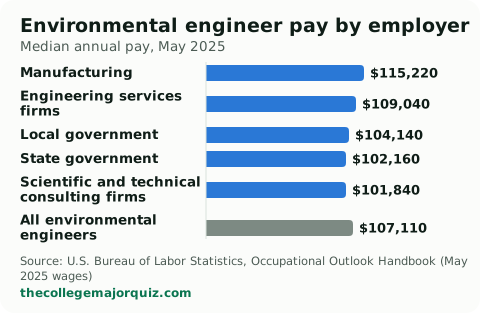
There's no solid national number for environmental engineer starting salary. The New York Fed, which tracks early-career pay by major, doesn't report environmental engineering separately. New graduates usually start below the median.
Our engineering pay comparison shows where it lands among the other branches.
Environmental engineering vs. environmental science
They work on the same problems from different angles. Environmental scientists and specialists conduct research or investigations to protect the environment or human health, and they typically need a bachelor's degree in environmental science or a related field such as natural resources, biology or physical science. Environmental engineers design the systems and solutions, and they typically need an engineering degree.
Engineers earn more. Environmental scientists and specialists had a median of $82,220 in May 2025, against $107,110 for environmental engineers. Science is the bigger field, though, with about 93,400 jobs.
Is environmental engineering hard?
Yes, it's a demanding engineering major. ABET's standards say an accredited environmental engineering program must cover math through differential equations, probability and statistics, calculus-based physics, chemistry (including stoichiometry, equilibrium and kinetics), earth science, biological science and fluid mechanics. Students also learn material and energy balances, how substances move between air, water and soil, hands-on lab work in more than one focus area, and design that accounts for risk, sustainability and environmental impact.
If you'd rather study environmental problems than design the fixes, environmental science is the other route.
Is environmental engineering a good major?
The demand is steady. BLS projects 6% job growth for environmental engineers between 2025 and 2035, faster than the 3% average for all occupations, with about 2,300 openings a year. Public awareness of environmental hazards and concerns about water and air pollution keep that demand up.
In my opinion, it suits someone who can work on their own but also enjoys working in a group, because the job calls for both.
How to become an environmental engineer
- Earn an engineering degree in environmental engineering or a related field, such as chemical, civil or general engineering. Employers often favor graduates of accredited programs, and some schools combine a bachelor's and a master's into a 5-year program.
- Find an internship or volunteer role that focuses on the environment.
- Work on your writing and speaking. The job runs on reports and agency reporting, and BLS lists communication among the key qualities, along with creativity, interpersonal, math and problem-solving skills.
- Get hired first, licensed later. Entry-level jobs don't require a license.
- Consider a PE license. Licensing generally takes an accredited engineering degree, a passed Fundamentals of Engineering (FE) exam, a few years on the job and then the PE exam itself. NCEES offers a PE Environmental exam.
- Add board certification. After licensing, environmental engineers can earn board certification, which shows expertise in one or more areas of specialization.
Think this might be your field? The quiz can show how environmental engineering ranks for you.
Questions about environmental engineering
Is environmental engineering worth it?
It can be, if you're ready for the regulatory side. Pay is strong, with a median of $107,110 in May 2025, and jobs are projected to grow 6% from 2025 to 2035. The tradeoff is red tape. So much of the work runs through state and federal agencies that it can be time-demanding and mentally exhausting.
What jobs can an environmental engineer do?
Environmental engineers work on water and wastewater systems, air pollution control, hazardous waste and site cleanup, and environmental permits and compliance. Most work for engineering and consulting firms or for state and local government agencies, according to the BLS.
Can a chemical or civil engineer become an environmental engineer?
Yes. BLS says entry-level environmental engineering jobs typically require a bachelor's degree in environmental engineering or a related field, such as chemical, civil or general engineering.
Neighboring fields
Chemical engineers like me can work right next to environmental engineers, so what a chemical engineer does is a natural next read. Some environmental engineers come from civil engineering, so what a civil engineer does is worth a look too. The other branches are in types of engineering degrees.
Sources
Pay and growth are from the BLS, checked twice against each Handbook page, and the permit rules are from the EPA. The permitting and leak detection parts also reflect my work with our site's environmental engineers.
- U.S. Bureau of Labor Statistics. Occupational Outlook Handbook: Environmental Engineers (May 2025 pay, 2025-35 projections; last modified October 29, 2026). bls.gov
- U.S. Bureau of Labor Statistics. Occupational Outlook Handbook: Environmental Scientists and Specialists. bls.gov
- U.S. Environmental Protection Agency. NPDES Permit Basics. epa.gov
- U.S. Environmental Protection Agency. Basic Information about Operating Permits (Title V). epa.gov
- ABET. Criteria for Accrediting Engineering Programs, 2026-2027, program criteria for environmental engineering and similarly named engineering programs. abet.org
- NCEES. PE Environmental exam. ncees.org
- Federal Reserve Bank of New York. The Labor Market for Recent College Graduates (outcomes by major, 2024 data). newyorkfed.org
- U.S. Environmental Protection Agency. Leak Detection and Repair: A Best Practices Guide (October 2007). epa.gov
- U.S. Environmental Protection Agency. What is Superfund? epa.gov
- National Center for O*NET Development. Environmental Engineers (17-2081.00), sample of reported job titles. onetonline.org