By Brennan, B.S. Engineering · Published · Updated · Pay data: May 2025, released August 2026
Civil engineers plan, design and supervise the building and upkeep of public works and other projects: roads, bridges, buildings, dams, airports and water systems. Some spend much of the day on construction sites, and others design in an office.
The field has about 380,600 jobs, and the Bureau of Labor Statistics (BLS) puts the median pay at $100,840 as of May 2025. Civil isn't my field. The details on daily work below come from my peers who are civil engineers at design firms and state agencies.
What is civil engineering?
It's the engineering behind the built world, from the streets you drive on to the water that comes out of your tap. Civil engineers study plans, survey reports and maps. They test soil and building materials to see whether they can hold up a foundation. They weigh regulations and site choices, price out equipment, materials and labor, and design transportation systems, hydraulic systems and structures in software.
The job also involves government agencies. Civil engineers submit permit applications to local, state and federal agencies and make sure projects follow the rules. They also oversee surveying to set building locations, grades and elevations, and they manage the construction, repair and replacement of buildings and infrastructure, according to the BLS.
Types of civil engineers
BLS names four main types:
- Construction engineers manage construction projects and make sure they're scheduled and built to plans and specifications.
- Geotechnical engineers make sure the foundations for streets, buildings and other structures are safe and sturdy.
- Structural engineers design and assess major projects, such as buildings, bridges and dams, for strength and durability.
- Transportation engineers plan, design and maintain streets and highways, airports, mass transit systems and harbors.
Water resources is another big specialty. The civil Professional Engineer (PE) exam from NCEES has five depth areas: construction, geotechnical, structural, transportation, and water resources and environmental.
What do civil engineers do on a daily basis?
Take one of my peers, a junior project manager on construction projects. He spends a lot of his day on site with the contractors. He runs the schedule, checks that the work looks the way it was designed and keeps a close eye on cost, since cost control is a big part of his job. Many of the civil engineers I know work as project managers like him.
The more senior civil engineers I know do more design work, at city governments and design firms. They work on bridges and buildings, and a lot of them work on sewer networks.
BLS says civil engineers work in offices and on construction sites, and some construction jobs mean setting up a temporary office, such as in a trailer. Most work full time. Those directing projects may put in extra hours to make sure designs meet requirements and projects hit their deadlines.
Expect some travel. My civil peers go out to several job sites, and many work a hybrid schedule, with some days at home.
Where do civil engineers work?
About half of civil engineers (51%) work for engineering services firms, the civil engineering firms and consultants that design projects for clients. State government (11%) and local government (10%) together employ about one in five. Another 7% work in nonresidential building construction and 3% in heavy and civil engineering construction, according to the BLS.
My civil peers fit that split: many went to engineering and design firms, and a lot of them work for state agencies. In the chemical plants I work in, civil and structural work usually goes to outside firms that specialize in it.
How much do civil engineers make?
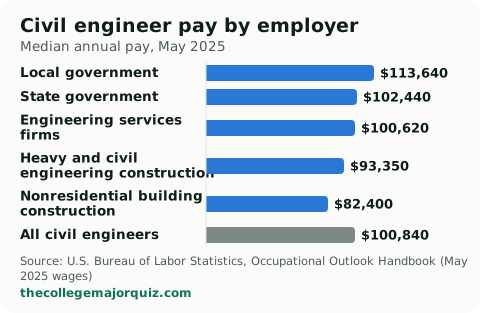
The median civil engineer salary was $100,840 in May 2025. The lowest 10% earned less than $68,240, and the top 10% earned more than $163,220. Government employers pay the most. The federal government tops the list at $117,790, though it employs only about 3% of civil engineers, and local government ($113,640) leads the larger employers in the chart below.
Civil engineer starting salary runs well below that. New York Fed data puts civil engineering grads at a median of $75,000 at ages 22 to 27 and $115,000 at ages 35 to 45. The civil engineers I know usually started at about $75,000 to $80,000, less than the electrical and chemical engineers I know.
For how civil pay ranks against other branches, see engineering salaries by field.
Is civil engineering hard?
It's engineering, so expect a lot of math. BLS says programs include math, physics, engineering mechanics and construction systems, and on the job, civil engineers use calculus, trigonometry and other math. The first two years overlap heavily with other engineering majors.
Civil is math heavy too, but its concepts are more straightforward than mechanical, where classes lean harder on theory. In my classmates' ranking of four majors, civil came last for difficulty, behind chemical, electrical and mechanical.
Most of my civil peers said the major was easy, and they gave a lot of credit to their professors. A great teacher can make a tough class much easier, so when you compare programs, ask current students about the teaching, not just the course list.
Is civil engineering a good career?
The outlook is steady. BLS projects 6% job growth for civil engineers from 2025 to 2035, faster than the average for all occupations, with about 22,700 openings a year. Infrastructure investment, new waste treatment plants and water system upkeep drive that demand. The catch: public projects depend on government money, so civil engineering jobs can rise and fall with funding.
Recent grads do well. In New York Fed data, civil engineering grads had 2.3% unemployment, against 4.2% for all majors, and only 15.6% were in jobs that don't need a degree, one of the lowest rates of any major.
A civil engineering degree can lead to design, construction, geotechnical, structural, transportation and water resources work, at private firms or in government. I think it's a strong pick if you want variety and work you can point to. My civil peers say no project is ever the same, because each one is designed around its own site and materials, and that keeps them interested. Starting pay trails other branches, but as economies grow, communities keep needing roads, bridges and water systems built and fixed.
How to become a civil engineer
- Earn a bachelor's in civil engineering or a related field. Employers usually prefer accredited programs, and a PE license generally requires an accredited degree.
- Work on communication and judgment. BLS lists communication, decision-making, interpersonal, math, organizational and problem-solving skills. Decision-making matters because civil engineers have to balance a plan's feasibility against cost and safety.
- Land an entry-level civil engineer job. No license is needed to start.
- Take the FE exam, then work toward your PE. The path is below.
Does civil sound like you? Take the quiz and see how high it ranks against the other 85 majors.
The FE-to-PE license path
Civil engineers typically need a license to provide services directly to the public, BLS says, and it can help them move into supervisory roles. State licensure generally takes four things:
- An accredited engineering degree.
- A passing score on the FE exam. NCEES calls the Fundamentals of Engineering exam generally the first step toward a PE license. It's designed for recent graduates and students close to finishing an engineering degree.
- Several years of relevant work experience.
- A passing score on the PE exam. The PE Civil exam has 80 questions and is offered on computer year-round.
Some of my civil and mechanical engineering peers earned a master's degree and a PE license because it helped in their work, and many engineering firms look for that credential.
Civil engineering questions
Do civil engineers need a PE license?
Only for some work. Entry-level civil engineers don't need one, but a license is typically required to provide services directly to the public, according to the BLS.
Can civil engineers make $200,000 a year?
A few do, but it isn't common without moving up. The top 10% of civil engineers earned more than $163,220 in May 2025. Management is one route, with a BLS median of $171,270 for architectural and engineering managers.
Civil vs. structural engineer: what's the difference?
Structural engineering is a specialty within civil engineering. BLS lists structural engineers as one of the main types of civil engineers, and they design and assess buildings, bridges, dams and other major projects for strength and durability. Structural is also one of the five depth areas on the civil PE exam.
Similar fields
Torn between this and mechanical? Read civil vs. mechanical engineering. You can also see what a mechanical or environmental engineer does, compare pay across engineering jobs, or look through types of engineering degrees.
Sources
Pay and outlook are from the BLS and exam details from NCEES, each checked twice against the original page. The parts about daily work come from civil engineers I know.
- U.S. Bureau of Labor Statistics. Occupational Outlook Handbook: Civil Engineers (May 2025 pay, 2025-35 projections; last modified August 27, 2026). bls.gov
- U.S. Bureau of Labor Statistics. Occupational Outlook Handbook: Architectural and Engineering Managers. bls.gov
- NCEES. FE exam. ncees.org
- NCEES. PE Civil exam. ncees.org
- Federal Reserve Bank of New York. The Labor Market for Recent College Graduates (outcomes by major, 2024 data). newyorkfed.org