By Brennan, B.S. Engineering · Published · Updated · Pay data: May 2025, released August 2026
Civil engineers design and build infrastructure, such as roads, bridges, dams, water systems and building foundations. Mechanical engineers design machines and devices, such as engines, generators, air-conditioning systems and robots. Pay is close: mechanical engineers earned a median of $104,110 in May 2025 and civil engineers $100,840, according to the Bureau of Labor Statistics (BLS). Mechanical engineering is projected to grow faster (11% vs. 6%), but civil engineering is the bigger field, and its recent graduates had lower unemployment.
Neither of these is my own field. I work with mechanical engineers in chemical manufacturing, and my civil engineering peers work at engineering and design firms and state agencies, so this comparison mixes the data with what I've seen from them.
Civil vs. mechanical engineering: what's the difference?
The difference between mechanical and civil engineering comes down to what you build. Civil engineers plan, design and supervise the construction and maintenance of buildings and infrastructure: streets and highways, bridges, dams, airports, water systems and the foundations everything sits on. Mechanical engineers design, develop, build and test mechanical and thermal devices: power-producing machines like generators and engines, power-using machines like refrigeration and air-conditioning systems, and products from medical devices to batteries.
Civil engineers work on large, fixed structures and public systems, and mechanical engineers work on the machines and equipment that move, make power or use it.
| Civil engineering | Mechanical engineering | |
|---|---|---|
| What they work on | Buildings and infrastructure | Machines and mechanical and thermal devices |
| Median pay (May 2025) | $100,840 | $104,110 |
| Top 10% earn more than | $163,220 | $164,340 |
| Job growth, 2025-35 | 6% | 11% |
| Jobs in 2025 | 380,600 | 298,500 |
| Largest employer | Engineering services firms (51%) | Architecture and engineering firms (20%) |
| Where they mostly work | Offices and construction sites | Offices, with visits to worksites |
| Recent grads' unemployment | 2.3% | 4.4% |
| Recent grads in jobs that don't need a degree | 15.6% | 20.1% |
| Grads with a graduate degree | 37.1% | 39.1% |
Sources: BLS Occupational Outlook Handbook; Federal Reserve Bank of New York (outcomes by major, 2024 data).
Civil vs. mechanical engineering salary
Are civil or mechanical engineers paid more? Mechanical engineers, but only slightly. The gap is about $3,000 at the median, and it's about $5,000 when you look at pay by college major:
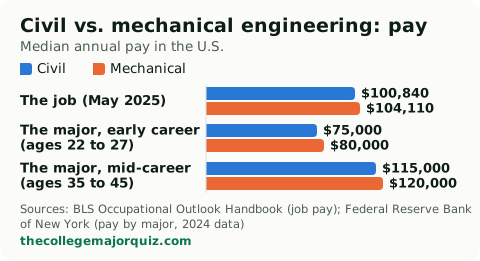
When I compare the data, where you work matters more than which of the two you pick. Civil engineers earned the most in local government ($113,640), while mechanical engineers earned the most at scientific research and development firms ($132,040). For the full breakdowns, see what a mechanical engineer does, or compare every field in the highest paying engineering jobs.
Where civil and mechanical engineers work
Looking at the employer numbers, this is one of the biggest practical differences. Civil engineering leans on engineering firms and government: about half of civil engineers (51%) work for engineering services firms, and state and local government together employ about one in five (21%). Mechanical engineers are spread across private industry: architecture and engineering firms (20%), machinery makers (14%), transportation equipment makers (10%), scientific research and development firms (7%) and computer and electronic product makers (6%).
The settings differ too. Civil engineers split their time between offices and construction sites, and some work out of temporary onsite offices such as trailers. Mechanical engineers generally work in offices and visit worksites when a problem or piece of equipment needs their attention, according to the BLS.
My peers fit that pattern. Many of my civil engineering peers went into engineering and design firms or state agencies, while my mechanical engineering peers went into defense companies, engineering firms and the chemical industry.
In the chemical plants I work in, civil and structural work is usually contracted out to firms that specialize in it, while mechanical engineers are on staff to keep the plant's equipment running.
Is mechanical engineering harder than civil?
From what my classmates told me, yes, a bit: they saw mechanical as the tougher of the two. Both are demanding majors. Civil engineering programs include coursework in math, physics, engineering mechanics and construction systems, while mechanical engineering programs include math, the life and physical sciences, and engineering and design, according to the BLS.
The way I see it, mechanical engineering has more difficult concepts, and its classes lean more heavily on theory and math. Civil engineering is math heavy too, but its concepts tend to be more straightforward.
How civil and mechanical engineering overlap
Civil and mechanical students take a lot of the same classes at first. Almost every engineering major starts with the same math, physics and general education courses for two years, so switching between civil and mechanical engineering is easiest in your first two years.
At my school, civil and mechanical students took the same math and physics prerequisites, and the one junior-level course I know they shared was mechanics of materials. I don't know of other upper-level courses the two majors had in common.
Which is better, civil or mechanical engineering?
The better pick depends on what you want to work on and where you want to work. Here's how the data breaks down:
- Choose civil engineering if you want to see your work in the world around you, such as roads, bridges and water systems, you like the idea of splitting time between an office and job sites, and you value stability: civil graduates had lower unemployment (2.3% vs. 4.4%), and government is a major employer.
- Choose mechanical engineering if you're drawn to machines, energy and how things move, you want the most options across industries, and you want the faster projected job growth (11% vs. 6%).
One thing to weigh on the civil side: public projects depend on government funding, so BLS notes that civil engineering jobs can rise and fall with the money available for projects. On the mechanical side, the field is broad enough that your day can look very different from one industry to the next. In the chemical plants where I work, mechanical engineers focus on reliability and asset integrity, keeping pumps, agitators and other equipment running, while my peers at defense companies and engineering firms do more design work.
In my opinion, if you're most interested in design work on structures, buildings and infrastructure, civil engineering is probably the right route. If you want the most options, mechanical engineering opens more paths: manufacturing, design, aerospace and many other industries. Civil is the more focused of the two and mechanical the more diverse, so the better choice depends on which kind of work you want to do.
Still on the fence? Both majors are in our free quiz, so you can see which one your answers lean toward.
Other questions on civil vs. mechanical
Are civil or mechanical engineers paid more?
Mechanical engineers, slightly. They earned a median of $104,110 in May 2025, compared with $100,840 for civil engineers, according to the BLS.
Which has more jobs, civil or mechanical engineering?
Civil engineering is the bigger field, with about 380,600 jobs in 2025 compared with 298,500 for mechanical engineering. But mechanical engineering jobs are projected to grow faster from 2025 to 2035, 11% compared with 6%, according to the BLS.
Can you switch from civil to mechanical engineering?
Yes. Engineering majors share math, physics and general education courses early on, so switching is easiest in your first two years.
Other engineering comparisons
Read what a civil engineer or a mechanical engineer does day to day, or compare mechanical vs. electrical engineering. The full list of branches is in types of engineering degrees.
Sources
The BLS is the source for job pay and growth, and the New York Fed for pay by major, so don't expect those two sets of numbers to line up exactly. Reviewed again on Oct 31, 2026.
- U.S. Bureau of Labor Statistics. Occupational Outlook Handbook: Civil Engineers (May 2025 pay, 2025-35 projections; last modified August 27, 2026). bls.gov
- U.S. Bureau of Labor Statistics. Occupational Outlook Handbook: Mechanical Engineers (May 2025 pay, 2025-35 projections). bls.gov
- Federal Reserve Bank of New York. The Labor Market for Recent College Graduates (outcomes by major, 2024 data). newyorkfed.org