By Brennan, B.S. Engineering · Published · Updated · Pay data: May 2025, released August 2026
Electrical engineers earn more (a median of $120,630 vs. $104,110 in May 2025), but mechanical engineering is the bigger field with faster projected job growth (11% vs. 8% for electrical and electronics engineers combined), according to the Bureau of Labor Statistics (BLS). The work is different too: mechanical engineers design machines and devices that move or use heat, such as engines, generators and air-conditioning systems, while electrical engineers design electrical equipment and systems, such as motors, power systems and communications equipment. Together they're the two most common engineering majors.
I'm a chemical engineer, and I've seen both fields up close: I had peers who double majored in mechanical and electrical engineering, and I work alongside both in chemical manufacturing. Below, I compare them side by side.
Mechanical vs. electrical engineering: what's the difference?
The difference between mechanical and electrical engineering comes down to what you work on. Mechanical engineering is one of the broadest engineering fields. Mechanical engineers design power-producing machines like electric generators and internal combustion engines, power-using machines like refrigeration and air-conditioning systems, machines inside buildings like elevators, and products from medical devices to batteries. Electrical engineers design, develop and test electrical equipment and systems, such as electric motors, radar and navigation systems, communications systems, power generation equipment and the electrical systems in cars and aircraft.
| Mechanical engineering | Electrical engineering | |
|---|---|---|
| What they work on | Machines and mechanical and thermal devices | Electrical equipment, power and electronic systems |
| Median pay (May 2025) | $104,110 | $120,630 |
| Top 10% earn more than | $164,340 | $184,300 |
| Job growth, 2025-35 | 11% | 8% (with electronics engineers) |
| Jobs in 2025 | 298,500 | 199,700 |
| Largest employer | Architecture and engineering firms (20%) | Engineering firms (22%) |
| Share of engineering grads | 20% | 21% |
| Recent grads' unemployment | 4.4% | 3.2% |
| Grads with a graduate degree | 39.1% | 47.7% |
Sources: BLS Occupational Outlook Handbook and Field of Degree: Engineering; Federal Reserve Bank of New York (outcomes by major, 2024 data).
Mechanical vs. electrical engineering salary
Who gets paid more, mechanical or electrical engineers? Electrical engineers, both as a job and as a major, though the gap is smaller early in a career:
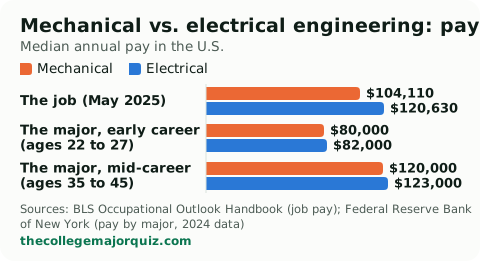
When I look at the data, industry matters for both. Mechanical engineers earned the most in scientific research and development ($132,040), while electrical engineers earned the most at transportation equipment makers ($129,210). For more on electrical pay by industry, see what an electrical engineer does, or compare every field in the highest paying engineering jobs.
Where mechanical and electrical engineers work
A lot of mechanical and electrical engineers end up in the same industries. In all three below, electrical engineers had the higher median pay:
| Industry | Mechanical engineers | Electrical engineers |
|---|---|---|
| Engineering firms | 20% of jobs, $103,440 | 22% of jobs, $105,780 |
| Transportation equipment makers | 10% of jobs, $105,560 | 7% of jobs, $129,210 |
| Computer and electronic product makers | 6% of jobs, $106,870 | 10% of jobs, $128,320 |
Share of each field's jobs and median pay, May 2025. Source: BLS. For engineering firms, BLS uses architectural, engineering and related services for mechanical engineers and engineering services for electrical engineers.
When I compare the data, the pay gap is small at engineering firms, about $2,300, but more than $21,000 at both kinds of manufacturers.
Is electrical engineering harder than mechanical?
From what my classmates told me, yes. Electrical engineering ranked as the second hardest engineering major, behind chemical, and mechanical came third. The biggest challenge in electrical engineering is the course load: students take many hard courses at the same time, and my peers mentioned circuits, electromagnetism and radio systems as especially tough. Mechanical engineering programs center on math, life and physical sciences, and engineering and design. Either way, it's a heavy, demanding major.
My peers who double majored found the electrical side harder. Most of them started in mechanical engineering and added electrical as their second major, so they were taking electrical courses on top of a full mechanical load, which may explain some of it. Still, most of them said the electrical courses were the harder half.
If you want a number, look at the Fundamentals of Engineering (FE) exam, generally the first step toward becoming a licensed Professional Engineer. It measures the exam, not the major, but it's one way to compare. In NCEES pass rates updated in July 2026, 73% of first-time takers passed the mechanical exam and 70% passed the electrical and computer exam. That covers graduates of accredited programs who tested within 12 months of graduating. See every major's rate in our guide to the hardest engineering major.
How mechanical and electrical engineering overlap
The two majors share a lot early on. Almost all engineering majors share the same math, physics and general education courses in the first two years, and mechanical and electrical engineering also share some courses, such as circuits. The overlap fades once you reach senior-level courses, so if you're thinking about switching between them, in my opinion the best time is between your freshman and junior years.
Some students do both. Some of my peers double majored, in mechanical and electrical engineering or in computer and electrical engineering, and most double majors I knew took five years instead of four. For more, see is a double major worth it.
Mechanical vs. electrical engineering classes
Here's what that looks like at Penn State, using its 2026-27 course lists. Both majors share a core that includes two semesters of calculus, differential equations, physics (mechanics, then electricity and magnetism), a chemistry course and a first-year design course. After that:
- Mechanical engineering adds courses like statics, dynamics, strength of materials, thermodynamics, fluid flow, heat transfer, vibrations, mechanical design and mechatronics, plus one course that covers circuit analysis, instrumentation and statistics. The degree takes at least 131 credits.
- Electrical engineering adds courses like circuits and devices, electronic circuit design, electromagnetics, nanoelectronics, linear systems and digital design. The degree takes at least 127 credits.
Which is better, mechanical or electrical engineering?
Neither is better overall. It depends on what you want to work on. Here's how I'd think about it:
- Choose electrical engineering if you're interested in robotics, how power moves and how to power things, or communications and telecommunications, and you want the higher median pay.
- Choose mechanical engineering if you have a genuine interest in the machines and devices mechanical engineers work on, and you want a broad degree in the larger of the two fields, with faster projected job growth.
In the chemical plants where I work, the two jobs look quite different. Mechanical engineers focus on asset integrity and reliability: rotating equipment, agitators, pumps and reactors, plus mechanical integrity programs, inspections and preventive maintenance programs, where they serve as the subject matter experts. Their titles include reliability engineer, mechanical engineer and maintenance engineer. Electrical engineers there focus on instrumentation, controls and the plant's distributed control system. That's one industry, though; both fields work across many others.
If you keep going back and forth, let the quiz weigh in. Both majors are on it.
Mechanical vs. electrical FAQ
Who gets paid more, mechanical or electrical engineers?
Electrical engineers. They earned a median of $120,630 in May 2025, compared with $104,110 for mechanical engineers, according to the BLS.
Can you double major in mechanical and electrical engineering?
Yes, and the two share some courses, such as circuits. It's a heavy load, though: most of the double majors I knew took five years instead of four.
Can you switch from mechanical to electrical engineering?
Yes. The two majors share math, physics and general education courses early on, so switching is easiest between your freshman and junior years, before senior-level courses diverge.
More engineering guides
Read what a mechanical, electrical or aerospace engineer does. Weighing civil instead? See civil vs. mechanical engineering. All the branches are in types of engineering degrees.
Sources
Job pay is from the BLS and pay by major is from the New York Fed, which is why you'll see two different gaps on this page. The class lists are one example, from Penn State's 2026-27 bulletin.
- U.S. Bureau of Labor Statistics. Occupational Outlook Handbook: Mechanical Engineers (May 2025 pay, 2025-35 projections; last modified August 27, 2026). bls.gov
- U.S. Bureau of Labor Statistics. Occupational Outlook Handbook: Electrical and Electronics Engineers. bls.gov
- U.S. Bureau of Labor Statistics. Field of Degree: Engineering (2024 Census Bureau data; last modified October 29, 2026). bls.gov
- Federal Reserve Bank of New York. The Labor Market for Recent College Graduates (outcomes by major, 2024 data). newyorkfed.org
- NCEES. FE Exam: Pass Rates (first-time takers from EAC/ABET-accredited programs within 12 months of graduation; updated July 2026). ncees.org
- Penn State. Undergraduate Bulletin 2026-2027: Mechanical Engineering, B.S. bulletins.psu.edu
- Penn State. Undergraduate Bulletin 2026-2027: Electrical Engineering, B.S. bulletins.psu.edu