By Brennan, B.S. Engineering · Published · Updated
No national data ranks engineering majors by difficulty, so be wary of any list that claims to. But what can be measured points to chemical and electrical as the toughest engineering majors. Chemical engineering adds advanced chemistry and physics to the math every engineering major takes, and electrical engineering's requirements name more advanced math than the other common majors do. They're also the two my classmates ranked hardest, and the top two in my own ranking below. But the gaps between majors are smaller than most rankings suggest: first-time pass rates on the Fundamentals of Engineering (FE) exam range only from 66% to 73% across the main disciplines, according to NCEES.
My own degree is chemical engineering, so keep that in mind as you read. This guide pairs what can be measured with how my classmates and peers ranked their own majors.
Engineering majors ranked by difficulty
Here's how I'd rank the hardest engineering degrees, from toughest to most manageable. It's my opinion, based on my own chemical engineering degree and what peers in other majors told me, not a measured result.
- Chemical engineering: the only one of the nine whose requirements call for chemistry at an advanced level.
- Electrical engineering: the most kinds of advanced math, and my peers took many hard courses at the same time.
- Mechanical engineering: my mechanical peers said the schedule was harder than the classes, with heavy credit hours every semester.
- Aerospace engineering: the same heavy schedules, and the major has to cover both atmospheric flight and space flight.
- Computer engineering: calculus, discrete math, and probability and statistics, with work on both hardware and software.
- Biomedical engineering: adds biology and human physiology to the engineering core.
- Civil engineering: the most manageable of the four majors my classmates compared.
- Industrial engineering: centers on operations research, statistics and engineering economy.
- Environmental engineering: a wide mix of science, including earth science and biology, but it had the second-highest FE pass rate (71%).
My classmates ranked the four majors they knew best in the same order: chemical, electrical, mechanical, then civil. The requirements and pass rates below are the measurable side.
What makes each engineering major hard?
Every accredited engineering program shares the same core: at least 30 semester credit hours of college-level math and basic sciences, at least 45 credit hours of engineering topics, and a major design project at the end, according to ABET, the organization that accredits engineering programs. On top of that, ABET sets requirements for each major. Here's what they call for:
| Engineering major | What ABET's program criteria call for |
|---|---|
| Chemical engineering | Math including differential equations and statistics; college-level chemistry and physics, some at an advanced level |
| Electrical engineering | Probability and statistics; calculus; advanced math such as differential equations, linear algebra, complex variables and discrete math; science |
| Computer engineering | Probability and statistics; calculus; discrete math; science |
| Mechanical engineering | Math including multivariate calculus and differential equations; basic science |
| Civil engineering | Math through differential equations; probability and statistics; calculus-based physics; chemistry; plus computer science, data science or another basic science |
| Biomedical engineering | Engineering, biology, human physiology, chemistry, calculus-based physics, math through differential equations and statistics |
| Environmental engineering | Math through differential equations; probability and statistics; calculus-based physics; chemistry; earth science; biological science; fluid mechanics |
| Industrial engineering | Productivity analysis, operations research, probability, statistics, engineering economy and human factors |
| Aerospace engineering | Modeling, simulation, computing and testing applied to designing and analyzing aerospace systems; content on both atmospheric flight and space flight |
Source: ABET, Criteria for Accrediting Engineering Programs, 2026-2027 (program criteria, summarized).
When I compare these requirements, two majors stand out. Of these nine, chemical engineering is the only one whose criteria call for chemistry at an advanced level, and electrical engineering's criteria list the most kinds of advanced math. Biomedical and environmental engineering stand out in a different way: they add biology, and in environmental engineering's case earth science too, so you cover more kinds of science.
In chemical engineering, the hardest stretch for me was the transport series: heat transfer, fluid dynamics and mass transfer. For more on the major, see what a chemical engineer does.
What are the hardest engineering classes?
The classes engineers name most depend on the major. Here's what my peers and I found hardest:
- Chemical engineering: the transport series (heat transfer, fluid dynamics and mass transfer).
- Electrical engineering: circuits, electromagnetism and radio systems. My electrical engineering peers said the biggest challenge was taking many hard courses at the same time.
For more on how electrical engineering's course load compares, see mechanical vs. electrical engineering.
FE exam pass rates by engineering major
The Fundamentals of Engineering (FE) exam is the first licensing exam on the way to becoming a Professional Engineer, and NCEES reports pass rates for each discipline's version of the exam. Among first-time takers from ABET-accredited programs who took it within 12 months of graduating, pass rates were close across the main disciplines:
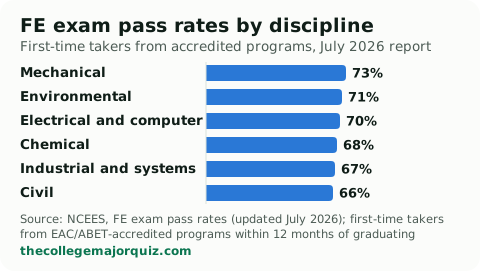
Mechanical had the highest pass rate (73%) and civil the lowest of the main disciplines (66%). A seven-point spread is small, and an exam isn't the same as a degree: each discipline's exam covers different material, and these results only include graduates who chose to take it. Still, looking at these numbers, I see one more sign that no engineering major is dramatically easier than the others once you reach the end.
What is the easiest engineering major?
There isn't an easy one. Every accredited engineering program carries the same core of at least 30 credit hours of math and basic sciences and 45 credit hours of engineering topics. In my ranking, environmental engineering is the most manageable, with industrial and civil just above it. Among the four majors my classmates compared, civil ranked as the most manageable, and on the FE exam, mechanical had the highest first-time pass rate.
Some majors lean on different strengths rather than less work. Industrial engineering's requirements, for example, center on productivity analysis, operations research, probability, statistics, engineering economy and human factors, while aerospace engineering's center on modeling, simulation, computing and testing of aerospace systems, covering both atmospheric flight and space flight.
If you want an engineering-related career with less theory, engineering technology programs are an option. The BLS notes that mechanical engineering technology programs lean more toward practical application than theory. Keep in mind that becoming a licensed Professional Engineer usually requires a degree from an accredited engineering program.
Should you choose an engineering major by difficulty?
Probably not. I think the differences between engineering majors are real but smaller than the difference between a major you enjoy and one you don't. Every engineering major is demanding, so pick the one whose work interests you, and the hard classes will feel more worth it. If you love chemistry, the extra chemistry in chemical engineering won't feel like a burden. If you're drawn to circuits and power, electrical engineering's math is the price of doing that work.
Compare what each major leads to in our guide to the types of engineering degrees, and see pay by field in the highest paying engineering jobs.
Hard isn't the only thing that matters. Our free quiz asks what you enjoy, then ranks all 9 engineering majors along with the rest.
Quick answers
Is chemical engineering the hardest engineering major?
It's the one my classmates ranked hardest, and its accreditation requirements add college-level chemistry and physics, some at an advanced level, on top of the math every engineering major takes. No national data ranks the majors, though, so treat any ranking as informed opinion.
Which engineering major has the highest FE exam pass rate?
Mechanical engineering, at 73% for first-time takers from accredited programs who tested within a year of graduating, in results NCEES published in July 2026. Environmental (71%), electrical and computer (70%), chemical (68%), industrial and systems (67%) and civil (66%) followed.
More on the majors
Types of engineering degrees walks through all nine. For a closer look at two of them, read what a chemical engineer does and what an electrical engineer does, or compare mechanical vs. electrical engineering. For how hard engineering is overall, see how hard an engineering degree is.
Wondering how engineering compares with every other field? See the hardest majors in college.
Sources
Nobody publishes an official ranking of hard majors. The requirements are from ABET's 2026-2027 criteria and the pass rates are NCEES's July 2026 numbers, each checked against the original. The ranking itself is opinion: mine and my peers'.
- ABET. Criteria for Accrediting Engineering Programs, 2026-2027 (general and program criteria). abet.org
- NCEES. FE Exam: Pass Rates (first-time takers from EAC/ABET-accredited programs within 12 months of graduation; updated July 2026). ncees.org
- National Survey of Student Engagement. NSSE Summary Tables: Core Survey, Time Spent (Q16-17), 2025 and 2026 (full-time seniors by major category). nsse.indiana.edu
- U.S. Bureau of Labor Statistics. Occupational Outlook Handbook: Mechanical Engineering Technologists and Technicians. bls.gov
- U.S. Bureau of Labor Statistics. Occupational Outlook Handbook: Mechanical Engineers (licensure). bls.gov