By Brennan, B.S. Engineering · Published · Updated
Which majors are the hardest? By study time, engineering comes out on top. By who switches out before graduating, it's the natural sciences. By how many seniors say their courses challenged them "very much" to do their best work, it's health professions and education. So the most difficult majors depend on which kind of "hard" you mean.
The hardest majors, ranked
| Rank | Major group | Hours a week preparing for class | Study more than 30 hours | Courses challenged them "very much" |
|---|---|---|---|---|
| 1 | Engineering | 18.4 | 15% | 23% |
| 2 | Biological sciences, agriculture and natural resources | 17.0 | 10% | 24% |
| 3 | Physical sciences, math and computer science | 16.9 | 11% | 22% |
| 4 | Arts and humanities | 16.3 | 10% | 25% |
| 5 | Health professions | 16.2 | 10% | 33% |
| 6 | Social sciences | 14.7 | 6% | 22% |
| 7 | Education | 14.3 | 7% | 33% |
| 8 | Social service professions | 13.8 | 6% | 29% |
| 9 | Business | 13.6 | 4% | 22% |
| 10 | Communications, media and public relations | 12.9 | 4% | 19% |
Ranked by average weekly hours full-time seniors spent preparing for class, National Survey of Student Engagement (NSSE) 2025 and 2026. These are NSSE's ten major groups, not single majors.
Rank by who switches out or by the "challenged" share and the order changes. Health professions and education jump to the top on the "challenged" measure, while engineering drops to the middle.
NSSE surveyed students at 714 four-year colleges in the U.S. and Canada in the spring of 2025 or 2026. The averages are close in the middle of the list. The heavy weeks show the gap better: 15% of engineering seniors studied more than 30 hours a week, against 4% in business and communications.
There's no official ranking of hard majors. Study time is one fair measure, not the final word.
What is the hardest major in college?
Each measure gives a different answer:
- Most study time: engineering, at 18.4 hours a week for full-time seniors.
- Most students switching out: the natural sciences. Of students who started college in fall 2017 and earned a degree, only 64% of natural sciences starters finished in that field.
- Most seniors feeling pushed: health professions and education. A third of those seniors said their courses challenged them "very much" to do their best work.
None of these is a perfect test of difficulty. Together they give a pretty fair picture.
Which majors push students the hardest?
NSSE also asks seniors, "To what extent have your courses challenged you to do your best work?" They answer from 1 (not at all) to 7 (very much). This is the share in each field who picked 7:
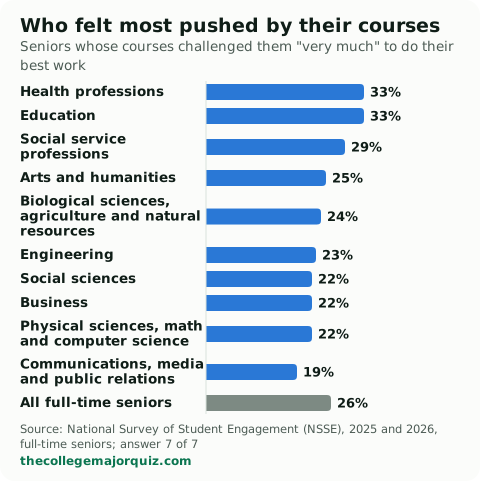
Engineering seniors study the most, yet only 23% gave their courses the top score. Health professions and education seniors led at 33% each.
The gaps are small. Every field averaged about 5.3 to 5.7 on the 7-point scale, so most seniors in every major felt pushed. And it's how students feel, which depends on more than the major itself.
Which majors do students switch out of most?
The natural sciences. A 2025 study from the American Academy of Arts and Sciences, using National Student Clearinghouse data, followed students who started college in fall 2017. Of the natural sciences starters who earned a degree, only 64% finished in that field. That was the lowest of the main fields. Education came next at 68.5%.
Engineering held on to more of its students: 80.4% of engineering starters who finished a degree finished in engineering (the study counts computer science with engineering). Business kept the most, at 82.8%.
Older federal data points the same way. Among students who started college in 2011-12, 52% of those who first declared math changed majors within 3 years, and 40% in the natural sciences. Engineering was 32%, business 31% and computer science 28%.
I saw this too. Several peers I started chemical engineering with switched to business or to another engineering major they thought would be easier. Others went from physics to math, and from chemistry to biology.
What about physics, chemistry, nursing and architecture?
These show up on almost every "hardest majors" list. The national data can't single most of them out. What it does say:
- Physics and chemistry: NSSE groups them with math and computer science, at 16.9 hours a week. Natural sciences starters were the least likely to finish in their field (64%).
- Nursing: it falls under health professions, which tied with education for the most seniors saying courses challenged them "very much" (33%). Study time was in the middle, at 16.2 hours. That group also includes other health majors, so it isn't nursing alone.
- Architecture: NSSE counts it with arts and humanities, and federal switching data lumps it with other applied fields. No current national data I found backs up claims that it's the hardest.
- Computer science: among students who started in 2011-12, 28% of CS starters changed majors, well below math (52%) and the natural sciences (40%).
What makes a major hard?
I think it's a mix: the material, the hours, the tests and the professors.
The material
I majored in chemical engineering. Most of it went fine for me. The transport series did not: fluids, heat transfer and mass transfer. Those three were the hardest classes in my major.
Honestly, I think my struggle was more about my professor's teaching style than the material. But the material is hard too. The classes build on each other. At Texas A&M, for example, chemical engineering students take fluid operations in the fall of junior year, then heat transfer and mass transfer in the spring. Heat transfer requires a C or better in fluids.
A lot of transport is built on empirical relationships turned into math, not on clean theory you can prove from scratch. Much of it happens at the molecular level, which is hard to picture. And no two problems are the same. You have to figure out a new approach every time. That's what engineering is.
The hours
Hard classes take time. Engineering seniors spend almost 5 more hours a week preparing for class than business seniors (18.4 vs. 13.6).
The tests
A lot of my tests weren't multiple choice. They were write-out problems, so you had to get the right answer. There was no lucky guessing.
The professors
Some of my professors were world-renowned experts in their fields. They expected a lot. That made the classes harder, but I think my education was much better because of it. Compared with my overall course load, the rest of my classes felt relatively easy, and having great teachers helped.
If math doesn't come easy to you, a math-heavy major will feel harder. Your professors matter a lot too.
Should you avoid a hard major?
Not just for being hard. Engineering starters stay in college at a high rate. In the newest National Student Clearinghouse data, 93.1% of fall 2024 engineering starters were still enrolled (or had finished) by their second fall, the highest of the ten most common bachelor's fields. Across all bachelor's starters, it was 88.6%.
Pick the major that fits what you like doing. If you're not sure what that is, the college major quiz matches your interests to 86 majors.
Hard major questions
What are the 10 hardest majors?
Ranked by weekly study time, NSSE's ten major groups go: engineering, biological sciences, physical sciences with math and computer science, arts and humanities, health professions, social sciences, education, social service, business, and communications. Engineering seniors average 18.4 hours a week and communications seniors 12.9. These are major groups, not single majors.
What are the 5 hardest degrees?
By weekly study hours: engineering (18.4), biological sciences (17.0), physical sciences, math and computer science (16.9), arts and humanities (16.3) and health professions (16.2). Second through fifth are less than an hour apart.
What is the hardest major of all time?
No data can answer "of all time." In the newest national survey, engineering seniors report the most study time, at 18.4 hours a week.
Is math the hardest major?
By switching, it did in older federal data. Among students who started college in 2011-12, 52% of those who first declared math changed majors within 3 years, the highest share in that report. NSSE groups math with the physical sciences and computer science, at 16.9 hours of study a week.
More on hard majors
For engineering alone, see is engineering hard? and the hardest engineering major. Thinking about another hard field? Read whether chemical engineering is harder than chemistry or the best pre-med majors. Curious about the other end of the list? See the easiest majors.
Sources
Study hours and the "challenged" shares come from NSSE's 2025 and 2026 dashboards (full-time seniors). Switching and staying rates come from the Academy's 2025 brief, the National Student Clearinghouse (June 2026) and a 2017 federal report, and course order from Texas A&M's catalog. Each number was checked against the original.
- National Survey of Student Engagement. NSSE Summary Tables: Core Survey (2025 and 2026; Time Spent and Course Engagement). Indiana University, 2026. nsse.indiana.edu
- National Survey of Student Engagement. Major Field Categories. nsse.indiana.edu
- Leu, K. Beginning College Students Who Change Their Majors Within 3 Years of Enrollment (NCES 2018-434). National Center for Education Statistics, December 2017. nces.ed.gov
- Humanities Indicators, American Academy of Arts and Sciences. From Matriculation to Completion: How Do Humanities Majors Compare? 2025. amacad.org
- National Student Clearinghouse Research Center. Persistence and Retention: Fall 2024 Beginning Postsecondary Student Cohort. June 2026. nscresearchcenter.org
- Texas A&M University. Chemical Engineering, BS and CHEN course descriptions, 2026-2027 catalog. catalog.tamu.edu