By Brennan, B.S. Engineering · Published · Updated
The easiest majors, measured by how much students study, are in communications, social service fields, business and education. There's no official list of the easiest majors, but national survey data shows where students spend the least time on coursework, and other data shows what happens after graduation.
The easiest majors, ranked by study time
The National Survey of Student Engagement (NSSE) asks seniors at hundreds of colleges how many hours a week they spend preparing for class. This is the share in each major group who said 10 hours or less:
- Communications, media and public relations: 45.8%. Communications, journalism and public relations.
- Social service professions: 41.8%. Criminal justice, criminology and social work.
- Business: 40.9%. Business administration, marketing, hospitality and management information systems, plus finance and accounting.
- Education: 39.8%. Elementary, secondary, special and early childhood education.
- Social sciences: 35.8%. Psychology, sociology, political science and similar majors.
- Health professions: 30.6%. Nursing and other health majors.
- Arts and humanities: 30.2%.
- Physical sciences, math and computer science: 26.8%. Chemistry and physics are in this group too.
- Biological sciences: 26.5%.
- Engineering: 22.1%.
Ranked by the share of full-time seniors who spend 10 hours a week or less preparing for class, NSSE 2025-26 (I calculated the shares from NSSE's counts). These are NSSE's major groups, not single majors. Across all full-time seniors, it's 33.4%.
That matches what I saw. I majored in chemical engineering, and my peers in majors people call easy did seem to have a lighter load. The hours they put into their classes weren't anywhere near as long as mine.
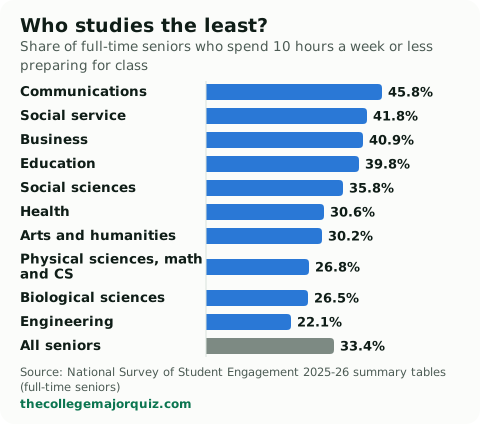
So in the four lightest groups, about 4 in 10 seniors study 10 hours a week or less. In engineering, it's about 2 in 10. For the other end, with average hours for every field, see the hardest majors.
Why "easy" depends on how you measure it
Study time is only one measure. NSSE also asks seniors how much their courses "challenged you to do your best work," on a scale of 1 to 7. The two measures don't always agree.
- Communications, business and social sciences are in the bottom half on both. Their seniors study less, and fewer say their courses pushed them "very much" (19% to 22%).
- Education and social service seniors study less, but they're among the most likely to say their courses challenged them very much: 33% in education and 29% in social service. Across all seniors, it's 26%.
So education may be light on homework hours, but its seniors don't describe it as easy. The survey doesn't say why, but fewer study hours isn't the same thing as an easy major.
Do easier majors give better grades?
There's no recent national data on GPA by major. The best evidence I found is one study of fall 2012 courses at the University of Kentucky, published in 2024 in the journal Econometrica. That semester, STEM courses there averaged a 2.90 grade and other courses averaged 3.26. Students also spent 43% more time studying for STEM courses.
The researchers say "Differences in demand for STEM and non-STEM courses explain much of why STEM classes give lower grades." So easier grading isn't just about the subject. The data is from one university in fall 2012, so treat it as a clue, not a rule.
Easy degrees that pay well
These are the closest thing to easy high paying degrees in the data. Business seniors have the second-lowest average study time of any field, yet two business majors have some of the strongest outcomes in New York Fed data:
- Finance: $70,000 median pay early in your career and $112,000 at mid-career.
- Accounting: $68,000 early and $97,000 at mid-career, with only 2.6% unemployment.
Both beat the $58,000 and $87,000 for all majors. One of my peers who studied business found accounting classes tough and math-heavy, so "easier" here means fewer study hours on average, not no effort. If you're weighing these, see accounting vs. finance.
Easy majors with lower pay or weaker job odds
Some easier fields come with real trade-offs:
- Education: the four lowest mid-career pay figures of all 73 majors are education majors, from $52,000 to $56,000. But job security is strong. Special education has the lowest unemployment of any major, at 0.7%.
- Criminal justice: 65.8% of recent grads worked in jobs that don't need a degree. That's the highest underemployment of any major.
- Communications: about 53% underemployment, well above the 39.4% for all majors, even though its unemployment rate is close to average.
So the same "easy" label covers majors with very different futures. Check the numbers for the exact major, not just the field.
Students in easier majors work more hours at jobs
NSSE also asks about paid work. Seniors in the low-study fields hold off-campus jobs for more hours each week: about 14 hours in social service and education and 13 in business, compared with 7 in engineering. Across all seniors, it's about 11.
About 31% of business seniors worked more than 20 hours a week off campus, compared with 13% of engineering seniors. The survey doesn't say which causes which. But if you need to work through school, a major with fewer study hours can make that more doable.
Should you pick an easy major?
I spent a lot of nights with a textbook, so I get why "easy" sounds good. College is expensive, and a lighter load leaves time for a job, a team or a life.
An easier major can be a smart move if it fits you. Business is a good example: of students who started in business and finished a degree, 82.8% finished in business, the highest of any field in a 2025 American Academy of Arts and Sciences report.
But "easy" is a bad reason on its own. In that same report, education starters had the highest rate of leaving without any degree, at 32%. A major you don't care about is hard to finish, no matter how light the homework is.
My advice: don't pick a major just because it's easy. Pick one that pays off after you graduate, leads to a career that pays well, or is something you really want to do.
If you're not sure where you fit, take the college major quiz. It matches your interests to 86 majors, so you can find one that feels easier because you actually like it.
Easy major questions
What is the easiest major in college?
No official ranking exists. By study time, communications is lightest: about 46% of full-time seniors in communications fields studied 10 hours a week or less in NSSE's 2025-26 survey, compared with 33% of all seniors.
What is the easiest major that pays well?
Finance and accounting are in the business group, which has some of the fewest study hours, yet both beat the all-majors median pay. Finance grads earned a median of $70,000 early and $112,000 at mid-career in New York Fed data.
Is communications an easy major?
By study time, it's the lightest field in NSSE data, at 12.9 hours a week on average for full-time seniors. Still, 19% of communications seniors said their courses challenged them very much.
What is the easiest degree to get?
If you mean the quickest, it's usually an associate degree. The Bureau of Labor Statistics says one usually takes at least 2 years of full-time study, compared with at least 4 years for a bachelor's degree. Among bachelor's majors, communications has the lightest study load in NSSE data.
Do easy majors lead to good jobs?
It depends on the major. Accounting and finance grads had low underemployment, while criminal justice had the highest of all 73 majors in New York Fed data, at 65.8%.
More on choosing a major
Want the other end? Read the hardest majors. Curious about business workloads? See is business a hard major. Still deciding? Try the best majors for undecided students.
Sources
Study time, challenge ratings and work hours come from NSSE's 2025-26 tables for full-time seniors (I calculated the 10-hours shares from its counts), and pay and job figures from the New York Fed's 2024 data. The grading study, the Academy's 2025 report and the BLS degree lengths are listed below, and I checked each number twice against the original.
- National Survey of Student Engagement. NSSE Summary Tables, Core Survey (2025 and 2026). Indiana University, 2026. nsse.indiana.edu
- National Survey of Student Engagement. Major Field Categories. nsse.indiana.edu
- Federal Reserve Bank of New York. The Labor Market for Recent College Graduates, outcomes by major (2024 data). February 4, 2026. newyorkfed.org
- Ahn, T., Arcidiacono, P., Hopson, A., and Thomas, J. Equilibrium grading policies with implications for female interest in STEM courses. Econometrica 92(3), 849-880, 2024. doi.org
- U.S. Bureau of Labor Statistics. Employment Projections: Definitions (typical education needed for entry). Last modified August 27, 2026. bls.gov
- Humanities Indicators, American Academy of Arts and Sciences. From Matriculation to Completion: How Do Humanities Majors Compare? 2025. amacad.org