By Brennan, B.S. Engineering · Published · Updated
Finance pays more, but accounting grads have an easier start. In New York Fed data, finance majors earned a median of $70,000 early in their careers and $112,000 at mid-career, compared with $68,000 and $97,000 for accounting. But recent accounting grads had lower unemployment (2.6% vs. 2.8%), and fewer of them worked in jobs that don't need a degree (21.2% vs. 27.8%).
The bigger difference is where each degree points. Accounting leads most directly to accountant jobs and the CPA license. Finance leads most directly to financial analyst jobs.
I'm not a business major myself. I'm a chemical engineer, and I work with a lot of accountants, controllers and financial analysts in the chemical industry. A lot of the CPAs I know majored in accounting, and some of them took several finance classes too.
Accounting vs. finance major at a glance
Pay is the median for full-time workers with only a bachelor's degree. Unemployment and underemployment (working in a job that typically doesn't need a degree) are for recent grads ages 22 to 27. Figures for each major are New York Fed data (2024, released February 2026), and job pay and growth are from the BLS handbook.
| Measure | Accounting | Finance |
|---|---|---|
| Early-career pay (ages 22 to 27) | $68,000 | $70,000 |
| Mid-career pay (ages 35 to 45) | $97,000 | $112,000 |
| Unemployment | 2.6% | 2.8% |
| Underemployment | 21.2% | 27.8% |
| Have a graduate degree (ages 25 to 65) | 33.7% | 31.5% |
| Most direct job | Accountant or auditor | Financial analyst |
| That job's median pay (2025) | $83,680 | $103,570 |
| That job's growth, 2025 to 2035 | 5% | 7% |
| Credential to know | CPA (a state license) | CFA (a charter from CFA Institute) |
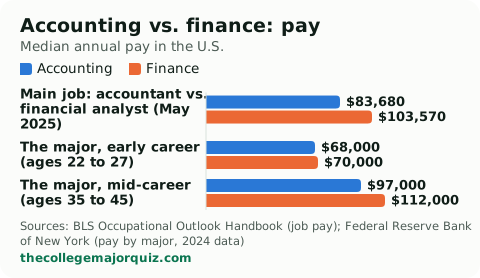
When I compare the data, the pay gap is small at first and grows later: $2,000 early on, then $15,000 by mid-career. Both majors also had a lower share of graduate degrees than the 39.3% for all majors. To see the seven business majors the New York Fed tracks side by side, check the best business majors.
What's the difference between a finance and accounting degree?
Accounting is mostly about recording and checking a company's money. Finance is mostly about planning what to do with it. BLS says accountants and auditors prepare and examine financial records, while financial analysts evaluate financial data, forecast trends and write up recommendations for businesses and investors. Both work with a company's financial numbers, and the two majors share a lot of classes.
What classes do accounting and finance majors take?
Both start with the same business core, then split. At the University of Illinois, Penn State and the University of Texas at Austin, it looks like this:
- Accounting majors take upper-level financial accounting (called intermediate accounting at Penn State and UT Austin) plus auditing, taxation or both. Penn State requires two semesters of intermediate financial accounting, plus auditing and taxation.
- Finance majors take courses in investing and markets, like investment and portfolio management at Illinois and valuation at UT Austin.
Each major also borrows from the other. Accounting majors at Illinois and Penn State take corporate finance, and finance majors at UT Austin take intermediate accounting. A lot of the classes overlap, and some of the CPAs I know took several finance classes on top of their accounting major. For how much math is involved, see is business a hard major.
Which jobs does each degree lead to?
Accounting leads to accountant and auditor jobs, which BLS says typically need a bachelor's degree in accounting or a related field, such as business. They paid a median of $83,680 in 2025, with 5% growth projected from 2025 to 2035.
Finance leads to financial analyst jobs, which typically need a bachelor's degree in finance or a related field such as business. They paid a median of $103,570, with 7% growth projected. Budget analyst ($91,640) and personal financial advisor ($105,070) are other options, and BLS lists several majors for each.
Both can lead to financial manager ($166,570), a later step. BLS lists 5 years or more of experience, usually in another business or financial job like accountant or financial analyst. Controllers, who direct the preparation of financial reports, are one type of financial manager. For more jobs with pay and growth, see what you can do with a business degree.
CPA vs. CFA: the credential for each major
- CPA (certified public accountant): a state license. Accountants who file reports with the Securities and Exchange Commission (SEC) must have it. The exam has three Core sections (auditing and attestation, financial accounting and reporting, and taxation and regulation) plus one Discipline section you choose.
- CFA (Chartered Financial Analyst): from CFA Institute. You pass three levels of exams, which CFA Institute says takes three to four years, and you need 4,000 hours of relevant work experience to earn the charter. Students can take Level I up to 23 months before they graduate.
For the CPA, the traditional route takes 150 semester credit hours, 30 more than a typical 120-hour bachelor's degree, plus a year of experience and passing the exam, according to NASBA, the national association of state boards of accountancy. NASBA now also describes a route that takes a bachelor's degree in accounting plus two years of experience instead. Each state has to adopt it, so check with your state board.
On the finance side, BLS says some financial analyst jobs may require a license, and FINRA is the main licensing group for the securities industry.
Can you work in finance with an accounting degree?
Yes. Financial analyst jobs typically take a degree in finance or a related field such as business, and at Illinois and Penn State, accounting majors take corporate finance.
That's what I've seen too. Most of the controllers at the companies I've worked for have finance and accounting backgrounds. Others did an engineering degree and later got a master's in finance or accounting. In my experience, companies don't really treat the two majors differently for those roles. If someone gets one of those jobs without a finance background, they look at that person's past experience to see if they can do the job.
If you want the CPA, though, NASBA's model routes all call for an accounting degree, and two of the three start with a bachelor's in accounting, so accounting is the more direct major.
What skills are needed for finance?
Think about what a financial analyst does. They evaluate data, forecast trends and write up recommendations. BLS lists analytical, math, communication, computer and decision-making skills, plus attention to detail, as important qualities for the job. Penn State's finance electives point the same way, with courses in advanced financial modeling and data science and artificial intelligence in finance. BLS also says students often benefit from internships, which can help them gain practical experience.
Is a finance degree better than an accounting degree?
If you want the CPA and a steadier start, accounting makes more sense. If you like markets, investing and forecasting, and you want the higher mid-career pay, finance does. And if you're torn, the overlap is big, and the companies I've worked for don't really treat the two differently.
If you're also looking at economics, BLS lists economics as a typical major for financial managers, but NASBA's CPA routes all call for an accounting degree, at the bachelor's or master's level.
Should you double major in accounting and finance?
If you like both and can handle the workload, yes. But you can also get the bachelor's in one and a master's later, and in my opinion that's probably the best route. In my experience, a lot of companies will pay for continuing education, so you might get that master's for free.
Some schools build the combination in. Spalding University lists a double major in accounting and business administration with a finance concentration at 124 total credit hours. For the pros and cons of double majoring in general, see is a double major worth it and double major vs. dual degree.
Still torn? Try our free quiz. It covers accounting, finance and economics along with 83 other majors.
Accounting vs. finance: other questions
Which pays more, accounting or finance?
Finance, in New York Fed data. Finance grads earned a median of $70,000 early in their careers and $112,000 at mid-career, compared with $68,000 and $97,000 for accounting.
Is accounting or finance more in demand?
Both are growing. BLS projects 7% growth for financial analyst jobs, much faster than average, and 5% for accountant and auditor jobs, faster than average, from 2025 to 2035, and recent accounting grads had slightly lower unemployment, 2.6% vs. 2.8%.
Do you need a CPA to work in accounting?
Not always. BLS says any accountant who files a report with the SEC must be a licensed CPA, and other accountants choose to become one to enhance their job prospects or gain clients.
Where to read next
The best business majors page compares pay and job numbers for the whole group, and what you can do with a business degree covers the jobs. Leaning toward accounting? See whether an accounting degree is worth it. If you're still working out how to decide, try how to choose a college major.
Sources
Pay, unemployment and underemployment are from the New York Fed's February 2026 release. Job outlook is from the BLS, and course rules are from each school's catalog. The dollar gaps are simple subtraction from those figures, and each number was checked against the original source.
- Federal Reserve Bank of New York. The Labor Market for Recent College Graduates (outcomes by major, released February 4, 2026, 2024 data). newyorkfed.org
- U.S. Bureau of Labor Statistics. Accountants and Auditors, Occupational Outlook Handbook (last modified October 29, 2026). bls.gov
- U.S. Bureau of Labor Statistics. Financial Analysts, Occupational Outlook Handbook (last modified August 27, 2026). bls.gov
- U.S. Bureau of Labor Statistics. Financial Managers, Occupational Outlook Handbook (last modified August 27, 2026). bls.gov
- U.S. Bureau of Labor Statistics. Budget Analysts, Occupational Outlook Handbook (last modified August 27, 2026). bls.gov
- U.S. Bureau of Labor Statistics. Personal Financial Advisors, Occupational Outlook Handbook (last modified October 29, 2026). bls.gov
- National Association of State Boards of Accountancy (NASBA). New CPA Licensure Pathways and CPA Mobility (December 23, 2025). nasba.org
- AICPA & CIMA. Everything You Need to Know About the CPA Exam. aicpa-cima.com
- CFA Institute. CFA Program (2026 exams). cfainstitute.org
- CFA Institute. CFA Program Policies. cfainstitute.org
- University of Illinois Urbana-Champaign. Accountancy, BS, Academic Catalog 2026-2027. illinois.edu
- University of Illinois Urbana-Champaign. Finance, BS, Academic Catalog 2026-2027. illinois.edu
- Penn State. Accounting, B.S., 2026-2027 Undergraduate Bulletin. psu.edu
- Penn State. Finance, B.S., 2026-2027 Undergraduate Bulletin. psu.edu
- University of Texas at Austin. Accounting (BBA), Undergraduate Catalog 2026-27. utexas.edu
- University of Texas at Austin. Finance (BBA), Undergraduate Catalog 2026-27. utexas.edu
- Spalding University. Double Major: Accounting and Business Administration: Finance, Catalog 2026-2027. spalding.edu
- Internal Revenue Service. Updates to frequently asked questions about educational assistance programs (FS-2026-10, April 2026). irs.gov