By Brennan, B.S. Engineering · Published
Yes. By the numbers, accounting is one of the safest bets in business. Its grads earn above average and have some of the lowest underemployment of any major. And the CPA path just got more flexible.
I'm a chemical engineer, and I've worked alongside accountants and controllers. Most of the CPAs I know majored in accounting, and a lot of them took finance classes too.
Is an accounting degree worth it?
The New York Fed tracks pay and job outcomes for 73 majors. Accounting beats the all-majors average on all four:
- Early-career pay: $68,000, 17th of 73. All majors: $58,000.
- Mid-career pay: $97,000, 22nd of 73. All majors: $87,000.
- Unemployment: 2.6%, the 19th lowest. All majors: 4.2%.
- Underemployment: 21.2%, the 12th lowest. All majors: 39.4%.
That underemployment number is the one I'd look at hardest. It's the share of recent grads working jobs that don't need a degree. Only engineering, computer science, nursing, teaching and construction majors did better. In plain terms, accounting grads usually land jobs that actually need their degree.
Finance pays more by mid-career, though. If you're torn between the two, see accounting vs. finance for the side-by-side.
What do accountants do?
At the manufacturing sites I've worked at, the accountants handle a lot of each site's finances. They manage just about every part of the money side.
BLS lists their main duties as:
- Organizing, analyzing and keeping financial records.
- Checking financial statements to make sure they're accurate and follow the law.
- Figuring out taxes owed and preparing tax returns.
- Suggesting ways to cut costs, raise revenue and improve profits.
One type BLS describes is management accountants, also called cost, corporate or industrial accountants. Their reports are for a company's own managers, not the public. BLS says they "often prepare budgets and evaluate performance" and "may help organizations plan the cost of doing business." Manufacturing employs about 6% of all accountants and auditors.
Accounting jobs and pay
Most accounting majors start as accountants or auditors. The Bureau of Labor Statistics (BLS) puts their median pay at $83,680 and projects 5% job growth from 2025 to 2035, which it calls "faster than the average." It expects about 115,300 openings a year, many of them to replace people who retire or switch careers.
Accounting can also lead to these jobs, according to BLS:
| Job | Median pay | Growth, 2025-35 | Note |
|---|---|---|---|
| Financial managers, including controllers | $166,570 | 9.7% | Some start as accountants; usually 5+ years of experience first |
| Financial examiners | $94,160 | 9.3% | BLS says coursework should include accounting or finance |
| Accountants and auditors | $83,680 | 5.0% | The main entry job |
| Tax examiners and revenue agents | $62,370 | -1.0% | Usually a bachelor's in accounting or business |
Source: BLS Occupational Outlook Handbook and 2025-35 projections. Median pay is for May 2025. Across all jobs, BLS projects 3.5% growth.
Controllers are a good example of where accounting can lead. BLS says they "direct the preparation of financial reports that summarize and forecast an organization's financial position," and they often oversee the accounting, audit and budget departments. At the companies I've worked for, most controllers came from finance and accounting, or from engineering with a master's in finance or accounting later.
Do you need to be a CPA?
Not for every job. But BLS says any accountant who files a report with the Securities and Exchange Commission "is required to be a licensed Certified Public Accountant (CPA)." Others get it to stand out or to win clients.
The big change: for years, a CPA license required 150 college credit hours, 30 more than a typical bachelor's degree. In May 2025, the two groups behind the national model law (AICPA and NASBA) approved a second route: a bachelor's degree with an accounting concentration, plus two years of experience, plus passing the CPA Exam. The 150-hour route still exists.
Each state has to adopt it on its own. Texas, for example, opened the new route on August 1, 2026. Check your state's board of accountancy for the rules where you'll work.
How hard is the CPA Exam?
It's four sections: three core sections everyone takes and one discipline section you pick. The chart shows the share of candidates who passed each one in 2025:
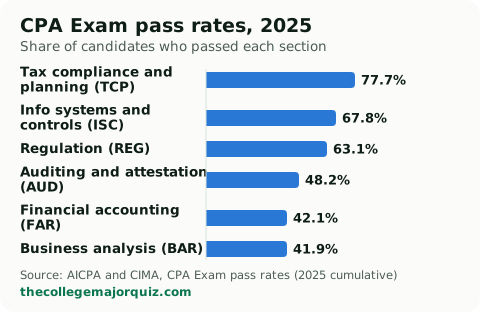
Fewer than half passed financial accounting and reporting (FAR), auditing (AUD) or business analysis and reporting (BAR). In 2025, 87,660 people took the exam and 23,978 passed their final section, according to NASBA.
Will AI replace accountants?
BLS rates accountants "very high" for AI exposure, like the other business and finance jobs on this page. But BLS is clear that exposure "does not imply job loss," and it still projects accountant jobs to grow.
Its outlook is worth quoting in full. BLS says "Some routine accounting tasks may be automated as platforms such as cloud computing, artificial intelligence (AI), and blockchain become more widespread." But "this change is not expected to reduce overall demand." Instead, "The automation of routine tasks, such as data entry, will instead make accountants' advisory and analytical duties more prominent."
The split shows up in the numbers. Accountants, who typically need a bachelor's, are projected to grow 5%. Bookkeeping, accounting and auditing clerks, who typically don't, are projected to decline 6%. That fits BLS's point: the routine work is what's getting automated.
For more on how AI lines up with different majors, see AI-proof majors.
Are fewer students majoring in accounting?
For a while, yes. But the AICPA's 2026 report shows accounting bachelor's degrees rose 8.5% in the 2024-25 school year, the first increase in recent years.
More are on the way. Enrollment in four-year accounting programs rose 8.9% to 205,180 in spring 2026, the third straight yearly increase. And in 2025, first-time CPA Exam candidates hit their highest level since 2018, not counting a one-year spike in 2023.
Firms still want them, too. In the same 2026 report, accounting grads were still the majority of new grads hired by the public accounting firms surveyed.
Who should major in accounting?
It's a good fit if you:
- Like rules, details and getting numbers to tie out.
- Want a clear career path with a license at the end of it.
- Care about job security as much as top pay.
Go in knowing the classes take work. One of my peers who studied business told me accounting was pretty tough, with a lot of math. And many companies will help pay for a master's later, so you don't have to do it all up front.
Would I recommend accounting? Yes, but it depends on the kind of job you want. In manufacturing, I think it's pretty safe from AI, because so much of the work happens on site, like managing inventory and working with other teams at the plant. That human side still matters a lot.
Not sure accounting fits you? The college major quiz matches your interests to 86 majors, including accounting, finance and other business majors.
Accounting major FAQ
Is accounting a good major for the future?
BLS projects accountant and auditor jobs to grow 5% from 2025 to 2035, faster than the 3.5% for all jobs, with about 115,300 openings a year. It expects AI to automate routine tasks but not to reduce overall demand.
Do you need a master's degree to be a CPA?
No. BLS says a master's degree is not required. A newer route, which states are adopting one at a time, uses a bachelor's degree plus two years of experience instead of 150 credit hours.
How much do accounting majors make?
New York Fed data shows a median of $68,000 for recent accounting grads and $97,000 at mid-career, compared with $58,000 and $87,000 for all majors.
Other business guides
Comparing business majors? Start with the best business majors. Torn between money majors? See accounting vs. finance. Wondering about the workload? Read is business a hard major.
Sources
Pay, unemployment and underemployment by major are from the New York Fed's 2024 data (released February 2026), and the ranks among 73 majors are my own count from that file. Job duties, pay and growth are from BLS's Occupational Outlook Handbook and 2025-35 projections, and AI ratings are from BLS's AI exposure table. CPA, enrollment and graduate figures are from AICPA, NASBA and the Texas State Board of Public Accountancy. Each number was checked against the original source.
- Federal Reserve Bank of New York. The Labor Market for Recent College Graduates, outcomes by major (2024 data). February 4, 2026. newyorkfed.org
- U.S. Bureau of Labor Statistics. Occupational Outlook Handbook: accountants and auditors, financial managers, financial examiners, tax examiners, bookkeeping clerks. Last modified August-October 2026. bls.gov
- U.S. Bureau of Labor Statistics. Artificial Intelligence (AI) exposure categories. Last modified August 27, 2026. bls.gov
- AICPA and NASBA. AICPA and NASBA Approve Model Legislation for New CPA Licensure Path. May 14, 2025. nasba.org
- Texas State Board of Public Accountancy. New Pathway for CPA Exam and Certification. March 10, 2026. tsbpa.texas.gov
- AICPA and CIMA. Learn more about CPA Exam scoring and pass rates. October 22, 2026. aicpa-cima.com
- NASBA. 2025 NASBA Report Now Available. August 2026. nasba.org
- AICPA and CIMA. 2026 Trends: A Report on Accounting Education, the CPA Exam, and Public Accounting Firms' Hiring of Recent Graduates. November 4, 2026. aicpa-cima.com
- AICPA. U.S. Accounting Undergraduate Enrollment Continues to Outpace Growth Rate for Business Majors Overall. June 9, 2026. aicpa-cima.com