By Brennan, B.S. Engineering · Published · Updated
No major is fully AI-proof. But some lead to jobs AI touches a lot less than others, and the federal government now rates every job on that. Of the 290 jobs that typically need a bachelor's degree or more, only 31 rate low or moderate for AI exposure. That's about 1 in 9.
I'm a chemical engineer, and AI already writes the first draft of my lab reports. So I get why students want an AI-proof major or degree. Nobody wants to spend four years on a degree and then watch software do the job. But AI can't physically see the work I do. A person still has to handle the hands-on parts of the job and watch what's actually happening on site.
In 2026, the Bureau of Labor Statistics (BLS) sorted 831 jobs into four groups by how exposed they are to AI compared with other jobs: low, moderate, high and very high. I went through every one.
Is any major really AI-proof?
Not in a way anyone can promise. BLS says a low rating means a job's work doesn't "match well with the current capabilities of AI models." A very high rating means more of the job's tasks "can be completed or assisted by AI technology."
But BLS is careful about what that means. In its words, "Exposure does not imply job loss," and "An exposure category is not a forecast of employment growth or decline." Plenty of very high jobs are still growing fast.
What surprised me: the jobs least exposed to AI mostly don't need a degree.
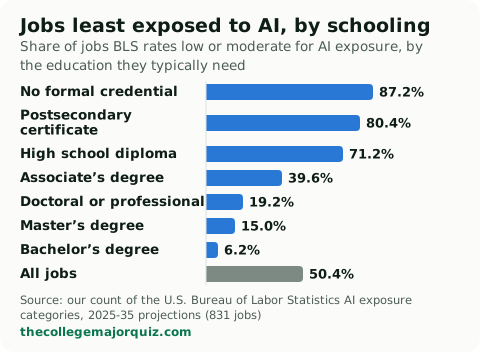
Of the 213 jobs BLS rates low, 206 typically need less than a bachelor's degree. Think hands-on work: building, fixing, moving and caring for people in person. Among jobs that typically start with a bachelor's, not a master's or doctorate, only 6% rate low or moderate.
So if you're going to college, the real question isn't "which major is AI-proof?" It's "which majors lead to work that's hands-on, or to jobs that are growing even with AI?"
Majors that lead to the least AI-exposed jobs
These are the degree-level jobs BLS rates low or moderate that are also projected to grow faster than the 3.5% average for all jobs. Notice the pattern: most of them involve working with people in person.
| Job | AI exposure | Growth, 2025-35 | Median pay | Common path |
|---|---|---|---|---|
| Physician assistants | Low | 21.1% | $135,880 | Bachelor's often in healthcare or biology, then a master's |
| Exercise physiologists | Moderate | 12.8% | $59,460 | Exercise physiology, exercise science or kinesiology |
| Athletic trainers | Moderate | 12.7% | $62,520 | Bachelor's with science and health courses, then a master's |
| Mental health and substance abuse social workers | Moderate | 10.3% | $60,280 | Social work, psychology or social science, then a master's in social work |
| Nurse anesthetists | Low | 9.7% | $236,590 | Nursing, RN license and critical care experience, then a master's or higher |
| Optometrists | Low | 9.5% | $136,570 | Biology or physical science, then a Doctor of Optometry |
| Airline pilots | Moderate | 8.3% | $232,140 | A degree in any field, plus flight training and experience |
| Coaches and scouts | Moderate | 6.1% | $47,320 | Kinesiology, physical education or sports management |
| Dentists | Moderate | 5.7% | $170,950 | A bachelor's with science courses like biology or chemistry, then dental school |
| Administrative services managers | Moderate | 5.2% | $114,130 | Business or a related field, plus work experience |
| Recreational therapists | Moderate | 4.8% | $61,960 | Recreational therapy or recreation and fitness |
Source: BLS AI exposure categories and 2025-35 projections; paths from each job's Occupational Outlook Handbook page. Median pay is for May 2025. Not shown: a few more low or moderate jobs that need a doctorate, like surgeons and orthodontists, and a few small fields.
In major terms, that points to:
- Biology, chemistry or health sciences as a pre-health major, aimed at PA school, optometry or dentistry. See the best pre-med majors for how those majors compare.
- Nursing, which leads to registered nursing and, with more school, to nurse anesthetist, one of the highest-paid low-exposure jobs.
- Kinesiology and exercise science or athletic training, for exercise physiology, athletic training and coaching.
- Social work or psychology, on the way to a master's in social work.
- Aviation, if flying is the goal. BLS says airline pilots can have a degree in any field, but they need a lot of flight experience.
The catch: many of these need grad school. Only 5 of the 11 jobs above typically start with a bachelor's, and two of those also need work experience.
Majors whose jobs are exposed but still growing
A high rating doesn't mean a job is on the way out. Some of the fastest-growing jobs in the country rate high or very high:
- Nurse practitioners: high exposure, projected to grow 41%.
- Data scientists: very high exposure, projected to grow 34.6%. BLS says they "will be needed to help businesses leverage AI and other technologies."
- Medical and health services managers: high exposure, 24.2% growth.
- Information security analysts: very high exposure, 21.0% growth.
- Speech-language pathologists, occupational therapists and physical therapists: high exposure, 11.9% to 16.6% growth.
- Software developers: very high exposure, 10.2% growth. BLS expects demand to be strong partly because of "software development for artificial intelligence (AI)." See whether computer science is still a good major.
For these jobs, AI is part of the work, not a replacement for it. That matches what I see. I covered the fast-growing, high-paying ones in the best degrees for the future.
What majors are at risk with AI?
BLS names AI as a reason for weaker demand in a handful of jobs. These are the ones that line up with common majors:
- Graphic design: graphic designers are projected to decline 1.7%. BLS says "Automated design tools, such as artificial intelligence (AI), are projected to make graphic designers more productive and reduce the need for these workers."
- English, communications and journalism: these are the usual majors for writers and authors. BLS says "Increasing use of artificial intelligence (AI) for writing is projected to dampen demand for these workers." It projects little or no change in their jobs.
- Pre-law and legal studies, if you stop at paralegal: BLS says paralegal demand "is expected to be limited by advances in technology, including artificial intelligence (AI)." The usual path is an associate's degree in paralegal studies, though some people major in social science or business.
Across whole fields, BLS expects AI tools to limit demand in some arts, design and media jobs and in office and administrative support, which it projects to shrink 4% by 2035.
That doesn't make these majors a bad choice. It means the plain version of the job is under pressure, so pair the major with skills AI can't easily cover, or aim at the parts of the field that are growing.
For what it's worth, no job or task at my company has shrunk because of AI yet. That's one workplace, so it isn't proof either way.
Which engineering majors are the most AI-proof?
None of them rate low. But engineering splits into two groups:
- High exposure: chemical engineers (4.7% growth), civil engineers (6.4%) and electrical engineers (9.9%).
- Very high exposure: mechanical (11.2%), industrial (12.4%), aerospace (8.3%) and biomedical engineers (7.6%).
Every one of them is projected to grow faster than the 3.5% average for all jobs. For mechanical engineers, BLS even says automation adds work: as factories add "more complex automation machinery," they'll be needed to fit it into existing systems.
So is chemical engineering safe from AI? I think it is, for a while. It's a fairly safe way to get your foot in the door in manufacturing, where a lot of the work still happens in person. That's my opinion, not a fact.
For more on each field, see what you can do with an engineering degree.
Is a business degree safe from AI?
Most business jobs rate very high. Accountants and auditors, market research analysts, financial analysts and management analysts all do. Yet all four are still projected to grow, from 5% for accountants to 10.1% for management analysts.
BLS is specific about accounting. It says AI and other tools may automate "Some routine accounting tasks," but "this change is not expected to reduce overall demand." Instead, it expects the advisory and analytical side of the job to become "more prominent."
The business jobs that rate lower tend to involve running things in person. Administrative services managers rate moderate, and medical and health services managers rate high with 24.2% growth. Both usually need work experience on top of the degree. If you're weighing business majors, start with the best business majors.
How AI changed my own work
My job mixes desk work and lab work. I run financial analysis on whether a project at our site is worth starting. I also run lab batches, collect the data and turn it into reports.
AI helps with both. I give it my data and tell it what I need and when. Since I follow the same steps every time, I built agents that know what data I'm feeding them and write the report. I review it and touch it up so it covers everything. That saves me time for the lab and the pilot plant.
It's also my troubleshooting partner. When a formulation isn't working or I'm stuck on some chemistry, I use it to dig through educational and scientific sources online. I don't work in production anymore, but I've seen plants start using AI there too, for troubleshooting and to improve their mechanical integrity and asset protection programs.
None of that replaced an engineer. It helped engineers work smarter.
How to pick a major with AI in mind
If I were picking a major today, I'd do this:
- Look at the job, not the major's name. Find the jobs your major leads to and check how they're projected to grow. BLS's AI exposure page lists the rating for all 831 jobs, so you can look up any job yourself.
- Favor hands-on or in-person work if AI worries you most. That's where the low ratings are.
- Or lean in. Many exposed jobs are growing because companies need people who can use AI well.
- Pick something you'll actually like. A safe job you hate is still a job you hate.
If you don't know which direction fits you yet, take the college major quiz. It matches your interests to 86 majors and shows the careers each one leads to.
AI-proof major questions
Is any major 100% AI-proof?
No. BLS rates jobs, not majors, and its ratings show how exposed a job is compared with other jobs. BLS also says exposure is not a forecast of job loss. Majors that lead to hands-on health care work, like physician assistant or nurse anesthetist, rate lowest.
What graduate jobs are most likely to be AI-proof?
Among jobs that need a master's or doctorate, BLS rates physician assistants, nurse anesthetists, optometrists, orthotists and prosthetists, prosthodontists, oral and maxillofacial surgeons and anesthesiologists as low exposure. Physician assistants are also projected to grow 21.1% from 2025 to 2035.
Is computer science still a good major with AI?
BLS rates software developers very high for AI exposure, but it still projects their jobs to grow 10.2% from 2025 to 2035, partly because of software development for AI. Data scientists are projected to grow 34.6%.
What majors won't be replaced by AI?
No major comes with a guarantee. The safest bets lead to hands-on jobs that BLS rates low or moderate for AI exposure and that are still growing, like physician assistants (21.1% growth), nurse anesthetists and dentists. Pre-health, nursing, kinesiology and social work are the majors that lead there.
Is nursing AI-proof?
Not fully. BLS rates registered nurses high for AI exposure, but projects 5.6% growth. With more school, nurses can become nurse anesthetists, which BLS rates low, or nurse practitioners, which are projected to grow 41%.
More on majors and the future
Want careers that pay well and are growing fast? See the best degrees for the future. Thinking about health care? Read the best pre-med majors. Weighing engineering or business? Try what you can do with an engineering degree and the best business majors.
Sources
AI exposure ratings, growth and pay are from BLS's AI exposure file for the 2025-35 projections. The counts (31 of 290, 206 of 213, and the chart) are my own tally of that file. Degree paths and AI quotes are from each job's Handbook page. Every figure was checked twice against BLS's own files.
- U.S. Bureau of Labor Statistics. AI exposure categories and 2025-35 employment projections (XLSX) and Artificial Intelligence (AI) exposure categories. August 2026. bls.gov
- U.S. Bureau of Labor Statistics. Employment Projections: 2025-2035 Summary (USDL-26-1422). August 27, 2026. bls.gov
- U.S. Bureau of Labor Statistics. Occupational Outlook Handbook, job pages and glossary ("Growth rate"), last modified August-October 2026. bls.gov