By Brennan, B.S. Engineering · Published
Yes, for most students who like it. Computer science grads have some of the highest starting pay of any major. The catch is that recent grads also have one of the highest unemployment rates, and fewer students are signing up.
I'm a chemical engineer, not a programmer. I did a little coding in college, and at the plant I work alongside computer engineers who run our control systems, networks and IT. So I'll let the data do most of the talking.
Is a computer science degree worth it?
The New York Fed tracks pay and job outcomes for 73 majors. Computer science lands near the top on pay and near the worst on unemployment:
- Early-career pay: $87,000, 2nd of 73. All majors: $58,000.
- Mid-career pay: $120,000, tied for 5th. All majors: $87,000.
- Unemployment: 7.0%, the 4th highest. All majors: 4.2%.
- Underemployment: 19.1%, the 9th lowest. All majors: 39.4%.
That mix is unusual. Only anthropology, computer engineering and fine arts grads had higher unemployment. Yet the CS grads who did find work were among the least likely to be stuck in a job that doesn't need a degree.
When I look at the data, the degree still pays off. The hard part is landing the first job. The degree alone doesn't guarantee one, so internships and projects matter.
Computer science jobs and pay
Most CS grads aim for software developer jobs. The Bureau of Labor Statistics (BLS) puts their median pay at $135,980 and projects 10.2% growth from 2025 to 2035, almost three times the 3.5% rate for all jobs. That's about 95,300 openings a year.
But "tech" isn't one job. Some CS paths are growing fast, and one is shrinking:
| Job | Median pay | Growth, 2025-35 |
|---|---|---|
| Computer and information research scientists | $140,300 | 21.8% |
| Software developers | $135,980 | 10.2% |
| Information security analysts | $129,180 | 21.0% |
| Data scientists | $120,230 | 34.6% |
| Computer systems analysts | $105,850 | 7.9% |
| Computer programmers | $100,390 | -7.3% |
| Web developers | $92,650 | 3.8% |
Source: BLS Occupational Outlook Handbook and 2025-35 projections. Median pay is for May 2025. Research scientists typically need a master's degree; the rest typically need a bachelor's.
Data scientists and security analysts are the standouts. Computer programmers are the one job on the list BLS expects to lose ground.
CS also leads to more than tech companies. The computer engineers at my site work on control systems, PLCs and plant networks, and some work in IT. Plenty of employers outside tech, like manufacturers, need people who can write and fix software. For how CS compares with its closest cousin, see computer engineering vs. computer science.
Is computer science still a good major with AI?
BLS rates every job in the table above "very high" for AI exposure. That sounds scary, but BLS says plainly that "An exposure category is not a forecast of employment growth or decline."
Its job outlooks tell a split story. For software developers, BLS says demand "is projected to be strong due to the continued expansion of software development for artificial intelligence (AI)," along with robotics and other automation. In other words, AI is one reason it expects more developer jobs, not fewer.
The warning is for narrower coding roles. BLS says many companies are expected to use AI "to automate repetitive programming tasks," and it projects computer programmer jobs to fall 7.3%. For web developers, it says more use of AI "may soften the employment growth."
When I compare the data, the CS jobs that are growing use code to solve bigger problems, like security, data and research. The one that's shrinking is built around writing routine code. For more on how AI lines up with different majors, see AI-proof majors.
I'm sure AI tools are being used at my site. But I haven't seen them change the controls or IT work at my level yet.
Are fewer students majoring in computer science?
Yes, and it's recent. After four years of growth, undergraduate computer science enrollment at 4-year colleges fell 11.2% in fall 2025, according to the National Student Clearinghouse. That was the first drop in its 2020 to 2025 data.
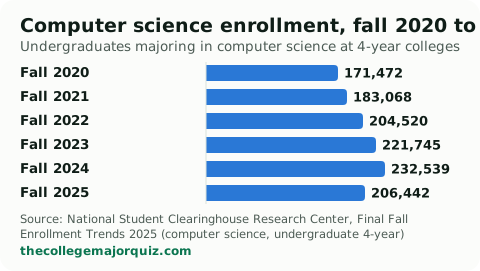
The slide kept going. Early numbers for fall 2026 show the broader computer and information science field down 12.4% at 4-year colleges. Those figures are preliminary and could change.
Degrees haven't caught up yet. The Computing Research Association's 2025 survey of PhD-granting computing departments found a record number of CS bachelor's degrees, up 12.8% in a year, while new CS majors fell 12.9%. CRA expects degree counts to "plateau and decline in the coming years."
For a student starting now, that could cut both ways. You'll still compete with big graduating classes for the next few years. But by the time you finish, there may be fewer new grads looking for the same jobs.
Who should major in computer science?
It's a good fit if you:
- Like building things and fixing them when they break.
- Enjoy math and logic, or at least don't mind a lot of it.
- Will code on your own time, through projects, internships or clubs.
It may not be the right pick if you're choosing it only for the pay. With 7.0% unemployment for recent grads, the degree alone won't carry you.
In my opinion, computer science is still a great major to choose. But AI can now do a lot of the work CS grads do, so it's riskier than it used to be. That's good and bad. Mostly, it makes the field more competitive.
Employers still value the degree. In a survey by the National Association of Colleges and Employers, computer science grads had the highest projected average starting salary of any major group for the class of 2026, at $81,535.
Not sure computer science fits you? The college major quiz matches your interests to 86 majors, including computer science, computer engineering and information technology.
Computer science major FAQ
Is computer science a good major for the future?
BLS projects software developer jobs to grow 10.2% from 2025 to 2035, almost three times the 3.5% for all jobs. Data scientists and information security analysts are projected to grow even faster. Computer programmers are the exception, with a 7.3% decline.
How much do computer science majors make?
New York Fed data shows a median of $87,000 for recent computer science grads and $120,000 at mid-career, compared with $58,000 and $87,000 for all majors.
Why is unemployment high for computer science grads?
The New York Fed doesn't give a reason. Its data shows a 7.0% unemployment rate for recent CS grads, the 4th highest of 73 majors. Enrollment is also falling. In a CRA survey of college computing departments, many comments about the drop mentioned fewer job opportunities and the impact of AI.
Other computing guides
Torn between two tech majors? See computer engineering vs. computer science. Curious which careers are growing fastest? Read the best degrees for the future. Want the full pay ranking? See the highest-paying majors.
Sources
Pay, unemployment and underemployment by major are from the New York Fed's 2024 data (released February 2026), and the ranks among 73 majors are my own count from that file. Job pay, growth and outlooks are from BLS's Occupational Outlook Handbook and 2025-35 projections, and AI ratings are from BLS's AI exposure table. Enrollment figures are from the National Student Clearinghouse and the Computing Research Association. Each number was checked against the original source.
- Federal Reserve Bank of New York. The Labor Market for Recent College Graduates, outcomes by major (2024 data). February 4, 2026. newyorkfed.org
- U.S. Bureau of Labor Statistics. Occupational Outlook Handbook: software developers, computer programmers, computer and information research scientists, information security analysts, computer systems analysts, data scientists, web developers. Last modified August 27, 2026. bls.gov
- U.S. Bureau of Labor Statistics. Table 1.2 Occupational projections, 2025-35, and worker characteristics, 2025. August 27, 2026. bls.gov
- U.S. Bureau of Labor Statistics. Employment Projections: 2025-2035 Summary. August 27, 2026. bls.gov
- U.S. Bureau of Labor Statistics. Artificial Intelligence (AI) exposure categories. Last modified August 27, 2026. bls.gov
- National Student Clearinghouse Research Center. Final Fall Enrollment Trends (fall 2025, major fields appendix). January 15, 2026. nscresearchcenter.org
- National Student Clearinghouse Research Center. Preliminary Fall Enrollment Trends (fall 2026). October 29, 2026. nscresearchcenter.org
- Computing Research Association. Taulbee Survey 2025: Bachelor's. 2026. datavisualization.cra.org
- Computing Research Association. New CRA Taulbee Survey Findings Show Record Degree Production Alongside a Cooling Enrollment Pipeline. June 2026. cra.org
- Computing Research Association. CERP Pulse Survey: A Snapshot of 2025 Undergraduate Computing Enrollment Patterns. October 2025. cra.org
- National Association of Colleges and Employers. Class of 2026 Salary Projections Are Promising. January 26, 2026. naceweb.org