By Brennan, B.S. Engineering · Published · Updated · Pay data: May 2025, released August 2026
The biggest difference is hardware. Computer engineering covers computer hardware and the software that runs on it, while computer science focuses on software: algorithms, computing theory, programming languages and software development. Computer engineering is also an engineering degree, so it comes with engineering-level math and science. Its graduates earned slightly more early in their careers ($90,000 vs. $87,000) and more at mid-career ($131,000 vs. $120,000), according to the New York Fed, but both majors had high unemployment among recent graduates.
I work with the computer engineers who run our plants' control systems, networks and IT, but I'm a chemical engineer myself. So this comparison starts with government and accreditation data, then adds what I've seen on the job.
What is the difference between computer science and computer engineering?
The difference comes down to how close you work to the hardware. Computer engineering is an engineering discipline: accredited programs prepare students to design complex electrical and electronic devices, software, and systems containing hardware and software components. Computer science is a computing discipline built around software: accredited programs require substantial coverage of algorithms and complexity, computer science theory, programming languages and software development, according to ABET, which accredits both.
| Computer engineering | Computer science | |
|---|---|---|
| What it focuses on | Computer hardware and the software that runs on it | Software, algorithms and computing theory |
| Minimum math (accredited programs) | 30 credit hours of math and basic sciences, including calculus | 15 credit hours of math and statistics |
| Matching job | Computer hardware engineer | Software developer |
| Median pay of that job (May 2025) | $161,740 | $135,980 |
| Jobs in 2025 | 76,100 | About 1.7 million |
| Early-career pay by major | $90,000 | $87,000 |
| Mid-career pay by major | $131,000 | $120,000 |
| Recent grads' unemployment | 7.8% | 7.0% |
| Recent grads in jobs that don't need a degree | 15.8% | 19.1% |
| Grads with a graduate degree | 39.4% | 32.7% |
Sources: ABET accreditation criteria, 2026-2027; BLS Occupational Outlook Handbook; Federal Reserve Bank of New York (outcomes by major, 2024 data; early career ages 22 to 27, mid-career 35 to 45).
What you study in each major
Both majors teach programming, and both require discrete mathematics, probability and statistics. After that, they split.
- Computer engineering follows the same core as other accredited engineering programs: at least 30 semester credit hours of college-level math and basic sciences and at least 45 credit hours of engineering topics, and its own ABET criteria add math through differential and integral calculus. You also take circuits and electronics, the electrical engineering side of the degree.
- Computer science requires at least 40 semester credit hours of computer science, including substantial coverage of at least one general-purpose programming language and exposure to computer architecture, networking, operating systems, and parallel and distributed computing. It also requires at least 15 credit hours of math and statistics, with rigor at least equal to introductory calculus.
So computer engineering trades some of computer science's depth in computing theory for more math, science and electronics.
Jobs: what each major leads to
Computer engineering lines up with computer hardware engineers, who research, design, develop and test computers and related equipment, such as processors, circuit boards and memory devices. It's a small field, with about 76,100 jobs in 2025, and its largest employers are semiconductor and electronic component makers, research and development firms, and computer systems design firms.
Computer science lines up with software developers, who design computer applications or programs. It's a far bigger field, with about 1.7 million jobs in 2025.
The doors aren't closed either way. BLS says software developers typically need a bachelor's degree in computer and information technology or a related field, such as engineering or mathematics, so computer engineering graduates compete for software jobs too. Going the other way is harder: entry-level computer hardware engineers typically need a bachelor's degree in computer engineering or a related field, such as electrical engineering.
A path most comparisons skip: plant controls and IT
Hardware design and software development aren't the only options. In the chemical plants I work in, computer engineers work on control systems, PLCs (the industrial computers that run equipment) and network systems, or in IT roles for the site. That's the kind of work the ACM and IEEE Computer Society's curriculum guidelines (CC2020) tie to computer engineering: computer-controlled equipment and networks of devices. If you like the idea of software that makes physical equipment run, this is a path where a computer engineering degree fits naturally.
Computer engineering vs. computer science salary
Which pays more? Computer engineering, on every measure here, though the gap is small early in a career:
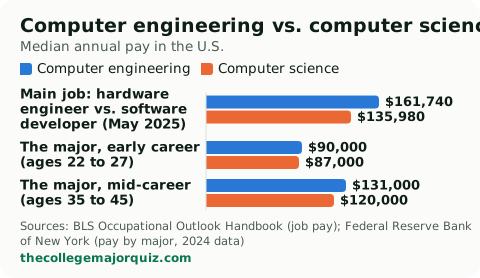
The job comparison has a catch: there are far more software developer jobs than computer hardware engineer jobs, so most graduates of either major who want a high-paying computing job will compete in the software market. In my opinion, that makes pay by major the fairer comparison, because it counts each major's graduates whatever job they hold.
Is computer engineering harder than computer science?
By the accreditation minimums, computer engineering asks for more math and science: at least 30 credit hours of math and basic sciences, plus math through differential and integral calculus under its own program criteria, compared with at least 15 credit hours of math and statistics for computer science. Computer engineering also adds circuits and electronics. Computer science isn't easy, though; it goes deeper into algorithms and complexity and computer science theory, with at least 40 credit hours of computer science.
The curriculum guidelines from ACM and the IEEE Computer Society (CC2020) draw the same line. They describe computer engineering as bringing together computing and electrical engineering, with "a heavy emphasis on mathematics required as a foundation," and say computer science "continues to have a more theoretical focus among the other computing disciplines, and its connection with abstract mathematics is still strong." Computer engineering's extra load is hardware and engineering; computer science's is abstract theory, along with programming and software development.
Job prospects: the downsides of each
What are the downsides of computer engineering? When I look at the data, the biggest one is the job hunt. Recent computer engineering graduates had a 7.8% unemployment rate, the highest of any engineering major the New York Fed reports, and computer science graduates were close behind at 7.0%. Both compare with 4.2% for all majors. For the CS major on its own, see computer science jobs and pay.
Once employed, both do well at landing jobs that need their degree: only 15.8% of recent computer engineering graduates and 19.1% of computer science graduates worked in jobs that don't need a degree, compared with 39.4% for all majors. The jobs themselves are growing: BLS projects 9% growth for computer hardware engineers and 10% for software developers, quality assurance analysts and testers from 2025 to 2035, both much faster than average.
Computer science or computer engineering: which should you choose?
It comes down to what you want to build. Here's how I'd split it, going by the data:
- Choose computer engineering if you're curious about how computers and devices work physically, you'd like to work on hardware or products with processors inside, and you want an engineering degree that still keeps software jobs open.
- Choose computer science if you mainly want to write software, you'd rather spend your electives on computing than on circuits and lab science, and you want to aim straight at the much larger software job market.
Can you switch later? On paper, the math and science you take for computer engineering more than covers computer science's minimum, so moving from computer engineering to computer science tends to be the easier direction. Moving the other way means picking up more math, science and electronics. Requirements vary by school, so check with an advisor before you switch.
Either way, plan on internships. With unemployment for recent graduates in both majors well above average, experience before graduation matters.
I think either major can be a good choice, and you'd likely be happy with either one. Computer engineering leans toward hardware, while computer science prepares you more directly for software roles. Many of the computer engineers I know ended up in software or plant controls, so choose based on preference: whether you want the hardware option, or a deeper focus on software and computing theory.
If you like both, the quiz might help. It scores computer engineering and computer science against your interests, confidence and goals.
More on computer engineering vs. CS
Is computer engineering the same as computer science?
No. Both teach programming, but computer engineering is an engineering degree that also covers hardware, circuits and electronics, while computer science focuses on software, algorithms and computing theory.
Which pays more, computer engineering or computer science?
Computer engineering, slightly. Computer engineering graduates earned a median of $90,000 early in their careers and $131,000 at mid-career, compared with $87,000 and $120,000 for computer science graduates, according to the New York Fed.
Can a computer engineer work as a software engineer?
Yes. BLS says software developers typically need a bachelor's degree in computer and information technology or a related field, such as engineering or mathematics, and computer engineering programs cover software as well as hardware.
If you're still comparing
Read what a computer engineer or an electrical engineer does, or look over the highest paying engineering jobs. The rest of the branches are in types of engineering degrees.
Sources
Course requirements are from ABET and the ACM/IEEE curriculum guide. Pay is from the BLS and the New York Fed, reviewed again on Oct 31, 2026. I'm not a computer engineer, so what I say about the work comes from the ones I work with.
- ABET. Criteria for Accrediting Engineering Programs, 2026-2027 (Criterion 5 and the Electrical, Computer and similarly named program criteria). abet.org
- ABET. Criteria for Accrediting Computing Programs, 2026-2027 (Computer Science and similarly named programs). abet.org
- U.S. Bureau of Labor Statistics. Occupational Outlook Handbook: Computer Hardware Engineers (May 2025 pay, 2025-35 projections; last modified August 27, 2026). bls.gov
- U.S. Bureau of Labor Statistics. Occupational Outlook Handbook: Software Developers, Quality Assurance Analysts, and Testers (last modified August 27, 2026). bls.gov
- Federal Reserve Bank of New York. The Labor Market for Recent College Graduates (outcomes by major, 2024 data). newyorkfed.org
- ACM and IEEE Computer Society. Computing Curricula 2020 (CC2020): Paradigms for Global Computing Education, section 2.3, Computer Engineering and Computer Science (December 31, 2020). acm.org