By Brennan, B.S. Engineering · Published · Updated · Pay data: May 2025, released August 2026
Electrical engineers design, develop and test electrical equipment and systems, such as electric motors, power generation equipment, communications systems and the electrical systems in cars and aircraft. Their work runs from power grids and plant controls to the electronics inside products. The Bureau of Labor Statistics (BLS) puts their median pay at $120,630 as of May 2025.
I work with electrical engineers in chemical manufacturing, where I'm a chemical engineer, and I have peers in the field at defense companies and engineering firms.
What is electrical engineering?
It's the engineering of electricity, electronics and electrical systems. It's also the most common engineering major: 21% of engineering graduates hold the degree. BLS lists these main duties:
- Design and develop electrical and electronic devices, products and systems
- Determine product or system requirements
- Use engineering or design software to create models, diagrams and layouts
- Inspect and test the reliability and safety of devices, products and systems
- Supervise the manufacturing or construction of products or systems
- Prepare documentation on system requirements and maintenance
- Evaluate systems and recommend design changes or equipment repairs
BLS groups electrical engineers with electronics engineers, who design the components and circuitry of electronic products, such as radar and sonar systems or audio-visual equipment.
Electrical engineer vs. electrician
People mix these up, but they're very different jobs. Electricians install, maintain and repair electrical power, communications, lighting and control systems. Most learn through an apprenticeship after high school, and most states require them to be licensed. Electrical engineers design those systems and need at least a bachelor's degree.
| Electrical engineer | Electrician | |
|---|---|---|
| Main work | Designs and tests electrical equipment and systems | Installs, maintains and repairs electrical systems |
| Typical education to start | Bachelor's degree | High school diploma, plus an apprenticeship |
| Median pay (2025) | $120,630 | $63,190 |
| Job growth, 2025-35 | 8% (with electronics engineers) | 9% |
Source: BLS Occupational Outlook Handbook.
What does an electrical engineer do on a daily basis?
In a chemical plant, where I work with them, a lot of the day goes to instrumentation. Electrical engineers spec out the instruments our process uses. They work on capital projects that have electrical parts, and they do a lot with the distributed control system (DCS), the computer system that runs the process. The job needs hands-on time on the plant floor, not just desk work.
New electrical engineers in chemical manufacturing often start on programmable logic controllers (PLCs) and the DCS. They learn from a senior engineer how to spec instruments and work on them.
At engineering firms, the day looks different. My peers there have hybrid roles, with some days in the engineering office and some at home, because the work allows it. Some electrical engineers work on power systems for buildings.
BLS says electrical engineers generally work in an office, though they may travel to project sites to look at a problem or a complex piece of equipment. Most work full time.
Types of electrical engineers
BLS splits the field into two job titles: electrical engineers and electronics engineers. The work itself falls into a few main areas:
- Power engineering: generating and delivering electricity, from power plants and electrical grids to the power systems in buildings. Electric power companies employ 10% of electrical engineers.
- Electronics: designing the components and circuitry inside electronic products. Semiconductor makers are among the largest employers of electronics engineers.
- Controls and instrumentation: the instruments, control systems and automation that run manufacturing processes. In the plants I know, these engineers go by titles like controls engineer, instrumentation and electrical (I&E) engineer, automation engineer or PLC engineer.
- Communications: communications systems are one of the main things BLS says electrical engineers design, and telecommunications companies employ 14% of electronics engineers.
- Vehicles, aircraft and defense: the electrical systems in cars and aircraft, plus radar and navigation systems. My peers in defense work on radar, electrical grids and aircraft electrical components. Much of it is under nondisclosure agreements, so they can only describe it in general terms.
Where do electrical engineers work?
Electrical engineers held about 199,700 jobs in 2025, and electronics engineers about 98,200. Their largest employers differ:
- Electrical engineers: engineering firms (22%), electric power companies (10%), computer and electronic product makers (10%), transportation equipment makers (7%) and construction companies (6%)
- Electronics engineers: the federal government (15%), telecommunications companies (14%), semiconductor makers (14%), research and development firms (9%) and engineering firms (8%)
Chemical manufacturing, where I work, isn't on either list.
How much do electrical engineers make?
The median electrical engineer salary was $120,630 in May 2025. The bottom 10% earned under $76,550, and the top 10% earned over $184,300. Electronics engineers had a median of $130,220, and BLS puts the two jobs together at $125,040. Among the industries BLS reports, the highest paying electrical engineering jobs are at transportation equipment makers and computer and electronic product makers:
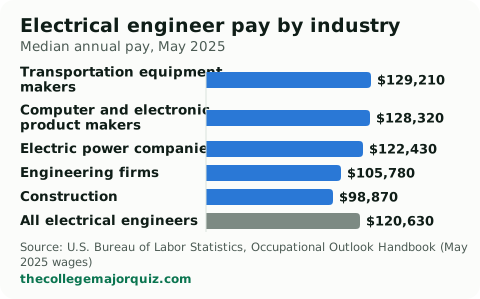
By major, electrical engineering graduates earned a median of $82,000 at ages 22 to 27 and $123,000 at ages 35 to 45, according to the New York Fed. My peers in the field say the pay is really good, and it's a big motivator for them.
The electrical engineers I know in chemical manufacturing started at around $80,000 to $88,000, close to what new chemical engineers start at. To see how electrical compares with other branches, check engineering pay by field.
Electrical vs. electronics engineering
They overlap a lot. In BLS terms, electrical engineers focus on electrical equipment and systems, like motors, power generation and the electrical systems in vehicles. Electronics engineers focus on the components and circuitry inside electronic products. Electronics engineers earned more in 2025 ($130,220 vs. $120,630), and they're more likely to work for the federal government, telecommunications companies and semiconductor makers.
Electrical engineering vs. computer engineering
The two fields are closely related. In BLS terms, computer hardware engineers design and test computers and related equipment, while electrical engineers work across power, motors, communications and other electrical systems. Computer hardware engineers earned more in 2025 ($161,740 vs. $120,630), and their jobs are projected to grow 9% from 2025 to 2035, compared with 8% for electrical and electronics engineers.
Computer engineering majors also out-earned electrical majors early on ($90,000 vs. $82,000) and at mid-career ($131,000 vs. $123,000). But recent computer engineering grads had higher unemployment (7.8% vs. 3.2%), per the New York Fed. One of my peers double majored in both. For more on the other side, see what a computer engineer does, and for how electrical stacks up against mechanical, see mechanical vs. electrical engineering.
Is electrical engineering hard?
Yes. Among my former classmates, electrical ranked as the second hardest engineering major, behind chemical. The course load is the biggest challenge: students take a lot of hard courses at the same time to fit the whole curriculum into four years. My peers named circuits, electromagnetism and radio systems as especially tough. The professor matters too, since a good one can make or break your grade in a hard course.
BLS lists digital systems design, calculus and electrical circuit theory among the courses in electrical engineering programs, along with lab and field work.
Is electrical engineering a good career?
Yes, and it's in demand. BLS expects 8% job growth for electrical and electronics engineers between 2025 and 2035, well above the 3% average for all jobs. Only 21.1% of recent electrical engineering grads are underemployed, meaning they hold jobs that don't require a degree. The figure for college graduates overall is 39.4%, according to the New York Fed.
Pros and cons of electrical engineering
Pros
- The work keeps changing. My peers like seeing legacy systems and components go out of date and getting to work on what replaces them.
- Pay is strong, and they call it a big motivator. The median was $120,630 in May 2025.
- You can go in many directions: power, electronics, controls, communications or defense.
- Hybrid schedules are common at the engineering firms where some of them work.
Cons
- Big workloads and very technical problems.
- Long hours at times, especially on big capital projects.
- Getting there takes a heavy course load, with lots of hard classes at the same time.
How to become an electrical engineer
- Earn a bachelor's degree in electrical engineering or a related engineering field. Programs mix classroom, lab and field work. Pick an ABET-accredited one if a Professional Engineer (PE) license might be in your future, since licensing boards generally look for an EAC/ABET-accredited degree.
- Do a co-op or internship. Both let you build experience while you study.
- Start as a junior engineer. No license is needed for entry-level jobs. Most new grads I know start as junior electrical engineers, especially at engineering firms.
- Keep your math and software sharp. BLS points to design software and programming languages, calculus, communication and problem-solving, along with the drive to keep learning.
- Keep up as the technology changes. Some employers prefer a master's degree, and experienced engineers may earn a PE license.
Not sure if electrical is your thing? See how it ranks for you on the free quiz.
Electrical engineering FAQ
Do electrical engineers work in an office?
Mostly. BLS says electrical engineers generally work in an office setting, though they may travel to project sites. In chemical plants, the job also takes hands-on time on the plant floor, and at engineering firms many have hybrid schedules.
How long does it take to become an electrical engineer?
A bachelor's degree takes about four years and is usually enough to start. A Professional Engineer license takes longer: most states also want about four years of work experience plus passing the FE and PE exams.
Do electrical engineers make good money?
Yes. Electrical engineers earned a median of $120,630 in May 2025, and the top 10% earned more than $184,300, according to the BLS. The median for all occupations was $50,980.
Can an electrician become an electrical engineer?
Yes, but it means going back to school. Electrical engineers typically need at least a bachelor's degree in electrical engineering or a related engineering field, while most electricians learn through an apprenticeship.
Other guides to try
Leaning toward computing? See computer engineering vs. computer science. Otherwise, read what a chemical engineer or an aerospace engineer does, or see all the branches in types of engineering degrees.
Sources
Pay, job and degree numbers are from the BLS and the New York Fed, checked against each original source. My electrical engineering peers filled in what the classes and first jobs are like.
- U.S. Bureau of Labor Statistics. Occupational Outlook Handbook: Electrical and Electronics Engineers (May 2025 pay, 2025-35 projections; last modified October 29, 2026). bls.gov
- U.S. Bureau of Labor Statistics. Occupational Outlook Handbook: Electricians. bls.gov
- U.S. Bureau of Labor Statistics. Field of Degree: Engineering (2024 Census Bureau data; last modified October 29, 2026). bls.gov
- U.S. Bureau of Labor Statistics. Occupational Outlook Handbook: Computer Hardware Engineers (May 2025 pay, 2025-35 projections). bls.gov
- Federal Reserve Bank of New York. The Labor Market for Recent College Graduates (outcomes by major, 2024 data). newyorkfed.org
- National Council of Examiners for Engineering and Surveying (NCEES). Licensure. ncees.org