By Brennan, B.S. Engineering · Published · Updated · Pay data: May 2025, released August 2026
Aerospace engineers design, develop and test aircraft, spacecraft, satellites and missiles. They also check that designs are safe and meet requirements, and they figure out what went wrong when a product fails.
Their median pay was $134,960 in May 2025, according to the Bureau of Labor Statistics (BLS). Many of my former classmates now work in the field, at companies like Boeing and Lockheed Martin and at other commercial aircraft and defense companies. My own field is chemical engineering, so the details on their work come from them.
What is aerospace engineering?
It's engineering for things that fly, inside Earth's atmosphere and beyond it. The products include commercial and military airplanes and helicopters, remotely piloted aircraft, launch vehicles and satellites, and military missiles and rockets.
On a project, aerospace engineers coordinate design, manufacturing and testing. They check whether a proposal is technically and financially feasible, whether it will be safe and meet its goals, and whether designs meet engineering principles, customer needs and environmental rules. They set criteria for design, quality, completion and support after delivery. When a product is damaged or malfunctions, they inspect it to find the cause, according to the BLS.
Engineers may focus on areas such as aerodynamics (how air flows around a vehicle), structural design, guidance, navigation and control, instrumentation and communication, robotics, and propulsion and combustion.
Aeronautical vs. aerospace engineering
Aeronautical engineering is one of the two branches of aerospace engineering. BLS counts both kinds as aerospace engineers:
- Aeronautical engineers work on aircraft that fly within Earth's atmosphere. They design aircraft and propulsion systems and study how aircraft perform and what they're made of.
- Astronautical engineers work on spacecraft and how they perform inside and outside the atmosphere, from small satellites called cubesats to traditional large satellites.
What does an aerospace engineer do on a daily basis?
It depends on the role. My aerospace peers spread across four kinds of work:
- Quality control: inspecting parts and assemblies.
- Testing: stress testing materials and components before a plane is assembled.
- Manufacturing: working on the floor during aircraft assembly, keeping production on track and running smoothly.
- Design: in more specialized roles, mechanical design for space applications, on parts that go into or beyond Earth's atmosphere.
BLS describes the typical setting as an office, often at a computer. Most aerospace engineers work full time, and some work more than 40 hours a week to monitor progress and troubleshoot problems as they come up.
Where do aerospace engineers work?
Aerospace engineers held about 68,700 jobs in 2025. Aerospace product and parts makers employed the most (38%), followed by engineering firms (16%), the federal government (15%), navigation, measuring and control instrument makers (8%) and research and development firms (8%), according to the BLS.
On the private side, aerospace engineering companies range from large commercial aircraft makers to defense contractors. On the government side, NASA says it hires 20 types of engineers and that aerospace engineering is one of its most common fields.
Security clearances
Defense work can require one. BLS says aerospace engineers who work on projects related to national defense may need a security clearance, and some types and levels of clearance require U.S. citizenship.
Many of my peers work on Department of Defense and other U.S. government projects. They work under nondisclosure agreements and need security clearances. As far as I know, the clearance hasn't caused any of them problems getting hired.
How much do aerospace engineers make?
The median aerospace engineer salary was $134,960 in May 2025. The lowest 10% earned under $86,700, and the top 10% earned over $205,890. Research and development paid the most ($149,260), then the federal government ($142,630), aerospace product and parts makers ($137,030), engineering firms ($132,440) and instrument makers ($126,740).
New grads start well below the median. New York Fed data puts aerospace engineering majors at a median of $85,000 at ages 22 to 27 and $130,000 at ages 35 to 45. My peers, spread across the Pacific Northwest, the Midwest and the Southeast, mostly started around $85,000 to $95,000. Junior engineers with 2 to 3 years of experience, especially in the Pacific Northwest and the Midwest, are closer to $95,000 to $120,000.
To see where aerospace lands against other branches, check engineering jobs ranked by pay.
Do you need an aerospace degree?
No. BLS says aerospace engineers typically need a bachelor's degree in aerospace engineering or a related field, and for many of my peers, mechanical engineering was the way in. At my school, aerospace was a concentration within the mechanical engineering program: 3 to 4 extra courses on top of the regular degree. Many of my former classmates took it, graduated with mechanical engineering degrees and now work for aerospace companies.
Requirements vary by school, so check your school's catalog to see what its aerospace degree or concentration includes.
Aerospace vs. mechanical engineering
Mechanical engineering is broader and covers mechanical and thermal devices, while aerospace focuses on aircraft and spacecraft. Aerospace pays more, both for the job and for the major:
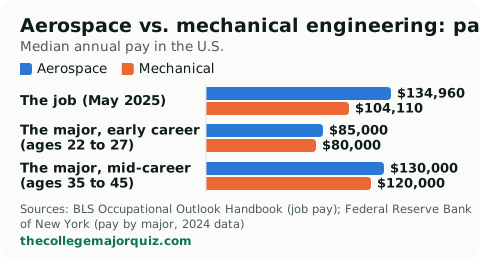
Mechanical is the much larger field, though, with faster projected growth: BLS expects 11% for mechanical engineers from 2025 to 2035, against 8% for aerospace engineers. For another matchup, see mechanical vs. electrical engineering.
Is aerospace engineering hard?
Expect a demanding major. Programs mix classroom, lab and field work in subjects like stability and control, structures and mechanics. On the job, aerospace engineers use calculus, trigonometry and other math to analyze, design and troubleshoot, per the BLS. My aerospace peers didn't think their classes were harder than other engineering majors. The schedule was the hard part: heavy credit hours every semester, which I saw across most engineering majors.
Is aerospace engineering a good career?
For people who like change, yes. BLS projects 8% job growth for aerospace engineers from 2025 to 2035, much faster than the 3% average. In New York Fed data, recent aerospace engineering grads had the lowest underemployment of any engineering major: only 14.7% held jobs that don't need a degree, well below the 39.4% rate across all majors. Their unemployment rate was 2.2%.
My aerospace peers like that it's an innovation field. It isn't a job where you make the same thing for 20 years. The technology keeps changing, and the goal is always a better product.
How to become an aerospace engineer
- Earn a bachelor's in aerospace engineering or a related field, such as mechanical engineering. Employers may prefer accredited programs, and an accredited degree is usually required for a Professional Engineer (PE) license later. Some colleges offer 5-year programs that lead to both a bachelor's and a master's.
- Do a co-op or internship. These let you build experience while you're in college. Among my peers, that experience helped going in.
- Plan for a clearance if you want to work on defense projects.
- Sharpen your math and analysis. BLS also lists business skills, including knowledge of the federal standards aerospace work has to meet, plus communication, interpersonal and problem-solving skills.
- Start at entry level. You don't need a license to start, though experienced engineers may earn a PE license.
Planes and rockets sound great, but does the work fit you? The free quiz compares aerospace and mechanical with 84 other majors.
Aerospace engineering questions
Does NASA hire aerospace engineers?
Yes. NASA says it hires 20 different types of engineers, and aerospace engineering is one of its most common fields. It posts its openings on USAJOBS.
Do aerospace engineers have to be U.S. citizens?
Not always. Citizenship mostly matters for defense work: BLS says some types and levels of security clearance require U.S. citizenship.
Are aerospace engineers in demand?
Demand is growing. BLS projects 8% job growth for aerospace engineers from 2025 to 2035, on a base of about 68,700 jobs in 2025.
Other engineering paths
For two very different kinds of engineering work, see what an electrical engineer does and what a chemical engineer does. All nine majors are in types of engineering degrees.
Sources
Pay is from the BLS for the job and the New York Fed for the major, each checked twice against the source. Anything personal here comes from my peers in the field.
- U.S. Bureau of Labor Statistics. Occupational Outlook Handbook: Aerospace Engineers (May 2025 pay, 2025-35 projections; last modified August 27, 2026). bls.gov
- U.S. Bureau of Labor Statistics. Occupational Outlook Handbook: Mechanical Engineers. bls.gov
- NASA. Careers in Engineering. nasa.gov
- Federal Reserve Bank of New York. The Labor Market for Recent College Graduates (outcomes by major, 2024 data). newyorkfed.org