By Brennan, B.S. Engineering · Published · Updated · Pay data: May 2025, released August 2026
Computer engineers design, build and test computer hardware, like processors, circuit boards and memory devices, and make sure it works with the software that runs on it. Many also work in software, because the degree covers both. Computer hardware engineer, the job closest to the major, paid a median of $161,740 in May 2025, per the Bureau of Labor Statistics (BLS).
Computer engineering isn't my field. I'm a chemical engineer who works with computer engineers who handle our plants' control systems, networks and IT, and I know others in software, hardware design and at NASA.
Computer hardware vs. software: what computer engineers really work on
BLS tracks computer engineers under one occupation, computer hardware engineers, and it's a small field: about 76,100 jobs in 2025. Software developers held about 1.7 million jobs the same year. They typically need a bachelor's degree in computer and information technology or a related field, such as engineering or mathematics.
So the degree opens two doors. Hardware work leans on the major's electrical engineering side, and software work leans on its programming side. Which way you go usually shows up in your electives, internships and first job, not in the name of the degree.
Most of the computer engineers I know went into software engineering roles. Others work on hardware, mostly design work at design firms. One works for NASA on the hardware computer systems behind a range of its space technologies. For a side-by-side look at the two majors, see computer engineering vs. computer science.
What is computer engineering?
It's the branch of engineering that combines electrical engineering with computing. Accredited computer engineering programs have to prepare students to analyze and design complex electrical and electronic devices, software, and systems containing hardware and software components, according to ABET, the engineering accreditation body. The ACM and IEEE Computer Society's curriculum guidelines (CC2020) put it another way: computer engineering is "the computing discipline that explicitly focuses on the development of hardware and software interface."
BLS describes computer hardware engineers as people who research, design, develop and test computers and related equipment. Their main duties:
- Design new computer hardware, creating schematics of computer equipment to be built
- Test the computer hardware after design or installation
- Analyze the test results and modify the design as needed
- Create detailed documentation for hardware design and testing procedures
- Update existing computer equipment so that it will work with new software
- Oversee the manufacturing process for computer hardware
Hardware and software have to work together, so hardware engineers often work with software developers. The hardware and software for mobile phones, for example, are frequently developed at the same time.
What does a computer engineer do on a daily basis?
BLS says some computer hardware engineers work in research labs, where they build and test different types of computer models, and others work in manufacturing. Most work full time.
At the chemical plants where I work, some computer engineers handle control systems, PLCs (the industrial computers that run plant equipment) and plant network systems. Others work in IT roles supporting the site. Their work is the software and networks that keep physical equipment running.
What jobs can a computer engineer do?
The degree points to a few BLS job titles:
- Computer hardware engineer: designs and tests processors, circuit boards, memory devices and other computer equipment, from schematics through prototypes. BLS also expects demand for hardware engineers to design parts for products that use processors, such as household appliances, medical devices and automobiles.
- Software developer: designs computer applications or programs. It's the larger job market, and computer engineering grads compete for it alongside computer science grads.
- Computer network architect: designs and builds data communication networks. It typically takes a bachelor's degree and 5 years or more of related experience, so it's usually a later-career job.
Where do computer engineers work?
The largest employers of computer hardware engineers, according to the BLS, are:
- Semiconductor and other electronic component makers: 24%
- Research and development firms: 18%
- Computer systems design and related services: 15%
- The information industry: 7%
- The federal government: 6%
How much do computer engineers make?
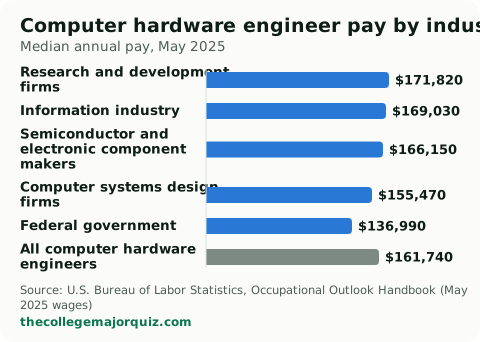
The median computer hardware engineer salary was $161,740 in May 2025. The bottom tenth earned under $92,940 and the top tenth over $225,330. Pay varied by industry, with research and development firms paying the most:
On the software side, software developers earned a median of $135,980 in May 2025.
For a sense of computer engineer starting salary, look at pay by major. Computer engineering grads ages 22 to 27 had a median of $90,000, and those 35 to 45 had $131,000, per the New York Fed. No other engineering major on that list has a higher early-career median. The computer engineers I know started at around $85,000 to $95,000, depending on location.
Is computer engineering hard?
Yes, it's a demanding major, with heavy math and two skill sets to learn at once. Accredited engineering programs require at least 30 semester credit hours of college-level math and basic sciences and at least 45 credit hours of engineering topics, according to ABET. Computer engineering programs must also include math through differential and integral calculus, probability and statistics, and discrete mathematics, the math behind computing. On top of that, you learn circuits and electronics from the electrical side and programming from the computing side.
The ACM and IEEE Computer Society's curriculum guidelines (CC2020) describe computer engineering as bringing together computing and electrical engineering, with "a heavy emphasis on mathematics required as a foundation." In practice, the workload looks more like an engineering degree than a typical computing degree.
Is computer engineering a good career?
By most measures, yes. BLS expects computer hardware engineering jobs to grow 9% between 2025 and 2035, much faster than average, with about 4,100 openings a year. Only 15.8% of recent computer engineering grads were in jobs that don't need a degree. Among recent grads from every major, the share was 39.4% (New York Fed).
The catch is the job hunt. Recent computer engineering graduates had a 7.8% unemployment rate, compared with 4.2% for all majors, and the hardware field itself is small. Plan on internships before you graduate. In a tight entry-level market, they matter.
In my opinion, computer engineering is a good choice if you like both how computers work physically and how to program them. The degree doesn't lock you into hardware, but it keeps the hardware door open in a way a pure software degree doesn't.
How to become a computer engineer
- Earn a bachelor's degree in computer engineering or a related field such as electrical engineering, which is what entry-level computer hardware engineers typically need, according to the BLS. Look for an ABET-accredited program.
- Learn to program. Hardware engineers commonly work with computer software systems, so it helps to be familiar with programming.
- Line up internships while you're still in school.
- Practice explaining your work. BLS lists communication right next to computer, critical-thinking and problem-solving skills for this job.
- Consider a master's degree. Some employers require or prefer a master's degree in computer engineering.
- Consider a PE license later. It isn't typical for computer engineers, but NCEES offers a Professional Engineer exam in computer engineering, designed for engineers with at least four years of post-college work experience. With experience, some computer hardware engineers advance to engineering manager roles.
Hardware, software or something else? Our free quiz can help you figure out where you lean.
Other computer engineering questions
Are computer engineers real engineers?
Yes. Computer engineering is an accredited engineering discipline, held to the same math, science and engineering coursework minimums as other engineering programs, and NCEES offers a Professional Engineer exam in computer engineering.
Is computer engineering a good paying job?
Yes. Computer hardware engineers earned a median of $161,740 in May 2025, according to the BLS, and computer engineering graduates earned a median of $90,000 early in their careers, according to the New York Fed.
Do computer engineers code?
Most do at least some. Accredited computer engineering programs cover software as well as hardware, and BLS says a familiarity with programming is helpful for hardware engineers because they commonly work with software systems.
Keep reading
If you're deciding between majors, read computer engineering vs. computer science. What an electrical engineer does is worth reading too. To compare pay across fields, see engineering jobs ranked by salary, and for all nine branches, types of engineering degrees.
Sources
Pay and job data are from the BLS and the New York Fed, and what the degree covers is from ABET and the ACM/IEEE guide, each checked twice against the original. The notes on plant control systems and networks come from working with computer engineers at my site.
- U.S. Bureau of Labor Statistics. Occupational Outlook Handbook: Computer Hardware Engineers (May 2025 pay, 2025-35 projections; last modified August 27, 2026). bls.gov
- U.S. Bureau of Labor Statistics. Occupational Outlook Handbook: Software Developers, Quality Assurance Analysts, and Testers. bls.gov
- U.S. Bureau of Labor Statistics. Occupational Outlook Handbook: Computer Network Architects. bls.gov
- ABET. Criteria for Accrediting Engineering Programs, 2026-2027 (Criterion 5 and the Electrical, Computer and similarly named program criteria). abet.org
- NCEES. PE Electrical and Computer: Computer Engineering exam. ncees.org
- Federal Reserve Bank of New York. The Labor Market for Recent College Graduates (outcomes by major, 2024 data). newyorkfed.org
- ACM and IEEE Computer Society. Computing Curricula 2020 (CC2020): Paradigms for Global Computing Education, section 2.3, Computer Engineering and Computer Science (December 31, 2020). acm.org