By Brennan, B.S. Engineering · Published · Updated
The best degrees for the future lead to jobs that pay well and are growing fast. By the newest federal projections, engineering and computer science lead to the most of those jobs, and math and statistics lead to the fastest-growing one, data scientist.
I'm a chemical engineer, and I use AI at work every day. So when people ask me which degrees are best for the future, I don't think the answer is "stay away from AI." The jobs I'd bet on are the ones growing because of it.
The Bureau of Labor Statistics (BLS) projects jobs from 2025 to 2035. I went through all 177 careers it says typically need a bachelor's degree. 24 of them pay a median of over $100,000 a year and are projected to grow at least 7%. BLS calls that "much faster than the average." Across all jobs, it projects 3.5% growth.
Four of those 24, like financial managers, also need 5 or more years of work experience first. I left them out, since you can't land them right out of college. That leaves 20.
What are the best degrees for the future?
Based on those 20 careers, these are the best majors for the future, by how many of the 20 they lead to:
- Computer science and IT: leads to at least 5 of the 20, including data scientist, software developer and information security analyst. Weighing the major? Read whether a computer science degree is worth it.
- Engineering: 7 of the 20 are engineering careers. BLS also names engineering as a related degree for software developers, management analysts and construction managers.
- Math and statistics: the main route to data scientist and actuary.
- Business and finance: leads to financial analyst, financial risk specialist and management analyst, and works for health services and construction managers too.
- Health administration: the main route to medical and health services manager, the second-fastest-growing career here.
Data scientists lead the list by a mile. BLS projects their jobs to grow 34.6% by 2035, nearly 10 times the rate for all jobs. BLS also lists business as a degree field for data scientists, so a business analytics major can be another route in.
Which jobs pay $100K+ and are growing fast?
Here are the top 10 by projected growth:
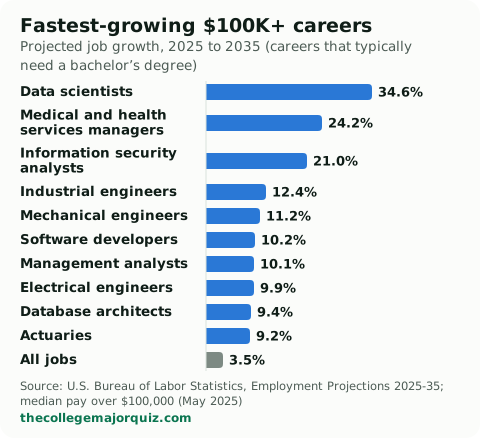
And here's the full list of 20, with the majors BLS names for each job:
| Career | Median pay | Growth, 2025-35 | Common majors |
|---|---|---|---|
| Data scientists | $120,230 | 34.6% | Math, statistics, computer science |
| Medical and health services managers | $123,860 | 24.2% | Health administration, nursing, business |
| Information security analysts | $129,180 | 21.0% | Computer and information technology, engineering, math |
| Industrial engineers | $102,440 | 12.4% | Industrial, mechanical or electrical engineering |
| Mechanical engineers | $104,110 | 11.2% | Mechanical engineering |
| Software developers | $135,980 | 10.2% | Computer and information technology, engineering, math |
| Management analysts | $101,860 | 10.1% | Business, social science, engineering |
| Electrical engineers | $120,630 | 9.9% | Electrical or electronics engineering |
| Database architects | $139,500 | 9.4% | Computer and information technology, engineering |
| Actuaries | $130,000 | 9.2% | Math, actuarial science, statistics, business |
| Computer hardware engineers | $161,740 | 9.1% | Computer engineering, electrical engineering |
| Construction managers | $114,990 | 9.1% | Construction, business, engineering |
| Aerospace engineers | $134,960 | 8.3% | Aerospace engineering |
| Materials scientists | $117,790 | 8.3% | Chemistry, materials science |
| Airline pilots | $232,140 | 8.3% | Any field, such as transportation, engineering or business |
| Computer systems analysts | $105,850 | 7.9% | Computer science, information systems, IT |
| Biomedical engineers | $109,370 | 7.6% | Biomedical engineering, bioengineering |
| Materials engineers | $112,860 | 7.5% | Materials science and engineering |
| Financial risk specialists | $117,330 | 7.4% | Finance, business |
| Financial and investment analysts | $102,740 | 7.2% | Finance, business |
Source: BLS Employment Projections, 2025-35, and Occupational Outlook Handbook. Median pay is for May 2025. Growth is BLS's exact figure to one decimal; BLS career pages round it to whole numbers. A few BLS pages combine two jobs (for example, software developers with testers), so their headline numbers differ from the ones here.
Two notes. Median pay means half of workers earn more and half earn less. New grads usually start below it. And airline pilots need a lot more than a degree. They also need an airline transport pilot (ATP) certificate, which has federal requirements for age, flight hours and exams.
Which degrees are in high demand?
Fast growth isn't the only way to measure demand. Some of these careers are big, so they open up a lot of jobs every year, even at a slower growth rate. Here are the most openings a year projected through 2035:
- Software developers: about 95,300 a year
- Management analysts: about 94,100
- Medical and health services managers: about 62,300
- Construction managers: about 49,700
- Computer systems analysts: about 32,900
Openings include new jobs plus spots left by people who retire or switch careers. On the other end, actuaries (about 1,500 a year), biomedical engineers (about 1,200) and materials scientists (about 600) are small fields. They pay well and are growing, but there are fewer seats.
How will AI change these jobs?
BLS says AI cuts both ways. In its newest projections, from August 2026, it says "Although the growing adoption of AI is expected to support demand for some occupations, associated productivity gains may dampen employment demand for others." It expects automation tools, "including those powered by AI," to reduce demand for several office and administrative support jobs. That group is projected to shrink 4% by 2035, faster than any other. Wondering which majors lead to the jobs AI touches least? See AI-proof majors.
For several careers on this list, BLS says AI is part of why they're growing:
- Information security analysts: "Increased use of artificial intelligence (AI) and the rise of e-commerce have increased the need for enhanced security."
- Data scientists: BLS says they "will be needed to help businesses leverage AI and other technologies."
- Database architects: as companies "adopt artificial intelligence (AI) to process their data," BLS says these architects "will be critical."
- Mechanical engineers: as factories add "more complex automation machinery," BLS expects mechanical engineers to be needed to fit it into existing systems.
In 2026, BLS also started rating how exposed each job is to AI, and 15 of these 20 careers rate "very high." BLS is clear that exposure "is not a forecast of employment growth or decline." To me, that says AI will change how these jobs are done. The people who know how to use it will do well.
Should you pick a major that's future-proof?
When I chose chemical engineering, I didn't think about being future-proof. I should have. Today, I think you should ask whether your career can hold up to recessions and to AI.
It also helps to pick a major that leaves doors open. In chemical engineering, we did a little coding. One of my peers went on to work as a data analyst at an investment bank. If you're good with data, a lot of these careers are within reach from more than one major.
Keep two things in mind. These are projections, not promises, and BLS updates them every year. And a fast-growing career won't help much if you hate the work. Pick something on this list that fits what you actually like doing. If you're not sure what that is, the college major quiz matches your interests to 86 majors.
Future degree questions
What is the best degree for the future?
By BLS projections, engineering and computer science lead to the most of the 20 fast-growing careers that pay over $100,000, with engineering alone leading to seven. Math and statistics are the main route to the fastest-growing one: data scientists are projected to grow 34.6% from 2025 to 2035, with a median pay of $120,230.
What degree is most in demand?
By openings, software developers lead the 20 careers here, with about 95,300 a year projected through 2035. Most enter with a degree in computer and information technology or a related field, such as engineering or math.
Is engineering a good degree for the future?
BLS projects industrial engineers to grow 12.4% and mechanical engineers 11.2% from 2025 to 2035, both much faster than average. Electrical, computer hardware, aerospace, biomedical and materials engineers also made the list of 20.
More on majors and careers
Want pay by major instead of by career? See the highest paying majors. Leaning toward business? Read the best business majors. Curious about engineering? Start with types of engineering degrees and what you can do with an engineering degree.
Sources
Pay, growth and openings are from BLS's 2025-35 projections tables, checked twice against each career's Handbook page. The 20 careers are every one in BLS's 2025-35 table that typically needs a bachelor's degree, pays a median over $100,000, is projected to grow 7% or more and doesn't require 5+ years of work experience. AI quotes are from each career's Handbook page and BLS's August 2026 projections release.
- U.S. Bureau of Labor Statistics. Table 1.2 Occupational projections, 2025-35 and Table 1.10 Occupational separations and openings, projected 2025-35. Employment Projections, August 2026. bls.gov
- U.S. Bureau of Labor Statistics. Employment Projections: 2025-2035 Summary (USDL-26-1422). August 27, 2026. bls.gov
- U.S. Bureau of Labor Statistics. Occupational Outlook Handbook, career pages and glossary ("Growth rate"), last modified August-October 2026. bls.gov
- U.S. Bureau of Labor Statistics. Artificial Intelligence (AI) exposure categories. August 2026. bls.gov