By Brennan, B.S. Engineering · Published
Yes, for the right student. Business analytics grads earn well above average, both early on and at mid-career. The analyst jobs it points to are all projected to grow much faster than average. The trade-off is a higher unemployment rate than the average major.
I'm a chemical engineer, not a business major, but data runs my job. In my engineering work, the tool I leaned on most was Excel: a lot of data analysis, charting and graphing. Now I use AI to help turn that data into reports. That mix of data, business sense and tools is basically what this major teaches.
What is business analytics?
It's using data to answer business questions. Which product should we stock more of? Where are we losing money? What will sales look like next quarter?
The U.S. Department of Education's official list of college programs files business analytics under data analytics, not under business. It defines it as "A program that prepares individuals to apply data science to solve business challenges." Classes cover things like machine learning, optimization, probability, logistics, consumer behavior, marketing and "visual analytics," which means charts and dashboards.
So expect more math, statistics and coding than a typical business major, plus the business classes that tell you which questions are worth asking.
Is a business analytics degree worth it?
The New York Fed tracks pay and jobs for 73 majors. This chart compares business analytics with other majors that work with data:
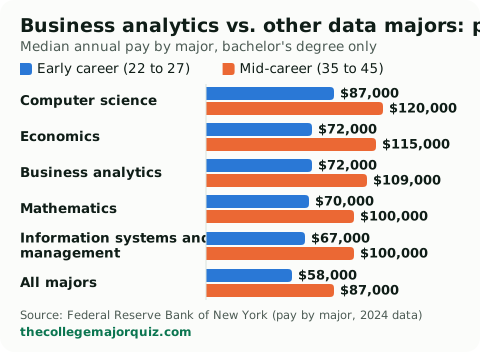
Out of all 73 majors, business analytics ranks tied for 12th in early-career pay at $72,000, and 11th at mid-career at $109,000. That's well above the $58,000 and $87,000 for all majors.
Two more numbers matter:
- Unemployment: 5.0% for recent business analytics grads, above the 4.2% for all majors. Computer science was even higher, at 7.0%.
- Underemployment: about 29% worked in jobs that don't need a degree, compared with 39.4% for all majors. That's lower than 50 of the 73 majors.
Most business analytics grads also don't go on to grad school. About 27% of them hold a grad degree, below the 39% for all majors. So the bachelor's is doing most of the work.
If you want to see how it stacks up against finance, accounting and other business majors, I compared all seven in the best business majors.
What jobs can you get with a business analytics degree?
The Bureau of Labor Statistics (BLS) doesn't list business analytics as a degree for any job by name. But it names business as a degree field for all of these:
| Job | Median pay | Growth, 2025-35 | Openings a year |
|---|---|---|---|
| Data scientists | $120,230 | 34.6% | 24,800 |
| Computer systems analysts | $105,850 | 7.9% | 32,900 |
| Financial and investment analysts | $102,740 | 7.2% | 24,700 |
| Management analysts | $101,860 | 10.1% | 94,100 |
| Operations research analysts | $88,940 | 11.9% | 7,500 |
| Logisticians | $82,320 | 17.6% | 26,600 |
| Market research analysts | $78,760 | 7.0% | 82,000 |
Source: BLS Occupational Outlook Handbook and 2025-35 projections. Median pay is for May 2025. BLS calls all seven "much faster than the average," which means 7% or more. Across all jobs, it projects 3.5%.
A few notes on fit:
- Operations research analysts may be the closest match. BLS expects more demand for them "in the field of analytics to improve business planning and decision making."
- Data scientists pay the most. BLS names math, statistics and computer science first, though business is on its list too. Expect serious coding.
- Management analysts have the most openings, but BLS lists some work experience as part of the usual path in.
- Logisticians are growing fastest of the bunch, and logistics is one of the subjects in the official definition of the major.
Median pay means half earn more and half earn less. New grads usually start below it.
What skills do business analytics majors need?
BLS says data scientists "must learn data-oriented programming languages as well as statistical, database, and other software." It says operations research analysts rely on "statistical and database software."
The U.S. Department of Labor's O*NET database gets more specific. For business intelligence analysts, it flags SQL, Python, R, Excel, Tableau and Power BI as in-demand technology.
That matches what I see. The people I know who do data analytics use SQL, Python and similar business software.
Business analytics vs. data science, MIS and statistics
These get mixed up a lot. Going by the official program definitions:
- Data science leans harder on computer science: data storage, data management, data mining and programming. Business analytics adds business subjects like strategy, marketing and logistics.
- Management information systems (MIS) is about building and running the data systems a company uses: networks, data storage and security. Business analytics is about using the data to make decisions. In New York Fed data, MIS grads earned less early on ($67,000) and had higher unemployment (6.0%).
- Statistics is the general math underneath it all: probability, regression and sampling. It's more theory and less business. BLS says statisticians typically need a master's degree.
Will AI replace business analytics jobs?
BLS rates all seven jobs in the table "very high" for AI exposure. That sounds scary, but BLS is clear that exposure "is not a forecast of employment growth or decline." Every one of those seven jobs is still projected to grow much faster than average.
For some of them, BLS says AI is part of the reason. Data scientists "will be needed to help businesses leverage AI and other technologies." And as companies expand their tech, "including artificial intelligence (AI)," BLS says computer systems analysts will be hired to design and install new systems.
That matches my own experience. Where AI helps most is the analysis itself, especially with large data sets. It can write summaries for you and take a lot of busy work off your plate. AI agents I built now write the first draft of my reports.
But I still choose what data goes in, and I review and fix what comes out. So the skill worth building is knowing which question to ask and whether the answer makes sense.
For more on how AI lines up with different majors, see AI-proof majors.
Who should major in business analytics?
It's a good fit if you:
- Like solving puzzles with numbers and want them tied to real business decisions.
- Are OK with statistics and some coding, not just spreadsheets.
- Want strong pay with a bachelor's alone.
It may not be if you'd rather work with people than data all day, or if you want the lowest-risk job hunt. Finance and accounting grads had lower unemployment in the same data.
Not sure data work is for you? The college major quiz matches your interests to 86 majors, including several business and data majors.
Business analytics major FAQ
Is business analytics a hard major?
It has more math than most business majors. The official program definition includes machine learning, optimization methods, computer algorithms and probability models, on top of business classes like marketing and logistics.
Do most business analytics majors go to grad school?
No. In New York Fed data, about 27% of business analytics grads hold a grad degree, compared with 39% for all majors.
Do business analytics majors make good money?
Yes. New York Fed data shows a median of $72,000 for recent grads and $109,000 at mid-career, compared with $58,000 and $87,000 for all majors.
Other business guides
Comparing business majors? Start with the best business majors. Weighing a money-focused path? See accounting vs. finance. Wondering about the workload? Read is business a hard major.
Sources
Pay, unemployment and underemployment by major are from the New York Fed's 2024 data (released February 2026), and the ranks among 73 majors are my own count from that file. Job pay, growth and AI ratings are from BLS's 2025-35 projections. Each number was checked against the original source.
- Federal Reserve Bank of New York. The Labor Market for Recent College Graduates, outcomes by major (2024 data). February 4, 2026. newyorkfed.org
- National Center for Education Statistics. Classification of Instructional Programs (CIP) 2020: 30.7102 Business Analytics, 30.7001 Data Science, 52.1201 Management Information Systems, 27.0501 Statistics. nces.ed.gov
- U.S. Bureau of Labor Statistics. Occupational Outlook Handbook, job pages, last modified August-October 2026, and AI exposure categories and 2025-35 employment projections. bls.gov
- U.S. Department of Labor. O*NET OnLine, Business Intelligence Analysts (15-2051.01), technology skills. 2026. onetonline.org