By Brennan, B.S. Engineering · Published · Updated
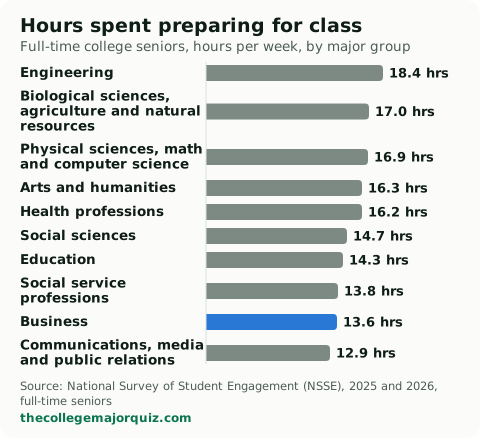
By study time, business isn't one of the hardest majors, but a business degree still takes real work. In a national survey of more than 200,000 college seniors in 2025 and 2026, full-time business majors spent about 13.6 hours a week preparing for class, the second lowest of the 10 major groups. They also reported about 16 hours a week of paid work, among the most of any group. When I look at the data, that's the real challenge for a lot of business majors: fitting classes around a job.
I'm a chemical engineer, not a business major, but I work with a lot of people who studied business. Some of the supply chain and sales people I work with studied business, and so did several of the accountants I know. This guide pairs national data with what I've seen from them.
How much do business majors study?
Less than most majors. In the National Survey of Student Engagement (NSSE) for 2025 and 2026, full-time business seniors averaged 13.6 hours a week preparing for class, compared with 15.5 for all full-time seniors. Across the 10 major groups, the averages ran from 12.9 to 18.4 hours.
Business seniors also reported about 16 hours a week of paid work, 3.6 on campus plus 12.8 off campus. Only social service majors reported more, and education majors were about even with business. All full-time seniors averaged about 14 hours. So I think the hard part often isn't one class. It's keeping up while you work.
Fewer study hours doesn't mean every class is easy, though.
One of my peers who studied business told me accounting was pretty tough for them. It's a math-heavy class, and it covers a lot of different math concepts.
Is a business major a lot of math?
Some. Plan on a college math course and at least one statistics or analytics class. Here's what three business schools require:
- University of Illinois (Gies College of Business): one math course from a list that includes calculus, pre-calculus and statistics, plus two business analytics courses.
- Penn State (Smeal College of Business): a calculus course and a statistics course, each with a C or better, to get into the finance major.
- Indiana University (Kelley School of Business): a business math course and a statistics course, each with a C or higher, for students starting in summer 2026 or later.
On top of that, accounting and finance classes are full of number work. If math isn't your favorite, plan to give statistics and accounting extra time.
What classes do business majors take?
Business schools like Penn State and Illinois start students with a shared core, so you get a taste of each area before you go deep in one. At Penn State, students take economics, accounting, management, marketing and finance courses before they can enter the finance major. Illinois' business core includes accounting, corporate finance and two business analytics courses.
After the core, the classes depend on your major. That's where the workload starts to differ.
What are the hardest business majors?
No national data ranks business majors by difficulty, so be wary of any list that claims to. What you can measure is the required coursework and the path after graduation. In my opinion, accounting has the clearest extra steps.
Accounting majors take a long run of upper-level accounting. At Penn State, the major requires two semesters of intermediate financial accounting, plus auditing and taxation. At the University of Texas at Austin, it requires two semesters of intermediate accounting plus auditing or taxation. Finance majors go deeper into markets and investing instead: Penn State's finance major requires courses in security analysis and portfolio management and in financial markets and institutions.
To become a certified public accountant (CPA), the traditional route takes 150 semester credit hours, 30 more than a typical 120-hour bachelor's degree, plus a year of experience and passing the CPA Exam, according to NASBA, the national association of state boards of accountancy. Some states now also offer a route that takes a bachelor's degree in accounting plus two years of experience and passing the CPA Exam instead, so check with your state board. For pass rates by section, see how hard the CPA Exam is.
What is the easiest business major?
No data ranks business majors from easiest to hardest. A more useful question is how each one pays off. In New York Fed data on recent graduates, 52.6% of business management majors worked in jobs that don't typically need a degree, compared with 21.2% for accounting.
For pay and job numbers on every business major, see the best business majors.
Do students switch out of business?
Not often. Business starters are among the most likely to finish in the field they started in. The American Academy of Arts and Sciences used National Student Clearinghouse data to follow students who started college in fall 2017. Of the business and management starters who earned a degree, 82.8% earned it in business, the highest share of any field in the study. In the natural sciences, it was just 64%.
Staying in college is a separate question. Among bachelor's students who started in fall 2024, 86.49% of business starters were still enrolled, or had earned a credential, by their second fall, according to the National Student Clearinghouse. That's a little below the 88.60% for all bachelor's starters.
An older federal study measured switching another way. Among students who started college in 2011-12, 31% of those who first declared business had changed majors within three years, close to the 29% for non-STEM fields overall.
That matches what I saw with my own peers. I don't know any who switched out of business. Most of them stayed, especially the ones who really wanted to do it.
How do you do well as a business major?
From what I've seen, the business grads who do well got varied work experience in college. Many did internships in more than one area, like accounting, finance, supply chain or marketing.
- Take the math and statistics prerequisites seriously. At Indiana, and for Penn State's finance major, they need a C or better to count.
- Plan your work hours. Business seniors averaged about 16 hours a week of paid work, so build your class schedule around it.
- Try more than one area. That's what the business grads I know who did well had in common.
So does it matter if business is easier than some other majors? In my opinion, not really. The payoff matters more. In 2024 data, workers with a business degree earned a median of $80,000, compared with $73,000 for college graduates in all fields, according to the BLS. How well it pays off depends a lot on the business major, so see whether a business degree is worth it before you pick one.
If you're still unsure business is for you, the free quiz includes accounting, finance, marketing and management, plus 82 majors outside that list.
More on how hard business is
Do business majors work while in college?
Many do. Full-time business seniors in NSSE's 2025 and 2026 surveys reported about 16 hours a week of paid work, 3.6 on campus plus 12.8 off campus. Only social service majors reported more.
How many credit hours do you need to become a CPA?
Traditionally 150 semester hours, 30 more than a typical 120-hour bachelor's degree, plus a year of experience and passing the CPA Exam. Some states now also allow a bachelor's in accounting plus two years of experience and the exam instead, so check with your state board.
Is a business degree hard to get?
It depends on the school, and some set grade bars you have to clear. At Indiana University, business students starting in summer 2026 or later need a C or higher in business math and statistics, and Penn State requires a C or better in calculus and statistics to enter the finance major.
Is business easier than other majors?
By study time, somewhat. Full-time business seniors averaged 13.6 hours a week preparing for class in NSSE's 2025 and 2026 surveys, near the low end of a range that ran from 12.9 to 18.4 hours across major groups.
More on business
See best business majors for pay and job numbers, or what you can do with a business degree for where each one can take you. There's also how to choose a college major if business is only one of your options. To see how business compares with every other field, read the hardest majors in college.
Sources
Study and work hours are from NSSE's 2025 and 2026 surveys, the numbers on who stays in business are from the American Academy of Arts and Sciences (2025) and the National Student Clearinghouse (2026), pay is from the BLS, and major rules are from each school's catalog. Each figure was checked against the original source, and the 16 hours of paid work is my own sum of NSSE's on-campus and off-campus averages.
- National Survey of Student Engagement. NSSE Summary Tables: Core Survey, Time Spent (Q16-17), 2025 and 2026 (full-time seniors by major category). nsse.indiana.edu
- Humanities Indicators, American Academy of Arts and Sciences. From Matriculation to Completion: How Do Humanities Majors Compare? (National Student Clearinghouse data, fall 2017 starters). 2025. amacad.org
- National Student Clearinghouse Research Center. Persistence and Retention: Fall 2024 Beginning Postsecondary Student Cohort (Data Appendix, persistence by major field). June 2026. nscresearchcenter.org
- Leu, K. Beginning College Students Who Change Their Majors Within 3 Years of Enrollment (NCES 2018-434). National Center for Education Statistics, 2017. nces.ed.gov
- University of Illinois Urbana-Champaign. Business Undeclared, Academic Catalog 2026-2027 (Business Core Math). illinois.edu
- Penn State. Accounting, B.S., 2026-2027 Undergraduate Bulletin. psu.edu
- University of Texas at Austin. Accounting (BBA), Undergraduate Catalog 2026-27. utexas.edu
- Penn State. Finance, B.S., 2026-2027 Undergraduate Bulletin (entrance-to-major requirements and prescribed courses). psu.edu
- Indiana University Kelley School of Business. I-Core Prerequisites and Required AI Courses, Undergraduate Bulletin. iu.edu
- National Association of State Boards of Accountancy (NASBA). New CPA Licensure Pathways and CPA Mobility (December 23, 2025). nasba.org
- Federal Reserve Bank of New York. The Labor Market for Recent College Graduates (outcomes by major, released February 4, 2026, 2024 data). newyorkfed.org
- U.S. Bureau of Labor Statistics. Field of Degree: Business (2024 Census Bureau data; last modified October 29, 2026). bls.gov