By Brennan, B.S. Engineering · Published · Updated
There's no single best pre-med major. The AAMC, the group behind the MCAT and the med school application, says "there's no required or even preferred majors that medical schools are looking for." Most applicants still pick biology. But in the newest AAMC data, math, physical science and humanities majors had higher average MCAT scores, and a bigger share of their applicants started med school.
The best pre-med majors, by the numbers
The AAMC sorts med school applicants into seven major groups. Ranked by how many students started med school per 100 applicants in each group, for fall 2025:
- Math and statistics: 57.3 started per 100 applicants, 515.8 average MCAT, 3.81 GPA, 335 applicants. The best numbers of any group, from the smallest group by far.
- Humanities: 52.0 per 100, 513.0 MCAT, 3.80 GPA, 1,453 applicants. A non-science group near the top. You still need the science prerequisites.
- Physical sciences: 51.3 per 100, 513.8 MCAT, 3.80 GPA, 4,243 applicants. The second-highest MCAT average of the seven groups.
- Social sciences: 42.3 per 100, 512.2 MCAT, 3.78 GPA, 4,758 applicants. About even with the 42.9 for all applicants.
- Biological sciences: 42.1 per 100, 511.9 MCAT, 3.81 GPA, 32,038 applicants. By far the most common pick, with 58.6% of all applicants.
- Other: 40.7 per 100, 511.7 MCAT, 3.82 GPA, 9,288 applicants. The second-biggest group, though the AAMC table doesn't say which majors it holds.
- Specialized health sciences: 40.3 per 100, 511.1 MCAT, 3.82 GPA, 2,584 applicants. The lowest ratio and MCAT of the seven, with a GPA as high as any group.
Ranked by students who started med school divided by applicants in each AAMC major group (my math from AAMC FACTS Table A-17, 2025-2026). MCAT and GPA are averages for the students who started. The ratio is not an official acceptance rate.
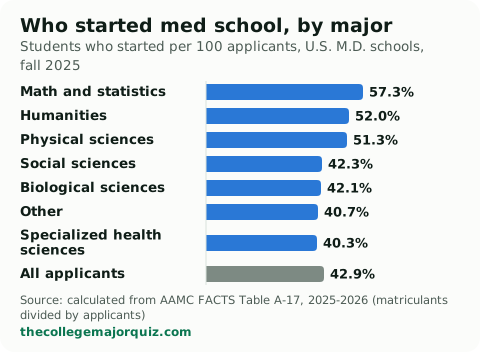
That doesn't mean switching to math will get you in. Only 335 math and statistics majors applied, and they're likely strong test takers to start with. It also isn't your chance of getting in: it counts students who actually started, for one year, and about 12,900 of that year's applicants had applied before. Still, med schools clearly take plenty of students from outside biology.
GPAs were nearly the same everywhere. Students who started med school averaged between 3.78 and 3.82 in every major group.
Does your major matter for medical school?
Not as a requirement. The AAMC's advice is to "make sure you fulfill the prerequisite coursework for the schools you want to apply to." BLS says the same thing about M.D. and D.O. programs: "No specific undergraduate degree is required," though most applicants studied subjects like biology, physical science or healthcare.
An assistant dean for admissions at the University of Illinois College of Medicine, writing for the AAMC, put it plainly: "most medical schools don't actually have a preference on what you studied."
Your major can still matter in other ways. It affects your GPA, how ready you are for the MCAT and how easily you can fit the required science classes.
What do most pre-med students major in?
Biology, by a wide margin. Of the 54,699 people who applied to U.S. M.D. schools for fall 2025, 32,038 (58.6%) majored in the biological sciences. Biology majors also made up 57.5% of the 23,440 students who started med school that fall.
The rest came from a mix of fields. AAMC's groups, by number of applicants:
| Major group | Applicants | Started med school |
|---|---|---|
| Biological sciences | 32,038 | 13,480 |
| Other | 9,288 | 3,783 |
| Social sciences | 4,758 | 2,014 |
| Physical sciences | 4,243 | 2,175 |
| Specialized health sciences | 2,584 | 1,041 |
| Humanities | 1,453 | 755 |
| Math and statistics | 335 | 192 |
Source: AAMC FACTS Table A-17, 2025-2026 (U.S. M.D.-granting schools; students applying to start in fall 2025).
What classes do you need for med school?
Each school sets its own list, but the same core shows up again and again. The AAMC says most students will take one year of biology, one year of English and two years of chemistry, through organic chemistry. Three schools' lists:
- Johns Hopkins: biology with lab, chemistry with lab, biochemistry, physics with lab, calculus and statistics.
- Ohio State: biology, general chemistry with lab, a two-semester organic chemistry series with lab, biochemistry and physics with lab. Courses like anatomy, psychology, sociology and the humanities are recommended.
- Harvard: a year of biology with lab, two years of chemistry including inorganic, organic and biochemistry, a year of physics and a year of writing.
The MCAT pulls from the same classes. It has four sections, and AAMC says they test intro biology, general and organic chemistry, first-semester biochemistry, intro physics, and intro psychology and sociology. The fourth section, Critical Analysis and Reasoning Skills, needs no extra coursework.
So any major works, as long as you fit these classes in. A biology or biochemistry major covers most of them anyway. If you major in something like English or engineering, plan your schedule early.
What if you don't get into med school?
Plan for it, because most applicants don't get in. In the 2025-2026 cycle, 24,300 of the 54,699 applicants (about 44%) were accepted to at least one U.S. M.D. school.
That's why your major's backup value matters. Here's how common pre-med majors do on the job market:
| Major | Pay, ages 22 to 27 | Pay, ages 35 to 45 | Recent grads in jobs that don't need a degree |
|---|---|---|---|
| Chemical engineering | $85,000 | $135,000 | 17.9% |
| Nursing | $70,000 | $87,000 | 12.8% |
| Physics | $67,000 | $105,000 | 29.1% |
| Biochemistry | $52,000 | $100,000 | 42.0% |
| Chemistry | $50,000 | $86,000 | 42.8% |
| Health services | $50,000 | $67,000 | 45.1% |
| Biology | $45,000 | $83,000 | 51.1% |
| Psychology | $45,000 | $72,000 | 48.3% |
| All majors | $58,000 | $87,000 | 39.4% |
Source: Federal Reserve Bank of New York (outcomes by major, 2024 data). Pay is the median for full-time workers with only a bachelor's degree.
Biology is the weak spot here. Recent biology grads were more likely than average to work in jobs that don't need a degree (51.1% vs. 39.4%), and they started lower ($45,000 vs. $58,000). Many go on to more school: 64.0% of working-age biology majors hold a graduate degree.
Biochemistry, nursing and physics hold up better, and so does engineering. Chemical engineering already includes general and organic chemistry, physics and calculus, so some of the pre-med list is built in, though you'd still need to plan for biology and biochemistry. If you're torn between chemistry and engineering, see chemical engineering vs. chemistry.
How to pick your pre-med major
In high school I was choosing between becoming a doctor, a chemist or an engineer. What turned me away from medicine was the time it takes: four years of college, four years of medical school, then 3 to 9 years of residency, depending on the specialty. Some of my college peers went anyway. They majored in biology, chemistry, biochemistry and engineering.
My advice is to do both: pick something you enjoy and something with a good career at the end. You'll get better grades in a subject you like, and the students who started med school in 2025 averaged a 3.81 GPA. The AAMC agrees: "Consider majoring in whatever interests you; this will keep you engaged and motivated during undergrad."
Then check that the major still leaves you a good job if med school doesn't work out, or if you decide, like I did, that 11 or more years of training isn't for you.
Pre-med but not sure what to major in? The free quiz matches your interests to 86 majors, so you can find one you'd enjoy.
Pre-med major questions
Is biology the best major for pre-med?
It's the most common, not the one with the best numbers. In 2025-2026, 57.5% of new M.D. students majored in the biological sciences, but math, physical science and humanities majors had higher average MCAT scores.
Can you go to med school with a non-science major?
Yes. AAMC says you don't have to be a science major, but you still need each school's prerequisite science courses, and the MCAT covers biology, chemistry, physics, psychology and sociology.
How long does it take to become a doctor?
Usually about 11 to 17 years after high school. BLS says doctors need a bachelor's degree, 4 years of medical school and 3 to 9 years of internship and residency.
How much do doctors make?
BLS lists a median of $275,930 for physicians and surgeons in May 2025, with 4% job growth projected from 2025 to 2035.
More on choosing a major
Weighing the sciences? Read chemical engineering vs. chemistry, compare pay in the highest paying majors, or start with how to choose a college major.
Sources
Applicant counts, MCAT scores and GPAs come from the AAMC's 2025-2026 tables (the per-applicant ratios and the 44% are my math), course lists from the AAMC's requirements report and each school's own page, and backup pay from the New York Fed. Each number was checked against the original.
- AAMC. FACTS Table A-17: MCAT and GPAs for Applicants and Matriculants to U.S. MD-Granting Medical Schools by Primary Undergraduate Major, 2025-2026. aamc.org
- AAMC. FACTS Table A-7.2: Applicants, First-Time Applicants, Acceptees, and Matriculants to U.S. MD-Granting Medical Schools by Gender, 2016-2017 through 2025-2026. aamc.org
- AAMC. How to Choose the Best Premed Major. aamc.org
- AAMC. Applying to Medical School as a Nonscience Major (Leila Amiri, University of Illinois College of Medicine). aamc.org
- AAMC. Admission Requirements. aamc.org
- AAMC. MSAR Report for Applicants and Advisors: Premed Course Requirements, 2027 cycle (Johns Hopkins and Ohio State entries). aamc.org
- Harvard Medical School. Prerequisite Courses. harvard.edu
- AAMC. What's on the MCAT Exam? and section overviews. aamc.org
- U.S. Bureau of Labor Statistics. Physicians and Surgeons, Occupational Outlook Handbook (last modified August 27, 2026). bls.gov
- Federal Reserve Bank of New York. The Labor Market for Recent College Graduates (outcomes by major, released February 4, 2026, 2024 data). newyorkfed.org