By Brennan, B.S. Engineering · Published · Updated
Chemistry is about understanding substances and finding new ones, mostly in a lab. Chemical engineering takes chemistry that already works and makes it run at full production scale. Rensselaer Polytechnic Institute's chemistry department says "the basic differences are novelty and scale."
A chemistry degree was on my list in high school. I liked chemistry and math, and I ended up in chemical engineering mostly because people who worked in chemical plants told me engineers earned more. Now I work at a plant with lab chemists, so I see both sides every week.
What's the difference between chemistry and chemical engineering?
RPI describes chemists as people who "work in a laboratory with small amounts of material," using instruments like spectrophotometers and chromatographs. Chemical engineers "scale up methods of synthesis, design systems for heating, cooling and transporting large amounts of material," and look for ways to make industrial processes cheaper and more efficient. They also pass along an old line: "a chemist wears a lab coat; a chemical engineer wears a hard hat."
That's close to what I see. The lab chemists at my plant test samples and check quality. When I worked in production, I took their results and used them to keep the process on track.
Chemistry vs. chemical engineering classes
You start with a lot of the same chemistry. At UW-Madison, chemical engineering students take general chemistry, analytical chemistry and two semesters of organic chemistry with a lab. After that, most of their classes are engineering. Chemistry majors keep going deeper into chemistry.
| Chemical engineering B.S. | Chemistry B.S. | |
|---|---|---|
| Upper-level core | Two thermodynamics courses, transport phenomena, momentum and heat transfer, mass transfer, kinetics and reactor design | Inorganic chemistry, physical chemistry I and II |
| Labs | A transport phenomena lab and an operations and process lab | Two physical chemistry labs, plus 3 more credits of lab work |
| Also required | Statistics for chemical engineers, process design, process dynamics and control | Advanced chemistry electives |
| Total credits | 132 | At least 120 |
Source: UW-Madison Guide, 2026-2027.
Other schools split the same way. In Wayne State's side-by-side table, chemical engineering juniors take transport phenomena, separations and reactor design while students in its chemistry B.S. (materials option) take physical chemistry, biochemistry and a research course. Wayne's chemical engineering degree doesn't require a foreign language or a minor. That chemistry option requires both.
Accreditation works differently too. ABET's rules for chemical engineering programs require "college-level chemistry and physics courses, with some at an advanced level," and using them to design and control processes, "including the hazards associated with these processes." Chemistry programs aren't ABET engineering programs. UW-Madison says its chemistry majors already meet most of the requirements for American Chemical Society certification, which adds things like at least 375 total lab hours.
Which major has more math?
Chemical engineering. ABET requires accredited programs to apply "differential equations and statistics to engineering problems," and RPI says a chemical engineer's main focus is heat and mass flow, thermodynamics "and the mathematics necessary for calculations in these areas."
I felt that. One semester I had differential equations and linear algebra in the same term as organic chemistry 2 and analytical chemistry. If you like chemistry but math wears you out, take that seriously before you pick.
Is chemical engineering harder than chemistry?
No study I trust ranks one against the other, so I won't pretend one does. At UW-Madison, chemical engineering takes more credits, and it has more math and a big design course at the end. Chemistry goes deeper into lab work, and a lot of chemistry careers lead to grad school.
Engineering students do report the most study time. In the 2025 and 2026 National Survey of Student Engagement, full-time engineering seniors spent 18.4 hours a week preparing for class, the most of any major group. Seniors in physical sciences, math and computer science, where chemistry falls, spent 16.9. For more, see is engineering hard?
Jobs and pay after each degree
The pay gap is big. In New York Fed data, chemical engineering majors earned a median of $85,000 at ages 22 to 27 and $135,000 at ages 35 to 45, the highest mid-career pay of all 73 majors in the table. Chemistry majors earned $50,000 and $86,000. My chemical engineer guide charts the pay for both majors and both jobs.
What happens right after graduation differs just as much:
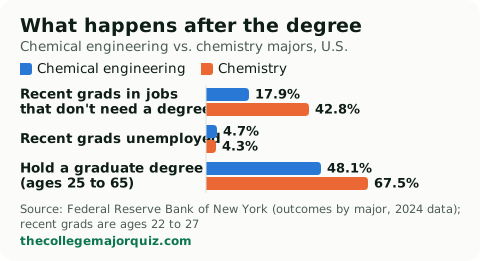
Among recent graduates, 17.9% of chemical engineering majors worked in jobs that typically don't need a degree, one of the lowest rates of the 73 majors. For chemistry it was 42.8%, above the 39.4% for all majors. Unemployment was close: 4.7% vs. 4.3%.
Both jobs are growing. BLS projects 5% growth for chemical engineers and 6% for chemists from 2025 to 2035. There are a lot more chemists, though: about 84,900 jobs vs. 21,900 for chemical engineers. Chemical manufacturing is the biggest employer of both, with 33% of chemists and 28% of chemical engineers. Chemists also work in research and development firms (16%) and testing labs (11%).
Do chemistry majors need grad school?
Often, if you want research. BLS says chemists typically need at least a bachelor's degree but "may need a master's degree or Ph.D. for some jobs, such as research positions."
The numbers show it. In the New York Fed data, 67.5% of working-age chemistry majors hold a graduate degree, the second highest share of the 73 majors after biochemistry. That compares with 48.1% for chemical engineering majors and 39.3% for all majors.
Can a chemical engineer work as a chemist?
The doors are open both ways, at least on paper. BLS says chemists need a degree in chemistry "or a related field," and chemical engineers need a degree in chemical engineering "or a related field."
The engineering license is the clearest difference. NCEES says engineering licensing boards generally require professional engineer (PE) candidates to have a degree from an ABET-accredited program and to pass the FE and PE exams, and most states also require four years of work experience. A chemistry degree isn't one of those, though NCEES notes that many states have other paths. You don't need a PE license to start as a chemical engineer, but some engineers earn one later.
Should you major in chemistry or chemical engineering?
I'd point you toward chemistry if you love the lab and research, want to discover new chemistry and are OK with grad school. That's where most of the discovery work happens. Thinking about medical school instead? See the best pre-med majors.
Chemical engineering fits if you like chemistry but care more about making it work at scale, you're comfortable with a lot of math and you want stronger pay right out of school. That was me.
Not sure either one fits? The free quiz compares 86 majors against your interests.
Chemistry or chemical engineering: quick answers
Who makes more money, a chemist or a chemical engineer?
Chemical engineers. BLS lists a median of $125,040 for chemical engineers and $91,240 for chemists in May 2025.
Do chemical engineers take organic chemistry?
Usually, yes. UW-Madison's chemical engineering degree requires two semesters of organic chemistry and an organic lab, along with general and analytical chemistry.
Can a chemistry major become a chemical engineer?
Sometimes, since BLS says chemical engineers need a degree in chemical engineering or a related field. But a PE license generally requires a degree from an ABET-accredited engineering program, and a chemistry degree isn't one.
More on chemical engineering
See what the job is like in what does a chemical engineer do, compare fields in types of engineering degrees, check the workload in the hardest engineering major, or start with how to choose a college major.
Sources
Course lists are taken from each school's own page, and pay, jobs and degree shares are from BLS and the New York Fed's data file (the rankings are counted from that file). The part about lab chemists is from my plant.
- U.S. Bureau of Labor Statistics. Chemical Engineers, Occupational Outlook Handbook (last modified October 29, 2026). bls.gov
- U.S. Bureau of Labor Statistics. Chemists and Materials Scientists, Occupational Outlook Handbook (last modified August 27, 2026). bls.gov
- Federal Reserve Bank of New York. The Labor Market for Recent College Graduates (outcomes by major, released February 4, 2026, 2024 data). newyorkfed.org
- ABET. Criteria for Accrediting Engineering Programs, 2026-2027. abet.org
- NCEES. Licensure. ncees.org
- Rensselaer Polytechnic Institute, Department of Chemistry and Chemical Biology. Chemistry or Chemical Engineering? rpi.edu
- University of Wisconsin-Madison. Chemical Engineering, B.S., Guide 2026-2027. wisc.edu
- University of Wisconsin-Madison. Chemistry, B.S., Guide 2026-2027. wisc.edu
- Wayne State University, Department of Chemical Engineering and Materials Science. Chemical engineering or chemistry? wayne.edu
- National Survey of Student Engagement. NSSE Summary Tables: Core Survey, Time Spent (Q16-17), 2025 and 2026 (full-time seniors by major category). nsse.indiana.edu