By Brennan, B.S. Engineering · Published · Updated
Yes, engineering is one of the most demanding majors, but most students who start it stay with it. Full-time engineering seniors averaged 18.4 hours a week preparing for class in the 2025 and 2026 National Survey of Student Engagement (NSSE), more than any other major group. Yet engineering starters stay in college at a higher rate than starters in any other big major.
So how hard is an engineering degree? It takes more study time than any other major group, but people don't flee it. Among students who started college in fall 2017, 80.4% of engineering starters who finished a degree finished it in engineering.
I went through a chemical engineering program myself, and I work in specialty chemicals now. This guide pairs national data with what my classmates and I found hard, and what got us through.
Why is engineering so hard?
Mostly because of how much math and science you take. That load is the main reason the answer to "is engineering a hard major?" is yes. Every accredited engineering program must include at least 30 semester credit hours of college-level math and basic sciences and at least 45 credit hours of engineering topics, according to ABET, the organization that accredits engineering programs. At 15 credits a semester, those 75 credit hours alone fill five full semesters. ABET's criteria for most engineering majors, including civil, mechanical, chemical, biomedical and environmental engineering, include differential equations, and the criteria for electrical engineering call for advanced math such as differential equations, linear algebra, complex variables and discrete math.
Every program also ends with a major design project that has to meet engineering standards and multiple constraints and builds on what you learned in earlier courses, so what you learn early keeps coming back.
Which classes are hardest depends on the major. For me, in chemical engineering, it was the transport series: fluid dynamics, heat transfer and mass transfer. My electrical engineering peers named circuits, electromagnetism and radio systems.
For me, junior year was the hardest full year, though my single toughest semester came earlier, in the spring of my sophomore year. The workload was high and the coursework was hard at the same time, so I was stretched two ways: for time, and for understanding the material well enough to keep up.
How many hours do engineering students study?
More than any other major group. Full-time engineering seniors averaged 18.4 hours a week preparing for class in NSSE's 2025 and 2026 surveys, compared with 15.5 for all seniors. Communications, media and public relations majors spent the least, at 12.9 hours.
Put another way, an engineering student puts in roughly a part-time job's worth of studying every week, on top of time in class and labs.
How many students stay in engineering?
Most of them. Among bachelor's students who started college in fall 2024, 93.1% of engineering starters were still enrolled somewhere, or had earned a credential, by their second fall, according to the National Student Clearinghouse. That was the highest rate of the 10 most common starting majors. For all bachelor's starters, it was 88.6%.
The longer view looks good too. The American Academy of Arts and Sciences followed students who started college in fall 2017, using Clearinghouse data. Of the engineering starters who finished a degree, 80.4% finished it in engineering. In the natural sciences, only 64% did. And 26.85% of engineering starters had left college without a degree by 2024, a little below the 28.9% for all bachelor's degree seekers. One catch: that study counts computer science as engineering, and a move from one engineering major to another counts as staying.
My own program felt rougher than that. I'd guess my chemical engineering class lost about 4 in 10 of its starting freshmen by junior year. Most of them were gone within two years, and a lot of them switched to a major that shared classes with ours.
An older federal study measured switching a different way. Among students who started college in 2011-12, 32% of those who first declared engineering or engineering technology had changed majors within three years. That was close to business and social sciences (31% each) and well below math (52%):
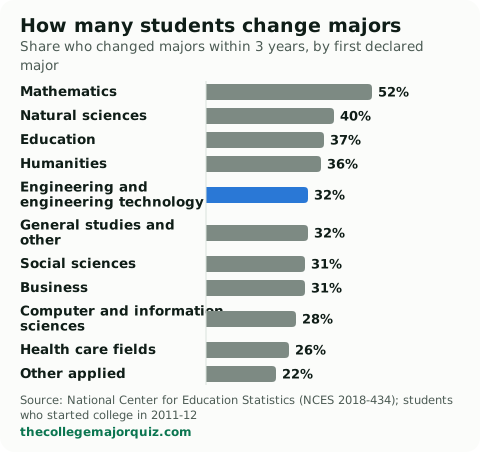
That study counts any change of major, not dropping out, and it mixes associate's and bachelor's students.
When I compare the data, engineering's reputation is scarier than its numbers. It takes the most study time of any major group, yet its starters are among the most likely to stay in college and finish in their field.
Is engineering hard for an average student?
Yes, but you don't have to be a genius, and the typical engineering senior isn't studying around the clock. In NSSE's 2025 and 2026 surveys, 15% of full-time engineering seniors spent more than 30 hours a week preparing for class. Another 22.11% spent 10 hours or less. Most fell somewhere in between.
Engineering seniors also weren't the group most likely to say their courses pushed them hard. Asked how much their courses challenged them to do their best work, on a scale of 1 to 7, 23% of engineering seniors picked 7, "very much." In health professions and in education, 33% did.
Paid work is the bigger difference. Most full-time engineering seniors (58.23%) didn't work off campus at all, and the group averaged 7.0 hours a week of off-campus work, against 10.6 for all seniors. The survey doesn't say why. Still, if you'll need a job in college, plan your hours before the semester starts.
How you start matters too. An older federal study, of students who began a bachelor's degree in 2003-04, linked lighter first-year STEM loads, less challenging first-year math and failed or withdrawn STEM courses to switching out. It also found that students with a 3.5 GPA or higher were more likely than those below 2.5 to leave STEM by switching majors. So leaving engineering isn't always a sign someone couldn't handle it.
If you're an average student weighing engineering, these habits help:
- Start strong in math. Take the most challenging math you're ready for in your first year, and get help early if calculus is a struggle.
- Keep your STEM grades up. Falling behind in those classes, even with good grades elsewhere, was a warning sign in that older study.
- Work the textbook examples. In my hardest classes, I leaned on the book. I worked through how each example set up the problem and solved it, and that helped me picture the concepts.
- Start two weeks out. The habit that helped me most was starting early. I began studying for each test two weeks ahead and broke the material down by chapter or concept, covering one at a time. About three days before the test, I switched to a full review of everything. Spreading it out made the workload manageable.
Does GPA matter? In my experience, employers don't treat GPA as a hard line, but they do look at it as a sign of capability and work ethic. It usually isn't the deciding factor, but a strong GPA tells them you can learn hard material and understand it.
Is it hard to become an engineer?
The path is long but clear. Most engineers start with a four-year bachelor's degree in engineering. A license isn't needed to start, but BLS says engineers such as mechanical engineers who sell their services to the public must be licensed as Professional Engineers (PEs). That generally takes an accredited engineering degree, passing the Fundamentals of Engineering (FE) exam, typically at least 4 years of work experience and passing the PE exam. Most first-time FE takers from accredited programs pass: 66% to 73% across the main disciplines, in results NCEES published in July 2026.
The job brings its own challenges. For me, that meant on-call weeks and a first year with a lot to learn. Take it one piece at a time.
In my opinion, the job is harder than the degree. Very little of what I learned in school carried over directly, so I had to learn how to do my job on the job.
Is engineering worth the difficulty?
For most students who like math and solving practical problems, yes. The BLS puts median pay for workers with an engineering degree at $105,000, against $73,000 for all fields. And 72% work in jobs that require at least a bachelor's degree, compared with 61% of all graduates. For where the degree leads, see what you can do with an engineering degree.
I think engineering is hard but manageable with a plan. The workload can peak in the middle of the degree, as it did for me in junior year, so build good habits early and start studying well before each test. Also remember that the degree is only the start. Much of what you'll do as an engineer, you'll learn on the job.
Think engineering might be for you? See where it lands on our quiz. All 9 engineering majors are in it.
Quick answers on engineering
Is engineering harder than other STEM majors?
By study time, a little. In NSSE's 2025 and 2026 surveys, full-time engineering seniors averaged 18.4 hours a week preparing for class, compared with 17.0 for biological sciences, agriculture and natural resources and 16.9 for physical sciences, math and computer science. About the same share in each of those groups, 22% to 24%, said their courses challenged them "very much."
What percentage of engineering students drop out?
About a quarter leave college without a degree. Among bachelor's students who started college in fall 2017, 26.85% of engineering starters had left without a degree by 2024, compared with 28.9% of all bachelor's degree seekers. That's National Student Clearinghouse data analyzed by the American Academy of Arts and Sciences, which counts computer science as engineering. In the first year, fewer leave: 93.1% of engineering starters in fall 2024 were still enrolled, or had earned a credential, by their second fall.
Do you need to be good at math to study engineering?
You need to be willing to work at it. Accredited engineering programs require at least 30 credit hours of college-level math and basic sciences, and most engineering majors go through differential equations, so a strong foundation in algebra and calculus makes the major much easier.
Read next
Want to know which majors are toughest? See the hardest engineering major page. You can also compare them in types of engineering degrees, read mechanical vs. electrical engineering, or check the highest paying engineering jobs.
Sources
Study time and survey answers are from NSSE's 2025 and 2026 surveys, and the numbers on who stays in engineering are from the National Student Clearinghouse (2026) and the American Academy of Arts and Sciences (2025). Each figure was checked against the original source, and what was hard and what helped is from my own degree.
- National Survey of Student Engagement. NSSE Summary Tables: Core Survey, Time Spent (Q16-17) and Course Engagement (Q9-10), 2025 and 2026 (full-time seniors by major category). nsse.indiana.edu
- National Student Clearinghouse Research Center. Persistence and Retention: Fall 2024 Beginning Postsecondary Student Cohort (Data Appendix, persistence by major field). June 2026. nscresearchcenter.org
- Humanities Indicators, American Academy of Arts and Sciences. From Matriculation to Completion: How Do Humanities Majors Compare? (National Student Clearinghouse data, fall 2017 starters). 2025. amacad.org
- Leu, K. Beginning College Students Who Change Their Majors Within 3 Years of Enrollment (NCES 2018-434). National Center for Education Statistics, 2017. nces.ed.gov
- Chen, X. STEM Attrition: College Students' Paths Into and Out of STEM Fields (NCES 2014-001). National Center for Education Statistics, 2013. nces.ed.gov
- ABET. Criteria for Accrediting Engineering Programs, 2026-2027. abet.org
- NCEES. FE Exam: Pass Rates (first-time takers from EAC/ABET-accredited programs within 12 months of graduation; updated July 2026). ncees.org
- U.S. Bureau of Labor Statistics. Occupational Outlook Handbook: Mechanical Engineers (licensure). bls.gov
- U.S. Bureau of Labor Statistics. Field of Degree: Engineering (2024 Census Bureau data; last modified October 29, 2026). bls.gov