By Brennan, B.S. Engineering · Published · Updated · Pay data: May 2025, released August 2026
Mechanical engineers design, build and test machines and other mechanical and thermal devices, from engines and air conditioners to robots and batteries. Many also keep existing equipment running: they find out why it fails and plan the fix.
It's one of the largest engineering fields, with about 298,500 jobs and a median pay of $104,110 in May 2025, according to the Bureau of Labor Statistics (BLS). I'm a chemical engineer in specialty chemicals manufacturing, and the mechanical engineers I work with most are in reliability, maintenance and project roles.
What is mechanical engineering?
It's the branch of engineering that deals with machines and with mechanical and thermal devices. BLS calls it one of the broadest engineering fields. Mechanical engineers design machines that make power, like electric generators and internal combustion engines, and machines that use power, like refrigeration and air-conditioning systems. They also design elevators and escalators, medical devices and new batteries.
The duties BLS lists fall into two halves. On the design side, mechanical engineers study a problem to see how a device could solve it, design or redesign that device with analysis and computer-aided design, build and test prototypes, and change the design based on the results. On the other side, they investigate equipment failures, figure out what's wrong, recommend fixes and oversee how the device gets made.
Which half takes up more of the week depends on where they work.
Areas of mechanical engineering
The field is broad, so it helps to think in areas of work rather than job titles. These are the main kinds of work you can do with a mechanical engineering degree.
- Design and product development. Designing, prototyping and testing machines and products, from engines to medical devices.
- Reliability and maintenance. Keeping plant equipment running. In the chemical plants where I work, mechanical engineers in this area focus on asset integrity: rotating equipment like agitators and pumps, reactors, mechanical integrity programs, inspections and preventive maintenance. Their titles include reliability engineer, maintenance engineer and mechanical engineer.
- Manufacturing. Overseeing how products get built, often at machinery makers and transportation equipment makers, two of the field's biggest employers.
- Aerospace and defense. Work on aircraft and defense systems. At my school, aerospace was a concentration within mechanical engineering, and many of my peers went to defense companies such as Northrop Grumman and Lockheed Martin. More on that side in what an aerospace engineer does.
- Robotics. BLS notes that robotic engineers plan, build and maintain robots.
What does a mechanical engineer do on a daily basis?
In the process plants I work in, a reliability or maintenance engineer's day splits across four kinds of work:
- Troubleshooting: walking down equipment the operations team is having trouble with, often rotating equipment like pumps and agitators, to find out what's wrong.
- Preventive maintenance: walking down and scoping preventive maintenance tasks so the maintenance team can plan around them.
- Repair planning: working with maintenance to plan equipment repairs.
- Capital projects: helping scope projects and build cost estimates.
The first three take most of their time. In many chemical plants, that work is also required by law. OSHA's Process Safety Management standard covers processes that handle highly hazardous chemicals at or above threshold quantities. For those, it requires a mechanical integrity program for equipment such as pressure vessels and storage tanks, piping, relief and vent systems, emergency shutdown systems, controls and pumps. The program needs written procedures, trained employees, inspections and tests that follow recognized and generally accepted good engineering practices, and fixes for equipment deficiencies. Running those programs is a core part of the job for the mechanical engineers I work with.
Design roles look different. BLS says mechanical engineers generally work in offices and visit worksites when a problem or piece of equipment needs attention, or to see their designs in person. As far as I understand, my peers at defense companies and engineering firms spend more of their day on design. Most mechanical engineers work full time, and some work more than 40 hours a week.
Where do mechanical engineers work?
Architecture and engineering firms are the biggest employer, with 20% of mechanical engineers. Next come machinery makers (14%), transportation equipment makers (10%), scientific research and development firms (7%) and computer and electronic product makers (6%), according to the BLS.
The mechanical engineers I know went into defense companies, engineering firms and the chemical industry. Chemical plants like mine are just one setting, and most mechanical engineers work somewhere else.
How much do mechanical engineers make?
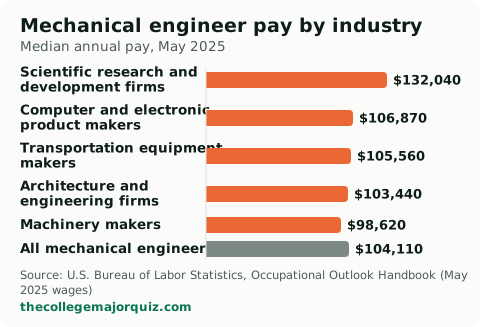
The median mechanical engineer salary was $104,110 in May 2025. The lowest 10% earned less than $73,990, and the top 10% earned more than $164,340. By industry, scientific research and development paid the most:
Pay right out of school is lower. New York Fed data on pay by major puts mechanical engineering grads at a median of $80,000 at ages 22 to 27 and $120,000 at ages 35 to 45. Most mechanical engineers I know started a little higher, at around $85,000 to $88,000.
To see how mechanical ranks against other branches, check which engineering jobs pay the most, or compare two fields head to head in mechanical vs. electrical engineering.
Is mechanical engineering a good career?
The numbers say yes. BLS projects 11% job growth for mechanical engineers from 2025 to 2035, against 3% for all occupations. And only 20.1% of recent mechanical engineering grads held jobs that don't need a degree, about half the rate across all majors (39.4%), the New York Fed reports.
In my opinion, it's a strong pick if you like to keep learning, but only if the work itself interests you. The mechanical engineers I work with say variety is what keeps them in it. Each day brings a different problem, so they stay engaged, and working on so many kinds of equipment builds a broad skill set.
Is mechanical engineering hard?
Yes. Programs cover math, the life and physical sciences, and engineering and design. The early math and physics courses are the same ones electrical engineering students take, and so are a few later ones, like circuits.
My classmates ranked it third hardest of the four majors they compared: behind chemical and electrical, ahead of civil. What my mechanical peers struggled with most was the load, not any one class. They took so many credit hours a semester that their time got stretched thin.
Mechanical engineering vs. mechanical engineering technology
The names are close, but the jobs aren't. BLS says mechanical engineering technology programs focus less on theory and more on practical application. Mechanical engineering technologists and technicians help mechanical engineers design, develop, test and manufacture machines. That job typically needs an associate's degree and paid a median of $74,510 in May 2025, about $30,000 less than mechanical engineers earned. If you might want a Professional Engineer (PE) license later, licensure usually requires a degree from an accredited engineering program.
How to become a mechanical engineer
- Earn a bachelor's in mechanical engineering. Most employers prefer graduates of accredited programs. Some colleges offer 5-year programs that end with both a bachelor's and a master's. At my school, biomedical was a concentration inside the mechanical program.
- Do an internship or co-op. Some programs push these to get students ready for industry work.
- Get comfortable with math and design problems. BLS points to creativity, listening, math, mechanical and problem-solving skills.
- Start in an entry-level job. You don't need a license yet.
- Consider a PE license. You need one to sell your services to the public in every state. It generally takes an accredited engineering degree, a passing score on the FE exam, typically at least 4 years of relevant work and a passing score on the PE exam. Some of my mechanical engineering peers earned both a master's and a PE license because it helped in their work.
- For reliability roles, look at the CMRP. The Certified Maintenance & Reliability Professional credential from the Society for Maintenance & Reliability Professionals (SMRP) covers business and management, equipment reliability, manufacturing process reliability, organization and leadership, and work management.
Mechanical is a broad field, so it can be hard to know if it's for you. The quiz is a quick way to get a read.
Mechanical engineering FAQ
Can you make $200,000 a year as a mechanical engineer?
Some do, but it's not common in the engineering job itself. The top 10% of mechanical engineers earned more than $164,340 in May 2025. Management is one way up: architectural and engineering managers had a median of $171,270, according to the BLS.
What does a reliability engineer do?
A reliability engineer keeps plant equipment running. In the chemical plants I work in, they look after pumps, agitators, reactors and other equipment, run mechanical integrity and preventive maintenance programs, plan repairs and help operations troubleshoot. Many of them are mechanical engineers.
Do mechanical engineers need a master's degree?
No. A bachelor's degree is the usual way in, and you can start in an entry-level job. Some of my mechanical engineering peers later earned a master's because it helped in their work, and some colleges offer 5-year programs that lead to both degrees.
Compare it with others
Two comparisons might help: mechanical vs. electrical engineering and civil vs. mechanical engineering. You can also read what an aerospace or biomedical engineer does. Types of engineering degrees has every branch.
Sources
Pay and job numbers are from the BLS, checked twice against each Handbook page. The reliability work is what I see at my job, backed by OSHA and SMRP.
- U.S. Bureau of Labor Statistics. Occupational Outlook Handbook: Mechanical Engineers (May 2025 pay, 2025-35 projections; last modified August 27, 2026). bls.gov
- U.S. Bureau of Labor Statistics. Occupational Outlook Handbook: Mechanical Engineering Technologists and Technicians. bls.gov
- U.S. Bureau of Labor Statistics. Occupational Outlook Handbook: Architectural and Engineering Managers. bls.gov
- Occupational Safety and Health Administration. 29 CFR 1910.119, Process Safety Management of Highly Hazardous Chemicals, paragraph (j), Mechanical integrity. osha.gov
- Society for Maintenance & Reliability Professionals. CMRP Certification. smrp.org
- Federal Reserve Bank of New York. The Labor Market for Recent College Graduates (outcomes by major, 2024 data). newyorkfed.org