By Brennan, B.S. Engineering · Published · Updated · Pay data: May 2025, released August 2026
Biomedical engineers design the medical devices, equipment and software that doctors and patients rely on, from hip and knee replacements to machines that diagnose disease. Some also keep hospital equipment running and train clinicians to use it.
It's a small field. The Bureau of Labor Statistics (BLS) counts bioengineers and biomedical engineers as one group, with about 23,800 jobs in 2025 and a median pay of $109,370 in May 2025.
At my school, biomedical engineering wasn't a separate major. It was a concentration inside mechanical engineering, a cluster of about three classes in topics such as biomechanics. I went the chemical engineering route instead.
What is biomedical engineering?
It's engineering applied to medicine and biology. Biomedical engineers combine engineering principles with the sciences to design and build equipment, devices, computer systems and software. The BLS lists these duties:
- Design equipment and devices, such as artificial internal organs, replacements for body parts and machines for diagnosing medical problems
- Install, maintain or provide technical support for biomedical equipment
- Work with manufacturing staff on the safety and effectiveness of biomedical equipment
- Train clinicians and others on the proper use of biomedical equipment
- Work with scientists to research how engineering principles apply to biological systems
- Develop statistical models or simulations using statistical or modeling software
- Prepare procedures and write technical reports and research papers
- Present research findings to scientists, clinicians, managers, other engineers and the public
- Design or conduct follow-up experiments as needed
Most of that happens in labs and clinical settings, on teams with scientists, health care workers or other engineers. Many biomedical engineers work in research and development or in quality assurance. Schedules are mostly full time, sometimes longer.
The products range from joint replacements and diagnostic machines to implants made from new materials and devices that help people recover from or adapt to physical or cognitive impairments.
Where do biomedical engineers work?
Research and development firms in the physical, engineering and life sciences hire the most, with 22% of the jobs. Next come medical equipment and supplies makers (10%), health care and social assistance (10%), colleges, universities and schools (9%) and makers of navigational, measuring, electromedical and control instruments (8%), according to the BLS.
Medical device companies
Regulation shapes a lot of device work. Since February 2, 2026, the FDA's Quality Management System Regulation (21 CFR Part 820) has covered makers of finished medical devices they plan to sell. It builds in ISO 13485:2016, the international quality standard for medical devices, and it requires formal design and development controls and risk management. So at a device maker, a new design comes with formal design and development requirements and risk management, not just the invention itself.
Hospitals
In a hospital, the specialty that fits is clinical engineering. Clinical engineers apply medical technology to improve health care, which includes installing and supporting biomedical equipment and training clinicians to use it. Hospitals also take co-op and intern students, along with medical device and pharmaceutical makers.
The 8 types of biomedical engineers
The BLS names eight specialties:
- Biochemical engineers focus on cell structures and microscopic systems to create products for bioremediation, biological waste treatment and other uses.
- Bioinstrumentation engineers use electronics, computer science and measurement principles to develop tools for diagnosing and treating medical problems.
- Biomaterials engineers study natural or lab-designed substances for use in medical devices or implants.
- Biomechanics engineers study thermodynamics and other systems to solve biological or medical problems.
- Clinical engineers apply medical technology to improve health care.
- Genetic engineers alter the genetic makeup of organisms, for example to develop vitamin-fortified food crops that help prevent disease.
- Rehabilitation engineers develop devices that help people recovering from or adapting to physical or cognitive impairments.
- Systems physiologists use engineering tools to understand how biological systems work and respond to changes in their environment.
How much do biomedical engineers make?
The median biomedical engineer salary was $109,370 in May 2025. The bottom 10% earned under $71,850, and the top 10% earned over $168,180. Your employer matters: of the industries BLS reports, instrument makers paid the most and schools paid the least.
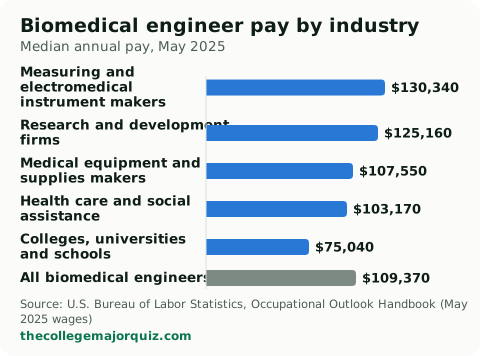
Starting pay is harder to pin down. The New York Fed breaks out early-career pay by college major, but it doesn't list biomedical engineering, and the BLS figures above cover every career stage.
Our ranking of engineering jobs by pay puts biomedical next to the other branches.
Is biomedical engineering good for pre-med?
It can be. The BLS notes that some biomedical engineers go on to medical or dental school. The major also covers biology, human physiology and chemistry alongside the engineering, according to ABET, the group that accredits engineering programs.
Just know it's a full engineering degree, with the math to match. If you change your mind about medicine, you still finish with a degree that leads to the device, research and hospital jobs above.
Is biomedical engineering hard?
Yes. It's a full engineering degree with biology and physiology on top. ABET requires accredited programs to give students experience with engineering, biology, human physiology, chemistry, calculus-based physics, math through differential equations and statistics. Students also solve problems where living and non-living systems interact, design devices and systems, and take measurements on living systems.
The math doesn't stop at graduation. BLS says biomedical engineers use calculus and other advanced math and statistics to analyze, design and troubleshoot. Typical courses include fluid and solid mechanics, circuit design and biomaterials.
Biomedical engineering vs. bioengineering
For most students, they're close to the same thing. The BLS counts bioengineers and biomedical engineers as one occupation, and ABET uses one set of standards for "bioengineering and biomedical and similarly named" programs. A name can hint at a different emphasis, so compare each program's course list, not its title.
Is biomedical engineering a good career?
Demand is growing. BLS projects 8% job growth over the 2025 to 2035 decade, much faster than the 3% average for all occupations, as demand rises for biomedical devices and procedures such as hip and knee replacements. That works out to about 1,200 openings a year.
Pros and cons of biomedical engineering
Pros
- Your designs end up in medicine, from hip and knee replacements to implants and diagnostic machines.
- Solid pay, with a median of $109,370 in May 2025.
- Plenty of settings: research labs, device makers, hospitals and universities.
- Room to change course. BLS notes that some go on to medical or dental school, and others become patent attorneys or move into management with an MBA.
Cons
- The field is small, with about 23,800 jobs in 2025. Employers usually accept related engineering degrees too, so you'll compete with other engineering majors for many roles.
- Some positions require a graduate degree, and leading a research team typically does.
- The coursework is a full engineering load with biology, physiology and chemistry on top.
- At device makers, new designs come with formal FDA design controls and risk management.
If you want the medical focus without betting everything on a small field, look for a mechanical engineering program with a biomedical concentration. You keep the broader degree and its larger job market.
How to become a biomedical engineer
- Pick an accredited program in biomedical engineering, bioengineering or a related engineering field. ABET accredits bioengineering and biomedical programs under their own standards.
- Line up a co-op or internship with a hospital, a medical device maker or a pharmaceutical manufacturer.
- Practice writing and presenting. The job includes technical reports and presenting findings to clinicians and managers, and BLS lists communication next to analytical, creative, math and problem-solving skills.
- Take a first job in research and development, quality, manufacturing or clinical engineering.
- Decide on grad school. Some positions require a graduate degree, and research team leads typically need one.
Curious whether biomedical is a fit? It's one of 9 engineering majors in our free quiz.
Biomedical engineering FAQ
Is it hard to find a biomedical engineering job?
It takes planning. The field is small, with about 23,800 jobs in 2025, and graduates of related engineering majors can apply for many of the same roles. BLS still projects about 1,200 openings a year, and co-ops or internships with hospitals and device makers help.
How long does it take to become a biomedical engineer?
Plan on four years for a bachelor's degree, the usual way in. Some jobs require a graduate degree, and leading a research team typically does, so research careers take longer.
What can you do with a biomedical engineering degree?
Graduates work in research and development, medical device and instrument manufacturing, hospitals and universities. The BLS notes that some earn law degrees and work as patent attorneys, and others earn an MBA and move into management.
Related fields
If the concentration route appeals to you, read what a mechanical engineer does. What a chemical engineer does is worth a look too, and every branch is side by side in types of engineering degrees.
Sources
Every pay, job and growth figure comes from the BLS Handbook and was checked twice against it. The concentration detail is from my own school.
- U.S. Bureau of Labor Statistics. Occupational Outlook Handbook: Bioengineers and Biomedical Engineers (May 2025 pay, 2025-35 projections; last modified August 27, 2026). bls.gov
- U.S. Bureau of Labor Statistics. Occupational Outlook Handbook: Architectural and Engineering Managers. bls.gov
- U.S. Food and Drug Administration. Quality Management System Regulation (QMSR), 21 CFR Part 820. fda.gov
- ABET. Criteria for Accrediting Engineering Programs, 2026-2027, program criteria for bioengineering and biomedical and similarly named engineering programs. abet.org
- Federal Reserve Bank of New York. The Labor Market for Recent College Graduates (outcomes by major, 2024 data). newyorkfed.org