By Brennan, B.S. Engineering · Published · Updated · Pay data: May 2025, released August 2026
Industrial engineers find better ways to run things. They study how workers, machines, materials, information and energy fit together in a factory, a delivery network or a hospital, then redesign the system so it wastes less time and money.
The median pay was $102,440 in May 2025, and the Bureau of Labor Statistics (BLS) expects jobs to grow 12% from 2025 to 2035, four times the 3% average for all jobs.
My school didn't offer industrial engineering. The industrial engineers I know came from other schools, and they went into manufacturing roles.
What is industrial engineering?
It's the engineering of efficiency: getting more done with less time, money, materials and effort. Industrial engineers weigh staffing, technology, safety and budget to find the best way to run a process. Most projects follow the same loop, based on the duties the BLS lists:
- Evaluate manufacturing, delivery, customer experience or other systems and identify ways to improve productivity and quality
- Collect data on processes and production by observing work, running time studies and surveying staff
- Analyze the data to find trends and areas for improvement
- Design processes, systems or improvements that get the most out of productivity, efficiency or space
- Work with other departments to put their recommendations in place
- Present their analysis and recommendations to management and other stakeholders
Plenty of that happens away from a desk. An industrial engineer might watch workers assemble parts on a factory floor one day and analyze the data in the office the next, the BLS says. Most work full time, and some put in more than 40 hours a week.
Industrial engineering outside factories
Manufacturing still hires the most. Of about 365,100 industrial engineering jobs in 2025, the largest employers were transportation equipment makers (15%), professional, scientific and technical services firms (14%), computer and electronic product makers (11%), machinery makers (8%) and chemical manufacturers (6%).
But the skills aren't tied to a production line. The BLS gives three examples: moving heavy parts inside a plant, cutting hospital wait times and making vehicles safer. Some industrial engineers travel between settings, from their office to a hospital or a railyard.
Professional, scientific and technical services is the one non-manufacturing industry in that top five. Industrial engineers focus on cutting internal costs, so consulting and engineering services firms and research and development firms value them too. BLS also names health care and transportation among the places they work.
Lean, Six Sigma and continuous improvement
Improvement work doesn't always sit with someone titled industrial engineer. Some plants have operational excellence (OpEx) or continuous improvement managers. They run improvement projects with the engineers on site: raising throughput, cutting waste, improving scheduling, and Lean or Six Sigma-type work.
That's the ground industrial engineers are trained for. Continuous improvement engineer is even one of the job titles reported for the occupation in O*NET, the Department of Labor's career database.
Common industrial engineering job titles
The BLS describes three specialties:
- Manufacturing engineers design or improve manufacturing systems and processes.
- Human factors engineers work on products, facilities and systems to improve people's well-being and how well the system performs.
- Validation engineers make sure equipment and systems turn out products that meet safety and quality requirements.
O*NET adds many more titles, including quality engineer, process engineer, operations engineer, plant engineer, facilities engineer, project engineer and research and development engineer. The work is about systems rather than one kind of product, so the same degree can lead to very different jobs.
How much do industrial engineers make?
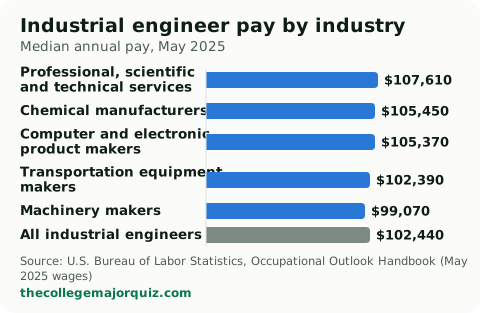
The median industrial engineer salary was $102,440 in May 2025. The bottom 10% earned under $74,370, and the top 10% earned over $159,860. Of the industries BLS reports, professional, scientific and technical services firms paid the most:
New graduates start lower. In New York Fed data, industrial engineering majors earned a median of $83,000 at ages 22 to 27 and $100,000 at ages 35 to 45. Across all majors, those figures were $58,000 and $87,000.
For how it stacks up against other branches, see which engineering jobs pay the most.
Industrial engineering vs. industrial engineering technology
The names are close, but the jobs are different. Industrial engineering technologists and technicians help engineers solve problems with manufacturing layout or production, often carrying out studies under an industrial engineer's direction. An associate's degree is the usual entry point, and their median pay was $66,120 in May 2025, against $102,440 for industrial engineers. If you might want a Professional Engineer (PE) license later, state licensure typically requires a bachelor's or higher degree in engineering.
Is industrial engineering hard?
It's an engineering degree, so expect plenty of math. BLS says industrial engineers use calculus, trigonometry and other math to analyze, design and troubleshoot.
Where the effort goes is what sets it apart. ABET, which accredits engineering programs, calls for industrial engineering programs to cover productivity analysis, operations research, probability, statistics, engineering economy and human factors. BLS adds coursework and labs in production systems planning and manufacturing systems design. Much of it centers on data and on how people, machines and processes fit together.
Is industrial engineering a good career?
Demand looks strong. Of all the engineering jobs in our pay guide, this one is growing fastest, with about 23,100 openings a year. Companies want lower costs, more automation and tighter supply chains and logistics.
One number to check first: 31.7% of recent industrial engineering graduates held jobs that don't need a degree, according to the New York Fed. The rate across every major was 39.4%, but aerospace, civil, computer, chemical, mechanical and electrical engineering all did better, from 14.7% to 21.1%. Internships and co-op programs, which many colleges offer, are the way to build experience early.
It suits students who'd rather fix how a whole operation runs than design one machine, and who like working with data and people about equally.
How to become an industrial engineer
- Load up on math and science in high school. BLS recommends algebra, trigonometry, calculus, computer science, chemistry and physics.
- Earn a bachelor's degree in industrial engineering or a related field such as mechanical, electrical, manufacturing or general engineering. Some schools offer 5-year programs that end with both a bachelor's and a master's.
- Do an internship or co-op while you're still in school.
- Take an entry-level job. No license is needed to start.
- Weigh a PE license later. It lets you oversee other engineers, sign off on projects and offer services directly to the public. To get there, you typically need an engineering degree, then the Fundamentals of Engineering (FE) exam, then several years of work before you sit for the PE exam. Some industrial engineers also earn an optional professional certification.
If making things run better sounds fun, try our free quiz and see where industrial engineering lands.
Industrial engineering questions
Is industrial engineering a real engineering degree?
Yes. ABET accredits industrial engineering programs under their own program criteria, and the BLS lists industrial engineers with the other engineering occupations. Industrial engineers can also earn a Professional Engineer license.
What can you do with an industrial engineering degree?
Besides working as an industrial engineer, graduates work as manufacturing, quality, process, continuous improvement and validation engineers. With experience, some move into plant management. BLS lists engineering as a common major for industrial production managers, who run manufacturing plants and earned a median of $126,060 in May 2025.
What skills do industrial engineers need?
The BLS lists communication, computer, creativity, critical-thinking, interpersonal, math and problem-solving skills. Communication gets its own note from the BLS: industrial engineers have to convey complex information to both technical and nontechnical audiences.
Majors close to industrial engineering
BLS names mechanical and electrical engineering as related degrees for this job, so what a mechanical engineer does and what an electrical engineer does are good next reads. What a chemical engineer does covers another plant job, and types of engineering degrees compares all nine.
Sources
Pay, growth and job titles are from the BLS and O*NET, checked twice against each source page. My school didn't offer this major, so my own input is limited to where the industrial engineers I know ended up and how plants staff improvement work.
- U.S. Bureau of Labor Statistics. Occupational Outlook Handbook: Industrial Engineers (May 2025 pay, 2025-35 projections; last modified October 29, 2026). bls.gov
- U.S. Bureau of Labor Statistics. Occupational Outlook Handbook: Industrial Engineering Technologists and Technicians. bls.gov
- U.S. Bureau of Labor Statistics. Occupational Outlook Handbook: Architectural and Engineering Managers. bls.gov
- U.S. Bureau of Labor Statistics. Occupational Outlook Handbook: Industrial Production Managers. bls.gov
- O*NET OnLine. Industrial Engineers (17-2112.00), sample of reported job titles. onetonline.org
- Federal Reserve Bank of New York. The Labor Market for Recent College Graduates (outcomes by major, 2024 data). newyorkfed.org
- ABET. Criteria for Accrediting Engineering Programs, 2025-2026, program criteria for industrial engineering. abet.org