By Brennan, B.S. Engineering · Published
Yes, computer science is a hard major, and the math and theory are a big reason why. ABET-accredited CS programs must include at least 15 credit hours of math and statistics, covering discrete math, probability and statistics. CS starters were also the least likely of the 10 most common bachelor's majors to still be in college a year later, in National Student Clearinghouse data. Engineering still asks for more study time, though.
I'm not a programmer. The only coding in my chemical engineering degree was Visual Basic for Applications (VBA), which one of my classes required. I haven't needed it at work, and with AI coding tools getting better, I doubt I will. Where I work, computer engineers handle control systems, PLCs and networks, and others handle IT. So this guide leans on curriculum standards, college catalogs and national data.
How hard is computer science?
Harder than average, but not the hardest by every measure. Three national measures:
- Study time: in the 2025 and 2026 National Survey of Student Engagement (NSSE), full-time seniors in the physical sciences, math and CS group spent 16.9 hours a week preparing for class, against 15.5 for all seniors. NSSE doesn't report CS alone.
- Staying in college: CS starters had the lowest second-fall rate of the 10 most common bachelor's majors (details in the dropout section below).
- Switching majors: in an older federal study of students who started college in 2011-12, 28% of those who first declared computer and information sciences changed majors within three years. Math (52%) and the natural sciences (40%) were much higher.
So CS takes more study time than average, and in the older data most CS starters didn't switch majors. The weak spot is how many aren't in college at all a year later. To see how every major group compares, read which majors are the hardest.
How much math is in computer science?
At least 15 credit hours of math and statistics at any ABET-accredited program, roughly five 3-credit courses. ABET wants discrete math, probability and statistics in that mix, at least as rigorous as intro calculus.
The newest curriculum guidelines go further. CS2023, from the ACM, the IEEE Computer Society and the Association for the Advancement of Artificial Intelligence (AAAI), sets the math every CS graduate should know: 29 class hours of discrete math, 11 of probability, 10 of statistics and 5 of linear algebra. Why so much statistics and linear algebra? Fast-growing areas like AI and data science run on them.
Two 2026-27 catalogs show what that looks like:
- UC San Diego: three calculus courses, linear algebra, two discrete math courses (CSE 20 and CSE 21) and one probability or statistics course.
- Georgia Tech: differential, integral and multivariable calculus, linear algebra, discrete math (CS 2050), applied combinatorics and a probability and statistics course. In the Systems and Architecture plus AI thread pair, that's 21 credit hours, about a sixth of the 126-hour degree.
Do you need to be good at math for computer science?
Not naturally, no, but you do need to put in the work. CS2023 says students should be persuaded "that anyone can learn mathematics, certainly the subset foundational to CS, and that success is not dependent on innate ability."
Coming in, you need solid high school math, mostly what a pre-calculus class covers: algebra, functions and graphs, exponents and logarithms, and basic trigonometry. The guidelines admit that many CS majors, perhaps aiming for software jobs, aren't keen on math, and that many students struggle with it. Their answer isn't a way around the math but remedial courses that get students ready. So if your algebra is shaky, fix it early, since every college math course after that builds on it.
What are the hardest computer science classes?
The ones built on proofs and theory, plus the systems courses at the end of long prerequisite chains. No national data ranks CS classes, but catalogs show which ones lean hardest on math and prerequisites:
- Discrete math (UC San Diego CSE 20, Georgia Tech CS 2050): logic, sets, functions and proof methods such as induction.
- Data structures (UC San Diego CSE 100, Georgia Tech CS 1332): UC San Diego's advanced course covers trees, graphs and hash tables, plus how fast they run, "both average case and amortized."
- Algorithms (UC San Diego CSE 101, Georgia Tech CS 3510): designing efficient algorithms, measuring their complexity and studying NP-complete problems.
- Theory of computation (UC San Diego CSE 105, Georgia Tech CS 4510): finite automata, Turing machines, the halting problem and undecidability. It's an elective at UC San Diego and required in Georgia Tech's Theory thread, but CS2023 lists these topics as core.
- Operating systems (UC San Diego CSE 120, Georgia Tech CS 3210 in the Systems thread): processes, synchronization, memory management and file systems. ABET requires accredited CS programs to give students exposure to operating systems.
These classes stack. At UC San Diego, discrete math leads to CSE 21, which leads to algorithms, and operating systems needs computer organization, advanced data structures and algorithms first. Grades count too: UC San Diego requires a C-minus or better in every major requirement, and Georgia Tech a C or better in all required CS courses.
What programming classes do CS majors take?
The coding has its own sequence, and it stacks the same way. Both sample course plans in CS2023 start with intro programming (often called CS1), then data structures (CS2), then algorithms. The catalogs follow that order:
- Intro programming: UC San Diego's CSE 11, Introduction to Programming and Computational Problem-Solving: Accelerated Pace, covers the basics plus Java, class design and recursion, and it's aimed at students with significant coding experience, such as AP Computer Science A. The two-course CSE 8A-B track covers the same ground, and CSE 8A assumes no prior programming. Georgia Tech starts with CS 1301 Introduction to Computing, then CS 1331 Introduction to Object Oriented Programming.
- Data structures: UC San Diego's CSE 12, Basic Data Structures and Object-Oriented Design, has you build linked lists, stacks, queues, binary trees and hash tables in Java. Georgia Tech's CS 1332 fills the same slot.
- Down to the hardware: UC San Diego's CSE 29, Systems Programming and Software Tools, moves to C with tools like gdb, valgrind and make, and CSE 30, Computer Organization, has you write assembly and design a basic processor. Georgia Tech's CS 2110, Computer Organization and Programming, covers machine language, assembly language and C.
- Large programs: Georgia Tech's CS 2340, Objects and Design, focuses on large programs, debugging and testing. UC San Diego's CSE 110, Software Engineering, stresses team development, version control and test tools.
For you, that means the tools change as you climb. At UC San Diego you go from Java in CSE 11 and 12 to C in CSE 29, assembly in CSE 30, then C++ with pointers and memory management in CSE 100. Each step is a prerequisite for a later one, and the department expects the lower-division courses, including CSE 12, 29 and 30, done by the end of sophomore year. One bad term in the intro sequence can push the rest back, so give these courses the same weight as the math.
Is computer science harder than engineering?
Not by study time or required math, but CS starters are less likely to stay in college:
- Study time: engineering seniors put in 18.4 hours a week of class prep, more than the physical sciences, math and CS group above. NSSE counts software engineering and computer engineering as engineering.
- Math and science: ABET requires accredited engineering programs to include at least 30 credit hours of college-level math and basic sciences, twice the CS math minimum. Engineering's 30 includes lab sciences, so it isn't a pure math comparison.
- Staying in college: engineering starters had the highest second-fall rate of the 10 most common majors, with 93.1% still enrolled or done. CS had the lowest.
So engineering usually asks for more hours and more math, while CS loses more of its starters in the first year. For the engineering side, see how hard engineering is. If you're choosing between the two computing majors, read how computer engineering and CS compare.
What is the computer science dropout rate?
About 15% of new CS students weren't in college a year later. National Student Clearinghouse data shows 85.0% of fall 2024 bachelor's starters in computer and information sciences were enrolled at some college, or had finished a credential, when their second fall came.
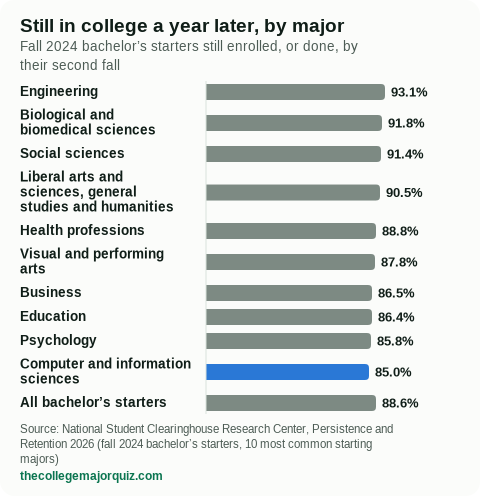
That's the lowest of the 10 most common starting majors. Only 77.1% of CS starters were still at the same college, so some of the rest had moved to another school.
The Clearinghouse groups students by the major they declared in their first fall, even if they switch later, and its CS group includes related computer and information programs. It doesn't say why students left, so the number shows how many leave, not whether the major was too hard for them.
How to get through a computer science degree
The catalogs and the CS2023 guidelines point to the same habits:
- Start calculus early. UC San Diego recommends enough high school math to take calculus in your first quarter.
- Work problems yourself. You learn this material by practicing it, not just by listening to lectures or watching demos.
- Expect to get stuck. Some peers will seem to solve hard problems without effort. As the guidelines put it, "eventual success through persistence is what matters."
Should you avoid computer science because it's hard?
Not for that reason alone. Whether it pays off is a separate question: in New York Fed data, CS grads' early-career pay ranks near the top of all majors, but recent grads also face above-average unemployment. See what CS grads earn and how the job market looks before you decide.
Still deciding? Take the college major quiz to see how computer science ranks against 85 other majors for your interests.
Computer science difficulty FAQ
Is computer science hard if you've never coded?
It can still work. UC San Diego, for one, calls high school programming helpful but not required. Start on a beginner track rather than the accelerated course, and put real effort into algebra and pre-calculus, which you can't skip.
How many computer science majors switch majors?
Fewer than in math or the natural sciences, in a federal study of students who started college in 2011-12. The bigger worry in newer data is CS starters who aren't in college at all a year later.
More on computing majors
Curious what the job looks like? Read what a computer engineer does. Weighing an easier path? See the easiest majors. Want a field with room to grow? Check the best degrees for the future.
Sources
Math and course requirements are from ABET's 2026-2027 criteria, the CS2023 curriculum guidelines and the 2026-27 UC San Diego and Georgia Tech catalogs. Study time is from NSSE's 2025 and 2026 surveys, staying-in-college rates from the National Student Clearinghouse (June 2026), switching rates from a 2017 NCES report on students who started college in 2011-12, and the note on pay and unemployment from the New York Fed's 2024 data. The 15%, the 21 credit hours and the rough course count are simple math from those sources. Each number was checked against the original source.
- ABET. Criteria for Accrediting Computing Programs, 2026-2027 (Computer Science and similarly named programs). abet.org
- ABET. Criteria for Accrediting Engineering Programs, 2026-2027 (Criterion 5, Curriculum). abet.org
- Joint Task Force on Computing Curricula (ACM, IEEE Computer Society and AAAI). Computer Science Curricula 2023, Mathematical and Statistical Foundations. January 2024. csed.acm.org
- UC San Diego. Computer Science and Engineering majors and courses, 2026-27 General Catalog. catalog.ucsd.edu
- Georgia Institute of Technology. Bachelor of Science in Computer Science (thread programs), 2026-2027 Catalog. catalog.gatech.edu
- Georgia Institute of Technology. Computer Science (CS) course descriptions, 2026-2027 Catalog. catalog.gatech.edu
- National Survey of Student Engagement. NSSE Summary Tables: Core Survey, Time Spent (Q16-17), 2025 and 2026 (full-time seniors by major category). nsse.indiana.edu
- National Survey of Student Engagement. Major Field Categories. nsse.indiana.edu
- National Student Clearinghouse Research Center. Persistence and Retention: Fall 2024 Beginning Postsecondary Student Cohort (Data Appendix, persistence and retention by major field). June 2026. nscresearchcenter.org
- Leu, K. Beginning College Students Who Change Their Majors Within 3 Years of Enrollment (NCES 2018-434). National Center for Education Statistics, 2017. nces.ed.gov
- Federal Reserve Bank of New York. The Labor Market for Recent College Graduates, outcomes by major (2024 data). February 4, 2026. newyorkfed.org