By Brennan, B.S. Engineering · Published · Updated
Yes. Economics is one of the best-paid majors outside engineering and computer science, and recent grads have lower unemployment than average. Just know that the job title "economist" usually takes a master's degree. Many grads use the degree in analyst, finance and business jobs instead.
I'm a chemical engineer, not an economist. But many of the project managers I work with studied economics, and so did a lot of the supply chain people.
Is an economics degree worth it?
The New York Fed tracks pay and job outcomes for 73 majors. Economics does well on all of them:
- Early-career pay: $72,000, tied for 12th of 73. All majors: $58,000.
- Mid-career pay: $115,000, tied for 8th. All majors: $87,000.
- Unemployment: 3.5%. All majors: 4.2%.
- Underemployment: 33.1%. All majors: 39.4%.
Underemployment means working a job that doesn't need a degree. So about one in three recent econ grads is in that spot, compared with about two in five across all majors.
Every major that out-earned economics was in engineering, computer science or construction services. That holds both early and mid-career.
Compared with the majors students often weigh it against:
| Major | Early-career pay | Mid-career pay | Unemployment |
|---|---|---|---|
| Economics | $72,000 | $115,000 | 3.5% |
| Finance | $70,000 | $112,000 | 2.8% |
| Mathematics | $70,000 | $100,000 | 5.8% |
| Accounting | $68,000 | $97,000 | 2.6% |
| Business management | $56,000 | $82,000 | 3.8% |
| Political science | $52,000 | $100,000 | 4.5% |
| All majors | $58,000 | $87,000 | 4.2% |
Source: Federal Reserve Bank of New York, 2024 data. Pay is the median for full-time workers with only a bachelor's degree. Early career is ages 22 to 27, mid-career is 35 to 45, and unemployment is for ages 22 to 27.
When I look at the data, economics pays the most of the group at both stages, but finance and accounting grads were less likely to be unemployed. Economics and finance are close on nearly every number in that table, so if you're choosing between them, let the classes you'd rather take decide it. Torn between finance and accounting instead? See accounting vs. finance.
Economics jobs and pay
The job called "economist" is small and usually needs grad school. The Bureau of Labor Statistics (BLS) says economists "typically need at least a master's degree to enter the occupation." Some government jobs hire people with a bachelor's degree and enough courses in economics, statistics or math. There are only about 1,100 openings a year.
The degree also fits many analyst and business jobs. These are some of them:
| Job | Median pay | Growth, 2025-35 | Openings a year |
|---|---|---|---|
| Management analysts | $101,860 | 10% | 94,100 |
| Market research analysts | $78,760 | 7% | 82,000 |
| Project management specialists | $102,320 | 7% | 76,500 |
| Financial analysts | $103,570 | 7% | 29,500 |
| Logisticians | $82,320 | 18% | 26,600 |
| Data scientists | $120,230 | 35% | 24,800 |
| Personal financial advisors | $105,070 | 1% | 17,100 |
| Operations research analysts | $88,940 | 12% | 7,500 |
| Budget analysts | $91,640 | 2% | 2,900 |
| Actuaries | $130,000 | 9% | 1,500 |
| Economists | $124,720 | 5% | 1,100 |
Source: BLS Occupational Outlook Handbook and 2025-35 projections. Median pay is for May 2025. Economists typically need a master's degree; the rest typically need a bachelor's. Growth for all jobs is 3.5%.
None of these jobs require an economics degree. Most accept several majors, and economics is one that fits. BLS lists economics as useful coursework for market research analysts, budget analysts and logisticians, and actuaries need economics courses to get certified. That flexibility has a catch. You'll often apply alongside business, finance and math majors, so your coursework and experience need to show which of these jobs you want.
Not every row is equal, either. Management analysts, logisticians and data scientists pair fast growth with lots of openings. Personal financial advisors and budget analysts are barely growing, so they're weaker bets to build a plan around.
The supply chain link matches what I see at work. BLS says logistician coursework "includes accounting, economics, procurement, and other business topics." For a wider list of options, see what you can do with a business degree.
Is economics a good major for the future?
The job outlook looks solid. Nine of the 11 jobs in the table above are projected to grow faster than the 3.5% average for all jobs. The two exceptions are personal financial advisors and budget analysts.
AI is the bigger question. BLS rates all 11 jobs "very high" for AI exposure, which is not a forecast of job loss; what AI exposure ratings do and don't tell you explains the difference.
Only two of these job outlooks mention AI, and they point in opposite directions:
- Data scientists: they'll be needed to help businesses use AI and other technologies. It's the fastest-growing job on the list.
- Personal financial advisors: AI advice tools may moderate demand, though many people are expected to keep using human advisors for complex advice.
Demand for economists themselves is expected to come partly from organizations that need people to analyze big data on pricing, advertising and other areas. For an econ student, that points toward the data-heavy roles, where AI adds demand instead of cutting it, and toward taking the statistics classes seriously.
Is economics a hard major?
It's math-heavy. A study of 2019 degree requirements found that 67% of economics degrees required calculus and 54% required econometrics, which is statistics applied to economic data. That econometrics share was up from 41% in 2010. So expect calculus, a good chance of econometrics, and a major that has been adding statistics, not dropping it.
Grad school asks for more. For a master's in economics, the American Economic Association recommends at least two semesters of calculus, linear algebra and two semesters of statistics. Since many economist jobs need a master's, plan your math classes early if that's your goal.
If math isn't your thing, compare it with other options in our guides to whether business is a hard major and the hardest college majors.
Are more students majoring in economics?
Yes. Economics enrollment at 4-year colleges grew 5.6% in fall 2024 and 5.3% in fall 2025, to about 100,300 students, according to the National Student Clearinghouse.
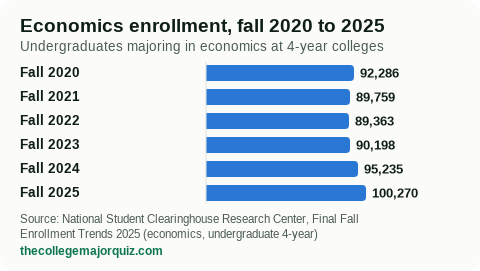
That's up 8.7% from fall 2020. It stands out because the wider social sciences field shrank 7.9% over the same years. Economics now makes up about a quarter of social science majors, up from about a fifth in 2020.
It's the opposite of computer science, where enrollment fell 11.2% in fall 2025. See whether computer science is still a good major for that story.
Who should major in economics?
It's a good fit if you:
- Like math and data, or don't mind a lot of both.
- Want options. The same degree leads to analyst jobs in business, finance, government and data.
- Are open to grad school. Economist jobs typically need a master's, and 41.6% of economics bachelor's holders have a graduate degree.
It may not fit if you want a degree tied to one specific job. Economics is broad, so it's on you to pick a direction.
Not sure economics fits you? The college major quiz matches your interests to 86 majors, including economics, finance and business.
Economics major FAQ
Do you need a master's degree to be an economist?
Usually. BLS says economists typically need at least a master's degree, and some roles need a Ph.D. Some entry-level government jobs hire people with a bachelor's and enough coursework in economics, statistics or math.
Is business economics a good major?
It can be a good pick if you want economics with a business focus. The New York Fed doesn't report business economics on its own, so the pay figures on this page are for economics. The National Student Clearinghouse counts it as a business field. About 18,400 students at 4-year colleges majored in it in fall 2025, up 5.5% from a year earlier.
Other business guides
Comparing business majors? See the best business majors. Thinking about a more job-specific degree? Read whether accounting is a good major. Want the full pay ranking? See the highest-paying majors.
Sources
Pay, unemployment and underemployment by major are from the New York Fed's 2024 data (released February 2026), and the ranks among 73 majors are my own count from that file. Job pay, growth and outlooks are from BLS's Occupational Outlook Handbook and 2025-35 projections, and AI ratings are from BLS's AI exposure table. Enrollment figures are from the National Student Clearinghouse. Each number was checked against the original source.
- Federal Reserve Bank of New York. The Labor Market for Recent College Graduates, outcomes by major (2024 data). February 4, 2026. newyorkfed.org
- U.S. Bureau of Labor Statistics. Occupational Outlook Handbook: economists. Last modified October 29, 2026. bls.gov
- U.S. Bureau of Labor Statistics. Occupational Outlook Handbook: management analysts, market research analysts, project management specialists, financial analysts, logisticians, data scientists, personal financial advisors, operations research analysts, budget analysts, actuaries. Last modified August 27 and October 29, 2026. bls.gov
- U.S. Bureau of Labor Statistics. Table 1.2 Occupational projections, 2025-35, and worker characteristics, 2025. August 27, 2026. bls.gov
- U.S. Bureau of Labor Statistics. Artificial Intelligence (AI) exposure categories. Last modified August 27, 2026. bls.gov
- National Student Clearinghouse Research Center. Final Fall Enrollment Trends (fall 2025, major fields appendix). January 15, 2026. nscresearchcenter.org
- Marshall, Underwood and Hyde. Requirements of the Undergraduate Economics Major: An Update and Comparison. American Economic Association annual meeting, 2023; The Journal of Economic Education, 2024. aeaweb.org
- American Economic Association. Recommended Mathematical Training to Prepare for Graduate School in Economics. aeaweb.org