By Brennan, B.S. Engineering · Published · Updated
It can be, but only if you have a plan for after graduation. With just a bachelor's degree, psychology pays less than most majors. Recent grads earn a median of $45,000, compared with $58,000 across all majors, according to New York Fed data. Becoming a psychologist typically takes at least a master's degree, and about half of psychology grads end up with a graduate degree.
In my opinion, the better question isn't whether psychology is a good major. It's what you plan to do with it. If you're open to grad school or already have a career in mind, it can be a solid choice. If you're picking it because it sounds interesting and hoping the job part works itself out, the numbers below are worth a careful look.
Is a psychology degree worth it?
On pay alone, it's below average at the bachelor's level. The New York Fed tracks 73 majors, and only 4 had a lower early-career median than psychology. Only 13 had a lower mid-career median. Many grads don't stop there, though: 51.9% of psychology grads have a graduate degree, compared with 39.3% across all majors. For them, the bachelor's is a first step, not the finish line.
Underemployed grads hold jobs that typically don't require a college degree, and almost half of recent psychology grads fall in that group.
Compared with majors that draw similar students:
| Major | Early-career pay | Mid-career pay | Unemployment | Underemployment |
|---|---|---|---|---|
| Psychology | $45,000 | $72,000 | 5.0% | 48.3% |
| Sociology | $49,900 | $79,000 | 4.6% | 52.0% |
| Social services | $43,000 | $60,000 | 1.9% | 30.1% |
| Criminal justice | $50,000 | $80,000 | 3.6% | 65.8% |
| Biology | $45,000 | $83,000 | 4.3% | 51.1% |
| Political science | $52,000 | $100,000 | 4.5% | 48.7% |
| Nursing | $70,000 | $87,000 | 2.1% | 12.8% |
| All majors | $58,000 | $87,000 | 4.2% | 39.4% |
Source: Federal Reserve Bank of New York, 2024 data. Pay figures are medians for full-time workers who hold only a bachelor's degree. Early career covers ages 22 to 27 and mid-career 35 to 45. The unemployment and underemployment rates are for recent grads ages 22 to 27.
Psychology starts out level with biology and close to sociology, but it has the lowest mid-career pay of the three. Nursing leads the group on early pay and has the lowest underemployment. If you're choosing between the two most similar majors, see how psychology and sociology compare.
The table also shows that pay and job fit don't always move together. Criminal justice pays more than psychology at both stages, but about two in three of its recent grads are underemployed. Social services pays less, yet it has the lowest unemployment in the group. If a high paycheck right out of school is your top goal, nursing is the standout here. If psychology is the subject you actually want to study, these numbers aren't a reason to skip it. They're a reason to plan ahead.
Some people online call psychology a useless degree. The data doesn't back that up, but it does show a gap between the major and the jobs grads land. In the National Science Foundation's 2023 survey of college graduates, 25% of workers whose highest degree is a psychology bachelor's said their job was closely related to it. Another 37% said somewhat related, and 38% said not related. Across all bachelor's degrees, 44% said closely related.
More school closes that gap. Among workers whose highest degree is a psychology master's, 73% said their job was closely related, and 89% of those with a psychology doctorate said the same.
No one job soaks up the major, either. In BLS data on everyone with a psychology degree, grad degrees included, even the most common occupations hold only about 4% of them each.
The job most people picture when they hear psychology does pay well, but it sits on the other side of grad school. Most psychology majors don't become psychologists, a job BLS says typically takes at least a master's degree (and a Ph.D. or Psy.D. for clinical and counseling psychologists). Psychologists earned a median of $99,110 in May 2025.
For specific jobs at each degree level and what they pay, see the jobs a psychology degree can lead to.
If you plan to stop at a bachelor's, my advice is to pick a direction early. Use your electives, a minor or an internship to build toward one area, like counseling, social work, teaching, management or health care. That way your degree points somewhere when you start applying for jobs.
Is psychology a hard major?
It's in the middle on workload, but it takes more statistics than many students expect. All three programs below require statistics and a research methods course.
National Survey of Student Engagement (NSSE) data puts full-time seniors in the social sciences, the group that includes psychology, at 14.7 weekly hours of class prep in the 2025 and 2026 surveys. That's 6th of NSSE's 10 major groups. Engineering seniors spent 18.4 hours, and business seniors 13.6. NSSE doesn't report psychology on its own. For the full ranking, see the hardest college majors.
The math is mostly statistics, not calculus. Three schools' current requirements:
- Ohio State: the BA requires Data Analysis in Psychology and Research Methods in Psychology, with a C- or better in both before advanced classes. The BS adds Quantitative and Statistical Methods in Psychology and a lab course.
- Cal State Northridge: the BA starts with Essentials of Statistics and a lab, then requires Statistical Methods in Psychological Research and Research Methods in Psychology, each with its own lab.
- Syracuse: the BA requires a two-semester statistics sequence plus Introduction to Research Methodology. Two of the allowed sequences swap the first statistics course for a calculus course.
Ohio State and Syracuse also offer a psychology BS, which adds more statistics, research or science on top of this. For the general split between the two degree types, see how BA and BS degrees differ.
If math isn't your strong suit, don't let the statistics scare you off, but don't put it off either. Take your first statistics course early. At Ohio State, you can't move on to advanced psychology classes until you pass it with a C- or better.
Is psychology a STEM major?
It depends on who's counting. The National Science Foundation treats psychology as a science, but the federal STEM list used for student visas includes only some psychology programs.
- National Science Foundation: its statistics agency groups psychology with the social sciences under "science and engineering fields" in its survey of college graduates.
- Department of Homeland Security: its STEM Designated Degree Program List, last updated in July 2024, decides which degrees qualify international students for a longer STEM work period after graduation. It includes research and experimental psychology programs, such as cognitive, developmental, experimental and social psychology, behavioral neuroscience, and psychometrics and quantitative psychology. It also includes industrial and organizational psychology. General psychology and clinical psychology aren't on it.
Most students are in the programs that aren't listed. In fall 2025, 82% of psychology majors at 4-year colleges were in general psychology, according to the National Student Clearinghouse. Research and experimental psychology programs had about 66,500 students, up 63% from fall 2020.
If STEM status matters to you, ask the school which federal program code (called a CIP code) its psychology degree uses.
Are more students majoring in psychology?
Enrollment is holding steady, just under its fall 2024 count, the highest of the last six years. About 530,600 undergraduates at 4-year colleges majored in psychology in fall 2025, down 0.4% from fall 2024 but up 6.4% from fall 2020, according to the National Student Clearinghouse.
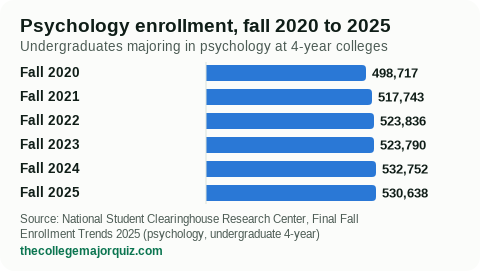
That's more students than all the social sciences combined, a group of about 404,000 that includes economics, political science and sociology. Computer science, by contrast, fell 11.2% in fall 2025 (see why fewer students are choosing computer science).
Being one of the most popular majors cuts both ways. You'll have plenty of classes and peers who share your interest. You'll also graduate alongside a lot of other psychology majors, so research experience or an internship can help you stand out.
Should you major in psychology?
It's a good fit if you:
- Want to understand why people think, feel and act the way they do.
- Are open to grad school. Psychologist jobs typically need it.
- Don't mind statistics. You'll take at least one course in it, plus research methods.
- Have a direction in mind. BLS data shows psychology grads working in teaching, management, social work, counseling and health care.
It may not fit if you want a high starting salary with only a bachelor's degree, or a degree that leads to one specific job. Thinking about medical school? Psychology is one route, and the best pre-med majors covers the others.
Not sure you want the whole major? I studied engineering, but I took a psychology elective. I can't remember a lot of the topics, but much of it was personality types: how people operate on different social spectrums and how to communicate with each type. I wouldn't say I apply those principles directly. The class did put an instinct in my mind that certain people have to be approached differently before you can communicate and work with them. That kind of people sense helps in almost any career, and a minor or a couple of electives can give you some of it without committing to the whole degree.
Still deciding? Take the college major quiz to see how your interests line up with 86 majors, including psychology, sociology and social work.
Psychology major FAQ
Is psychology a good major for the future?
Yes, if grad school is part of your plan. BLS projects 6% job growth for psychologists from 2025 to 2035, but those jobs typically need a graduate degree. With only a bachelor's, your future depends more on the direction you build than on the major itself.
Is a psychology degree useless?
No, but a bachelor's alone often leads to work outside the field. A master's makes a closely related job far more likely, so the degree pays off best when you know where you're headed.
Other psychology guides
Looking for specific jobs? See where a psychology degree can take you. Weighing a similar major? Read the psychology and sociology comparison. Want the full pay ranking? See the highest-paying majors.
Sources
Pay, unemployment, underemployment and graduate degree shares by major are from the New York Fed's 2024 data (released February 2026), and the counts of majors with lower pay come from that file. Psychologist pay, education and projected growth are from BLS's Occupational Outlook Handbook, and how widely psychology grads spread across jobs is from its psychology field of degree page. Course requirements are from the Ohio State, Cal State Northridge and Syracuse catalogs. Job relatedness is from the National Science Foundation's 2023 survey of college graduates, and the shares are calculated from its counts. Enrollment is from the National Student Clearinghouse, and study time from NSSE. Each number was checked against the original source.
- Federal Reserve Bank of New York. The Labor Market for Recent College Graduates, outcomes by major (2024 data). February 4, 2026. newyorkfed.org
- U.S. Bureau of Labor Statistics. Occupational Outlook Handbook: psychologists. Last modified August 27, 2026. bls.gov
- U.S. Bureau of Labor Statistics. Field of degree: Psychology (2024 Census Bureau data). Last modified October 29, 2026. bls.gov
- National Center for Science and Engineering Statistics. National Survey of College Graduates: 2023, Table 1-3, relationship of highest degree to job (NSF 25-322). January 13, 2025. ncses.nsf.gov
- U.S. Department of Homeland Security. DHS STEM Designated Degree Program List. Last updated July 22, 2024. ice.gov
- National Student Clearinghouse Research Center. Final Fall Enrollment Trends (fall 2025, major fields appendix). January 15, 2026. nscresearchcenter.org
- National Survey of Student Engagement. NSSE Summary Tables: Core Survey (2025 and 2026; Time Spent). Indiana University, 2026. nsse.indiana.edu
- The Ohio State University, Department of Psychology. Bachelor of Arts and Bachelor of Science requirements. psychology.osu.edu
- California State University, Northridge. University Catalog 2026-2027: Psychology, B.A. catalog.csun.edu
- Syracuse University. 2026-2027 Undergraduate Course Catalog: Psychology, BA and Psychology, BS.