By Brennan, B.S. Engineering · Published
Psychology studies how one person thinks, feels and acts. Sociology studies groups and whole societies, and how they shape the people in them.
As majors, they're closer than they sound: both require statistics and research methods, and both lead into counseling, social work and law school. The split comes after graduation. With only a bachelor's, sociology grads earn a little more. Psychology grads are more likely to keep going: New York Fed data shows 51.9% of psychology grads ages 25 to 65 hold a graduate degree, compared with 39.1% for sociology. Psychology also has a much bigger field of its own, but psychologist jobs typically take grad school.
What's the difference between psychology and sociology?
The difference is the level you look at. Psychology looks inside the person. Sociology looks at the groups around them.
- Psychology is "the scientific study of the mind and behavior," according to the American Psychological Association's dictionary. Think memory, emotions, personality, mental illness and how the brain works.
- Sociology is "the study of social life, social change, and the social causes and consequences of human behavior," according to the American Sociological Association (ASA). Think families, schools, crime, race, class and work.
Take a topic like stress at work. A psychologist might measure how one worker copes. A sociologist might ask why some jobs or groups of workers face more of it in the first place.
Do psychology and sociology overlap?
Yes, mostly through social psychology, which both fields study. The APA dictionary says the psychology version leans on what goes on inside a person's head, while the sociology version focuses on things like "status, role, and class."
Colleges mix the two as well. At UC Davis, the psychology major counts some sociology classes, like Social Interaction and Social Relationships, as electives. One track of its sociology major, the social services emphasis, requires General Psychology plus a class such as Social Psychology or Developmental Psychology.
Psychology vs. sociology classes
Both majors start with an intro course, then statistics and research methods. After that, psychology goes deeper into the mind and brain, and sociology into groups, inequality and theory. (I took a psychology elective in college but never a sociology class, so the comparison below comes from catalogs, not from sitting in both.) At two large public universities:
- Psychology (UC Davis BA): General Psychology, a statistics course, Research Methods in Psychology and some biology, then upper-level classes in cognition, psychobiology (the biology of behavior), social and personality, and developmental psychology.
- Sociology (UC Davis BA, general track): Introduction to Sociology, Introduction to Social Research Methods and Introduction to Social Statistics, plus anthropology, history, philosophy and a sociological theory course.
- Sociology (Ohio State BA): 13 courses, including Research Methods in Sociology, Statistics in Sociology, Social Stratification: Race, Class and Gender, and Introduction to Sociological Theory, plus one hands-on course such as an internship or undergraduate research.
So neither major lets you skip statistics.
Which is harder, psychology or sociology?
They're close. No national data separates them, and the National Survey of Student Engagement even files both under the same social sciences group.
The bigger jump is a psychology BS. At UC Davis, the psychology BA takes 56 to 62 units, while the BS with a biology emphasis takes at least 100 and adds calculus, physics, biology, and general and organic chemistry. A sociology BA has no science load like that. For how both fields rank against other majors, see the hardest college majors, and for the two degree types, see BA vs. BS degrees.
Psychology vs. sociology jobs and pay
With a bachelor's alone, sociology pays a little more. Psychology has far more jobs in its own field, but those take grad school.
The first five rows are New York Fed data for 2024. Pay is the median for full-time workers whose highest degree is a bachelor's, and underemployment means recent grads (ages 22 to 27) in jobs that typically don't need a degree. The job rows are from the Bureau of Labor Statistics (BLS).
| Measure | Psychology | Sociology |
|---|---|---|
| Early-career pay (ages 22 to 27) | $45,000 | $49,900 |
| Mid-career pay (ages 35 to 45) | $72,000 | $79,000 |
| Unemployment | 5.0% | 4.6% |
| Underemployment | 48.3% | 52.0% |
| Have a graduate degree (ages 25 to 65) | 51.9% | 39.1% |
| The job named after the field | Psychologist | Sociologist |
| That job's median pay (May 2025) | $99,110 | $106,030 |
| Jobs in the U.S. (2025) | 209,400 | 2,700 |
| Usual degree for that job | At least a master's | A master's |
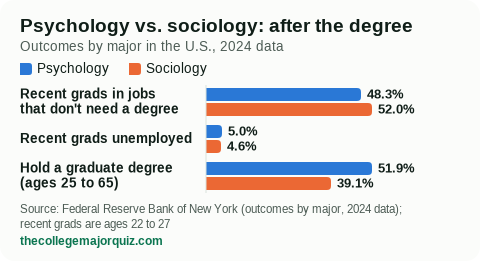
Head to head, sociology's pay edge is real but small: $4,900 early and $7,000 at mid-career. It also comes with more recent grads in jobs that don't need a degree, so neither major wins on outcomes alone, and both trail the all-majors medians. For how psychology's pay compares with nursing, biology and other neighbors, see psychology's pay and job outlook.
Psychologists: Employment is projected to grow 6% from 2025 to 2035, and the clinical and counseling psychologists most people picture typically need a Ph.D. or Psy.D. For jobs at every degree level, see psychology careers from bachelor's to doctorate.
Sociologists: Growth is projected at 4%, with only about 200 openings a year. Many people with a sociology background work in related jobs instead, such as policy analyst, demographer, survey researcher or statistician.
So most sociology majors work outside the title. A June 2026 ASA report on Census data for college grads ages 21 to 45 lists the 10 most common jobs for sociology majors whose highest degree is a bachelor's: managers, social workers, elementary and middle school teachers, administrative assistants, customer service reps, human resources workers, police officers, counselors, registered nurses and retail supervisors.
Which is better for social work, counseling, HR or law school?
Neither major locks you in or out. Going by BLS education requirements for each job, psychology has the edge for counseling, and the other three paths are open to both.
- Social work: A social work degree (BSW) is the most direct route, since it's the most common requirement for entry-level nonclinical jobs. For a master's in social work, either works: psychology is a common major and sociology is recommended coursework.
- Counseling: Psychology has the edge. Mental health counselors typically need a master's degree, and psychology is a common undergrad field for it, with social science also on the list.
- Human resources: It's a toss-up. Neither major is named for HR specialists, who typically study human resources, business, communications or a related field. Still, human resources workers made the ASA's top 10 jobs for sociology grads.
- Law school: Either works. Most law schools don't require a specific bachelor's degree, and social science is one of the common fields. UC Davis even has a law and society track inside its sociology major.
Thinking about medical school? Both subjects are on the MCAT. AAMC puts one section at roughly 65% intro psychology and 30% intro sociology. See the best majors for pre-med students for the science courses you'd still need.
Is sociology a good major?
It can be, if you like studying social problems with data and have a plan for using the degree. The plan matters because about half of recent sociology grads work in jobs that don't need a degree. Line up internships and a clear target, like social work, policy or law school, before you graduate.
It's also shrinking. National Student Clearinghouse data shows the number of undergrads majoring in sociology at 4-year colleges fell every year from fall 2020 to fall 2025, down 27.6% to about 58,400. Psychology grew 6.4% over the same years and now has about nine students for every one in sociology. For the psychology side of this question, see whether a psychology degree is worth it.
Can you double major or minor in psychology and sociology?
Usually, yes. Because the fields overlap, adding the second one as a minor doesn't take much extra room. At UC Davis, the sociology minor is five upper-level sociology courses (20 units), and the psychology minor is 23 to 25 units, including Research Methods in Psychology.
A full double major takes more planning. For the trade-offs, see whether a double major is worth it and how a college minor works.
Should you major in psychology or sociology?
Pick psychology if you're curious about the mind and the brain, or you want to become a psychologist, therapist or counselor. Plan on grad school for those jobs.
Pick sociology if you care more about social issues like inequality, crime, family or health, and want to study them with surveys and data. It's a good base for social work, policy and law school.
If you're torn, take the intro course in each, and check your school's general education list first. In college, my psychology elective counted toward a general education requirement. I want to say it was a humanities credit. I had to take one, and psychology is what I picked. If psychology or sociology fills a slot like that at your school, trying both early costs you little, and the one you don't pick can become your minor.
Still not sure? Our free college major quiz covers psychology, sociology and 84 other majors.
Psychology vs. sociology FAQ
Which pays more, psychology or sociology?
Sociology, slightly, for grads who stop at a bachelor's, in New York Fed data. The gap is a few thousand dollars a year, small enough that the career path you pick matters more than which of the two you major in.
Is sociology easier than psychology?
Not by much. Both majors require statistics and research methods, and national survey data groups them together. A psychology BS can be much harder, because schools like UC Davis add calculus, chemistry, physics and biology.
Can you become a therapist with a sociology degree?
Yes, but it takes grad school. A master's in social work is open to graduates of nearly any major and recommends sociology coursework, and clinical social workers need that master's plus a state license. Mental health counseling is another route, since social science is one of the common undergrad fields for counselors.
More on psychology and choosing a major
- Is psychology a good major?
- What can you do with a psychology degree?
- Best majors for undecided students
- Highest-paying college majors
Sources
Pay, unemployment, underemployment and graduate degree shares by major are from the New York Fed's 2024 data (released February 2026), and enrollment is from the National Student Clearinghouse's fall 2025 data. Job pay, growth and education are from BLS's Occupational Outlook Handbook and 2025-35 projections, the most common jobs of sociology grads are from the ASA's 2026 report, and course rules are from each school's catalog or department. The pay gaps and percent changes are simple math from those figures. Each number was checked against the original source.
- American Psychological Association. APA Dictionary of Psychology: psychology; social psychology. dictionary.apa.org
- American Sociological Association. What Is Sociology? asanet.org
- Federal Reserve Bank of New York. The Labor Market for Recent College Graduates (outcomes by major, released February 4, 2026, 2024 data). newyorkfed.org
- National Student Clearinghouse Research Center. Final Fall Enrollment Trends (fall 2025, major fields appendix). January 15, 2026. nscresearchcenter.org
- U.S. Bureau of Labor Statistics. Psychologists, Occupational Outlook Handbook (last modified August 27, 2026). bls.gov
- U.S. Bureau of Labor Statistics. Sociologists, Occupational Outlook Handbook (last modified October 29, 2026). bls.gov
- U.S. Bureau of Labor Statistics. Social Workers, Occupational Outlook Handbook (last modified August 27, 2026). bls.gov
- U.S. Bureau of Labor Statistics. Substance Abuse, Behavioral Disorder, and Mental Health Counselors, Occupational Outlook Handbook (last modified October 29, 2026). bls.gov
- U.S. Bureau of Labor Statistics. Human Resources Specialists, Occupational Outlook Handbook (last modified October 29, 2026). bls.gov
- U.S. Bureau of Labor Statistics. Lawyers, Occupational Outlook Handbook (last modified August 27, 2026). bls.gov
- American Sociological Association. What Are the Occupations of Sociology Bachelor's Degree Recipients? Evidence from the American Community Survey, 2016-2019 and 2021-2024. June 2026. asanet.org
- National Survey of Student Engagement. Major Field Categories. nsse.indiana.edu
- AAMC. Psychological, Social, and Biological Foundations of Behavior Section: Overview. aamc.org
- UC Davis. Psychology, Bachelor of Arts; Psychology, Bachelor of Science; Psychology Minor, 2026-2027 General Catalog. ucdavis.edu
- UC Davis. Sociology, Bachelor of Arts; Sociology Minor, 2026-2027 General Catalog. ucdavis.edu
- The Ohio State University, Department of Sociology. BA Sociology Major, AU22 and beyond (requirement sheet). osu.edu