By Brennan, B.S. Engineering · Published · Data: Census Bureau 2024, BLS May 2025
A psychology degree leads to jobs in counseling, social services, employee training, corrections, mental health care and education, and to management once you have experience. The catch is that most jobs with "psychologist," "counselor" or "therapist" in the title need a master's or doctorate plus a state license. With a bachelor's alone, you'll usually start in a related role, such as training specialist, probation officer or human services assistant.
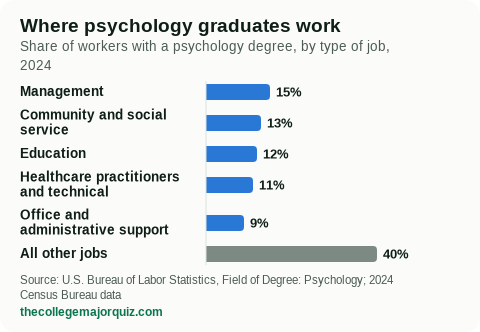
Psychology grads spread out more than you might expect. Bureau of Labor Statistics (BLS) data counts about 3.8 million U.S. workers with a psychology degree. Of those, 15% work in management, 13% in community and social service jobs such as counseling and social work, 12% in education and 11% in health care practitioner and technical jobs. Half of those workers hold an advanced degree, compared with 39% of workers across all fields of degree, so for many people the bachelor's is a first step toward grad school.
Psychology degree jobs: where grads actually work
Management, social services, teaching and health care employ the most psychology grads, followed by office and administrative support. Still, 40% work in other kinds of jobs, so there's no single path.
Single jobs are just as scattered. Elementary school teacher and manager tie for the most common, at only 4% each, and psychologists, social workers, counselors, lawyers and nurses each take a small slice after that. So the degree won't steer you to one job. Your electives, internships and grad school plans decide where you land.
Workers with a psychology degree earned a median of $60,000 in 2024, compared with $73,000 for all fields. They were also more likely to work part time: 20%, compared with 15% of all graduates.
Jobs with a bachelor's in psychology
With only a bachelor's, look at jobs in training, human services, corrections, addiction counseling and psychiatric care. They don't carry the psychologist title, but BLS names psychology as a fitting degree or field for most of them.
| Job | What they do | Median pay (2025) | Growth, 2025-35 |
|---|---|---|---|
| Training and development specialist | Plan and run programs that build employees' skills | $69,280 | 10.8% |
| Probation officer or correctional treatment specialist | Help rehabilitate people who have broken the law | $66,270 | 3.0% |
| Substance abuse or behavioral disorder counselor | Counsel people dealing with addiction or behavior problems | $59,350* | 18.4%* |
| Social and human service assistant | Help clients in psychology, rehabilitation and social work settings | $45,930 | 7.4% |
| Psychiatric technician | Care for people with mental or emotional conditions or developmental disabilities | $45,130 | 22.3% |
Source: BLS Occupational Outlook Handbook and 2025-35 projections; median pay for May 2025. *Includes mental health counselors, who typically need a master's.
Put the education rules side by side and they sort into two groups. Training specialists, probation officers and substance abuse counselors take a psychology bachelor's as it is, though training specialists often come from business fields and typically need some related work experience too, under 5 years. Human service assistant jobs can start with a high school diploma, and psychiatric technicians usually need a certificate, so for those two your bachelor's mainly helps with employers that prefer one.
That experience piece matters for training. In chemical manufacturing, where I work, training operators at new plants usually falls to senior operators who move into a learning and development coordinator role, or to engineers. It's technical staff, and you usually don't see people come out of college with a psychology degree doing it. That's one industry's view. But if you want training work in a technical setting, plan on building hands-on experience in the work itself, because a psychology degree on its own probably won't be enough there.
Human resources and market research are two more places to look, though neither names psychology in its usual degree fields. HR specialists ($75,940) typically need a bachelor's in human resources, business, communications or a related field. Market research analysts ($78,760) need a degree in market research or a related business, communications or social science field, and courses in statistics, research methods and marketing count. The stats and research methods in a psychology major fit market research well. For HR, a few business classes or an HR internship can close the gap. For more on this side of the work, see what you can do with a business degree.
Social work is a common goal, but entry-level nonclinical jobs most often ask for a bachelor's in social work (BSW). Psychology is still a common major for a master's in social work (MSW), which you can enter with a bachelor's in almost any field.
Expect a slower start with only a bachelor's. New York Fed data shows 48.3% of recent psychology grads (ages 22 to 27) work in jobs that don't need a degree, compared with 39.4% across all majors. For the full pay picture, see whether psychology is a good major.
What can you do with a master's in psychology?
A master's opens most licensed counseling and therapy jobs, plus some psychologist jobs, including school psychologist and industrial-organizational (I-O) psychologist.
| Job | Median pay (2025) | Growth, 2025-35 | What you need |
|---|---|---|---|
| Industrial-organizational psychologist | $193,950 | 6.5% | Master's |
| School psychologist | $95,990 | 0.8% | Master's, Ed.S. or doctorate |
| Marriage and family therapist | $66,940 | 13.5% | Master's and a state license |
| School or career counselor | $64,330 | 2.9% | Master's for school counselors |
| Mental health social worker | $60,280 | 10.3% | Master's in social work; license for clinical work |
| Mental health counselor | $59,350* | 18.4%* | Master's and a state license |
Source: BLS Occupational Outlook Handbook and 2025-35 projections; median pay for May 2025. *Includes substance abuse and behavioral disorder counselors.
I-O psychology pays the most, but it's a tiny field, with about 4,000 jobs in 2025. School psychology is bigger, with 64,000 jobs, but almost no projected growth.
Counseling is where the growth is. BLS projects 18% growth for substance abuse, behavioral disorder and mental health counselors from 2025 to 2035, "as people continue to seek treatment for addiction and mental health issues," with about 50,500 openings a year. If steady demand matters most to you, counseling has the strongest outlook of the master's jobs here.
Marriage and family therapists need a master's in psychology, marriage and family therapy or a related mental health field. Every state requires a license, which takes supervised clinical hours after the degree and a state-recognized exam. School counselors need a master's too, typically in counseling or psychology.
Psychology careers that need a doctorate
Clinical and counseling psychologists, the job most people picture when they hear "psychologist," typically need a Ph.D. or a Psy.D.
- Clinical and counseling psychologist: $100,580 median pay and 11.7% projected growth. It's the largest psychologist job, with 81,300 jobs in 2025.
- Psychology professor: $80,340 median pay and 4.0% growth. College psychology teachers typically need a doctorate.
- Psychiatrist: $281,870 median pay. Psychiatrists are medical doctors, so the route is medical school, not a psychology doctorate. Psychology can still be your major on the way. See the best pre-med majors.
- Lawyer: this takes law school, but 2% of workers with a psychology degree are lawyers.
You don't need a perfect undergrad match to get in. BLS says applicants to graduate psychology programs typically have a bachelor's in a field such as psychology, education or social science.
What are the highest paying psychology jobs?
Industrial-organizational psychologist tops the list, but with only about 4,000 jobs, few people land one. Every job near the top needs grad school.
Ranked by BLS median pay, the best-paid jobs in this guide are:
- Industrial-organizational psychologist: $193,950 (master's)
- Psychologist in other specialties: $110,840 (usually a master's)
- Clinical and counseling psychologist: $100,580 (doctorate)
- School psychologist: $95,990 (master's or more)
- Psychology professor: $80,340 (doctorate)
- Market research analyst: $78,760 (bachelor's)
- Human resources specialist: $75,940 (bachelor's)
- Training and development specialist: $69,280 (bachelor's)
Psychiatrists earn far more, but they're physicians. Management is the other high-paying route. Human resources managers earned a median of $149,280, though they typically need 5 years or more of related experience. To see how psychology compares with every other major on pay, check the highest paying college majors.
Do you need grad school for a career in psychology?
For careers in psychology itself, such as psychologist, counselor or therapist, yes. For many other jobs psychology grads hold, no.
A simple rule: if the job title says psychologist, counselor or therapist, plan on grad school and a license. If it doesn't, start with the bachelor's jobs above and decide on grad school once you know which direction you want. The bachelor's holds its own, too: 61% of workers with a psychology degree are in jobs that need at least a bachelor's, the same share as graduates in all fields.
If you're choosing between psychology and a close cousin, compare psychology and sociology side by side. Still weighing majors? The college major quiz takes about 4 to 6 minutes and shows how psychology stacks up against your other matches.
Psychology degree FAQ
Can you be a therapist with a bachelor's in psychology?
Not as a licensed therapist. Marriage and family therapists and mental health counselors typically need a master's degree, and every state requires both to be licensed.
How much do psychologists make?
Psychologists earned a median of $99,110 in May 2025. Pay depends a lot on the specialty, and industrial-organizational psychologists earn the most.
More on psychology and choosing a major
Wondering if the major pays off? Read is psychology a good major? Torn between social science fields? See psychology vs. sociology. Still exploring? Our list of the best majors for undecided students includes psychology.
Sources
Where psychology grads work comes from BLS Field of Degree data (2024 Census Bureau data). Pay, growth and education needs are from the BLS handbook and its 2025-35 projections, and the recent-grad figure is from the New York Fed. Each number was checked against the original source.
- U.S. Bureau of Labor Statistics. Field of Degree: Psychology (2024 Census Bureau data; last modified October 29, 2026). bls.gov
- U.S. Bureau of Labor Statistics. Occupational Outlook Handbook (May 2025 pay, 2025-35 projections; pages last modified August 27 and October 29, 2026): psychologists, substance abuse, behavioral disorder, and mental health counselors, marriage and family therapists, school and career counselors, social workers, social and human service assistants, probation officers and correctional treatment specialists, psychiatric technicians and aides, training and development specialists, human resources specialists, market research analysts.
- U.S. Bureau of Labor Statistics. Table 1.2 Occupational projections, 2025-35, and worker characteristics, 2025 (psychologist specialties, psychology teachers, psychiatrists, human resources managers). bls.gov
- Federal Reserve Bank of New York. The Labor Market for Recent College Graduates (outcomes by major, 2024 data). newyorkfed.org