By Brennan, B.S. Engineering · Published · Updated
Marketing is a good major if you can handle a slow start. Marketing majors earned a median of $100,000 by mid-career in New York Fed data, tied for 16th highest of 73 majors. Right out of school, though, 49.3% of recent grads worked in jobs that typically don't require a college degree.
I work with the marketing teams at my company, but I don't know many people who actually majored in marketing. In my opinion, you should do it if you're interested in that kind of work.
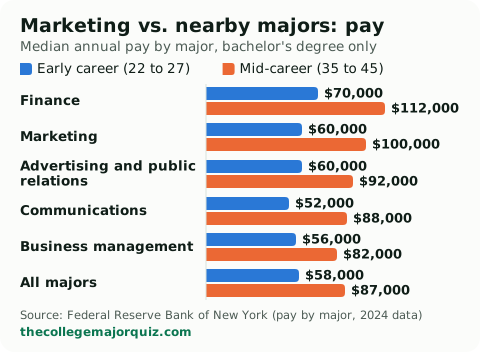
Marketing managers, the best-paid job in the table below, earned a median of $166,790 in 2025, and BLS projects 7% growth for them through 2035. Early pay is modest: marketing majors ages 22 to 27 earned $60,000, just above the $58,000 median for all majors.
Is a marketing degree worth it?
When I look at the data, it depends on how far out you look.
At ages 35 to 45, marketing majors earned $100,000. That's more than advertising and public relations ($92,000), communications ($88,000) and business management ($82,000) majors. Finance was higher, at $112,000.
Pay is the median for full-time workers with only a bachelor's degree.
The problem is underemployment. Among recent graduates, 49.3% of marketing majors worked in jobs that typically don't require a degree. That's the 19th highest rate of the 73 majors, and well above the 39.4% rate for all majors. Advertising and PR majors did better (38.1%), and communications majors did worse (53.0%). Marketing's unemployment rate, 4.4%, was close to the 4.2% for all majors.
Few marketing grads go on to a graduate degree: 19.7% of working-age marketing majors have one, the fifth lowest share of the 73 majors, compared with 39.3% overall. For all seven business majors side by side, see the best business majors.
What do marketing majors study?
Mostly customers, meaning who they are, what they want and how to reach them. Here's what three schools require.
- Penn State (Smeal College of Business): Principles of Marketing, Consumer Behavior, Marketing Research and Marketing Strategy, each with a C or better, plus 9 credits of electives such as Personal Selling, Digital Marketing and Marketing Analytics.
- University of Florida (Warrington): Principles of Marketing, Consumer Behavior and Marketing Management, plus 8 credits of marketing electives.
- University of Texas at Austin (McCombs): Principles of Marketing, a course called Information and Analysis, and a capstone built on case studies of advanced marketing problems.
Is marketing very math heavy?
Some, and I think more than a lot of people expect. All three schools above require a calculus class and at least one statistics class. At UT Austin, it's called Introduction to Data Science. Florida and UT Austin also require analytics or data science courses for all business majors.
In my experience, marketing and sales people work with data a lot. In my industry, statistics is very important. It's how you forecast what volumes of chemicals the market will need, project sales and revenue, and project how much the production unit needs to make to meet demand for a product. That work also overlaps with project and program management.
BLS also says statistics, research methods and marketing courses are important for market research analysts. My advice? Take statistics seriously.
What do marketing teams actually do?
In my experience, a lot of it is figuring out customers and passing that to the technical side. The marketing teams I work with focus on identifying customers, what those customers need and what the market needs for a lot of applications. Then they translate that data and input so the technical side can create new products. They also do a lot of outreach and customer management.
BLS describes market research analysts in a similar way. They study consumer preferences, business conditions and other factors to judge how well a product or service could sell.
Marketing degree jobs and pay
Here are jobs a marketing degree can point you toward, with 2025 median pay and projected growth.
| Job | Median pay (2025) | Job growth, 2025 to 2035 |
|---|---|---|
| Marketing manager | $166,790 | 7% |
| Sales manager | $148,270 | 4% |
| Advertising and promotions manager | $133,660 | -4% |
| Wholesale and manufacturing sales representative, technical and scientific products | $104,920 | 1% |
| Market research analyst | $78,760 | 7% |
| Public relations specialist | $74,750 | 2% |
| Wholesale and manufacturing sales representative, except technical and scientific products | $72,080 | -1% |
Source: BLS Occupational Outlook Handbook, pages updated August to October 2026 (median pay for May 2025).
The three manager jobs pay the most, but you don't start there. BLS says marketing managers typically need experience in an advertising, marketing, promotions or sales job first, and employers usually prefer sales managers to have several years of sales experience. Market research analyst is an easier way in. It typically needs a bachelor's degree and no related experience.
Is marketing management a good career choice?
It can be, if you're willing to work your way up. Marketing managers had the highest median pay of the jobs above, and BLS expects them to stay in demand as organizations use marketing campaigns to keep and grow their market share. Advertising and promotions managers are going the other way: BLS projects 4% fewer of those jobs by 2035.
Can a marketing major get into technical sales?
Sometimes. It pays more, $104,920 for reps who sell technical and scientific products vs. $72,080 for other wholesale and manufacturing reps. But BLS says those technical reps usually need a bachelor's degree, typically in a field related to the product, so a marketing degree alone may not be enough.
Still, from what I've seen, a lot of companies train you to learn the technical product well enough to sell it. Even people without an engineering or STEM background usually get trained well to sell and talk about the products. It depends on the role.
Is marketing being replaced by AI?
BLS projections don't point that way. They still show 7% growth for both marketing managers and market research analysts. But BLS does expect AI to change some of this work:
- Advertising: managers and their staff "are both expected to use improving technology, including artificial intelligence (AI), to more quickly generate, test, and modify digital advertisements."
- Public relations: social media should create new opportunities, but BLS adds that "artificial intelligence (AI) is increasingly making inroads into data-rich social media, which may soften demand for these workers."
- Sales: AI and tools like chat bots "may limit employment growth for sales representatives."
- Market research: growth is "expected to be driven by an increasing use of data and market research across many industries." BLS doesn't mention AI for this job.
When I compare the projections, market research analysts are set to grow 7% while advertising and promotions managers shrink 4%.
Who should major in marketing?
From the marketing teams I work with, it fits people who like figuring out who customers are and what they need, enjoy outreach and working with customers, and don't mind data. If your main goal is the best odds of landing a first job that needs your degree, finance (27.8% underemployed) and accounting (21.2%) look stronger than marketing (49.3%).
If you go for it, get real experience early. BLS says an internship may help you land a marketing manager or market research job. Still deciding? See how to choose a college major, or is business a hard major for the workload side.
Not sold on marketing? See how it stacks up against other majors for you with the free quiz.
Marketing major FAQ
Do marketing majors make good money?
Over time, yes. In New York Fed data, marketing majors earned a median of $60,000 at ages 22 to 27 and $100,000 at ages 35 to 45, above the medians of $58,000 and $87,000 for all majors.
Is marketing a business degree?
Yes. BLS counts marketing and marketing research as a business major, and it makes up 12% of business majors.
Do you need a master's degree for marketing?
Usually not to start. Market research analyst and marketing manager jobs typically need a bachelor's degree, though some employers of market research analysts prefer or require a master's.
Other business guides
Compare pay across business majors in the best business majors, see more jobs in what you can do with a business degree, check the workload in is business a hard major, or read how to choose a college major.
Sources
The rankings are counted from the New York Fed's data file, and job outlook is from the BLS. Course rules are from the Penn State, Florida and Texas catalogs. What I say about marketing teams comes from working with them.
- Federal Reserve Bank of New York. The Labor Market for Recent College Graduates (outcomes by major, released February 4, 2026, 2024 data). newyorkfed.org
- U.S. Bureau of Labor Statistics. Advertising, Promotions, and Marketing Managers, Occupational Outlook Handbook (last modified August 27, 2026). bls.gov
- U.S. Bureau of Labor Statistics. Market Research Analysts, Occupational Outlook Handbook (last modified August 27, 2026). bls.gov
- U.S. Bureau of Labor Statistics. Sales Managers, Occupational Outlook Handbook (last modified August 27, 2026). bls.gov
- U.S. Bureau of Labor Statistics. Wholesale and Manufacturing Sales Representatives, Occupational Outlook Handbook (last modified October 29, 2026). bls.gov
- U.S. Bureau of Labor Statistics. Public Relations Specialists, Occupational Outlook Handbook (last modified October 29, 2026). bls.gov
- U.S. Bureau of Labor Statistics. Field of Degree: Business, Occupational Outlook Handbook (2024 Census Bureau data, last modified October 29, 2026). bls.gov
- Penn State. Marketing, B.S., 2026-2027 Undergraduate Bulletin. psu.edu
- University of Florida. Marketing BSBA, 2026-2027 Academic Catalog. ufl.edu
- University of Texas at Austin. Marketing (BBA), Undergraduate Catalog 2026-2028. utexas.edu
- University of Texas at Austin. Marketing (MKT) course descriptions, 2026-27 Edition. utexas.edu